
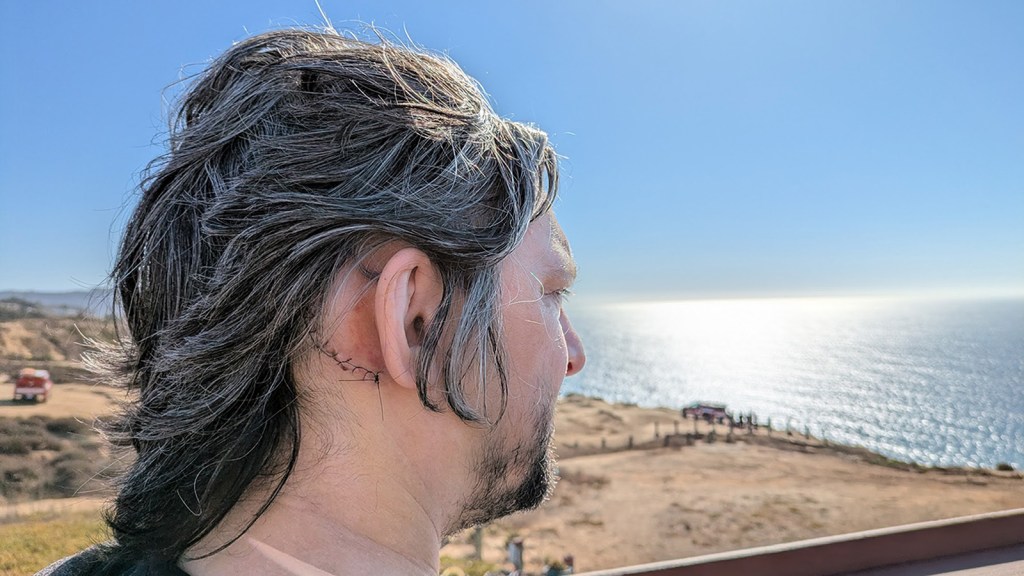
When Sean Wolfe began losing hearing in his right ear, it affected not only his ability to make out sounds but also to do something he loves: making music.
But after a successful and relatively uncommon two-pronged surgery at UC San Diego in La Jolla, he’s reacclimating and releasing projects again.
However, ending up where he is today was far from guaranteed.
Sound of trouble
Wolfe, who lives in Portland, Ore., first dabbled in music in the early 1990s. He started by creating samples and experimenting with synthesizers and eventually grew into making rock-infused electronic music under the name Salvo Beta.
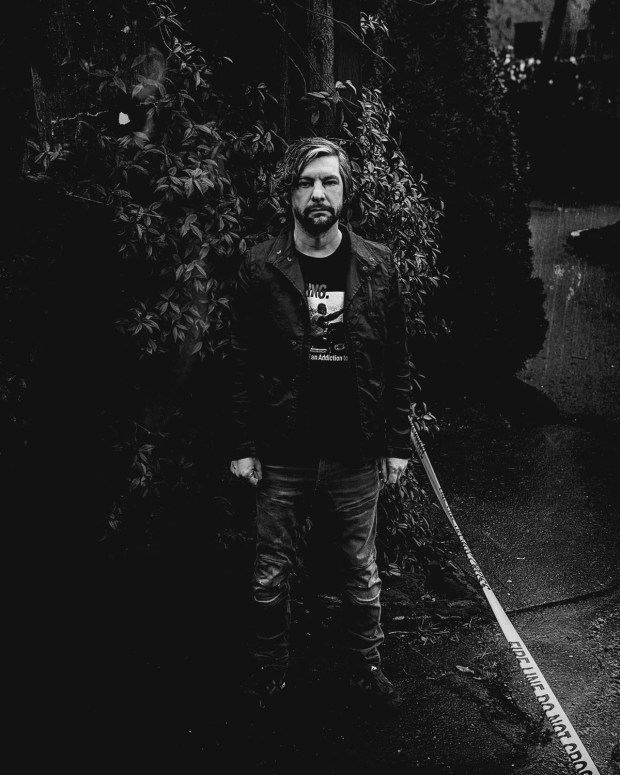 Sean Wolfe releases music under the name Salvo Beta. (Provided by Sean Wolfe’s family)
His first record was released in the early 2000s, around the time he started playing live shows. Between 2006 and 2012, he had a hiatus in his music-making, then resumed.
But at the onset of the COVID-19 pandemic in 2020, Wolfe started noticing loud and persistent tinnitus in his right ear.
“I’ve had a few times where you get ringing in your ear occasionally and it lasts for maybe an hour or two and goes away,” he said. “But this was different. It just was on all the time and it was kind of concerning me.”
Over the next two years, the condition worsened. Something as simple as taking a phone call or putting on headphones left him with an audio imbalance.
Amid his hearing loss, he decided in 2023 that if he was ever going to get his music out into the world, he would need to “really start taking it seriously and making an earnest effort,” he said.
Worried that he may have caused the hearing loss himself, he started looking for answers. He found one in 2024.
Wolfe was diagnosed with acoustic neuroma, a rare benign tumor that develops on nerves in the ear and impacts hearing and balance.
Only about 2,000 people in the United States are diagnosed with acoustic neuroma annually, according to Dr. Rick Friedman, a neurologist at UC San Diego Health.
Wolfe needed surgery to try to stave off more hearing loss in his right ear. But there was a 50% chance the surgery wouldn’t work.
After consulting with multiple medical centers and facing longer wait times, he landed on UCSD Health’s Acoustic Neuroma Program.
Two-pronged surgery
UCSD Health has the highest-volume acoustic neuroma center in the country, performing an average of 160 to 180 such surgeries a year.
Guiding Wolfe through his surgery was Friedman, who specializes in skull base surgery, and Dr. Marc Schwartz, a neurosurgeon and professor at the UCSD School of Medicine who specializes in skull base tumors.
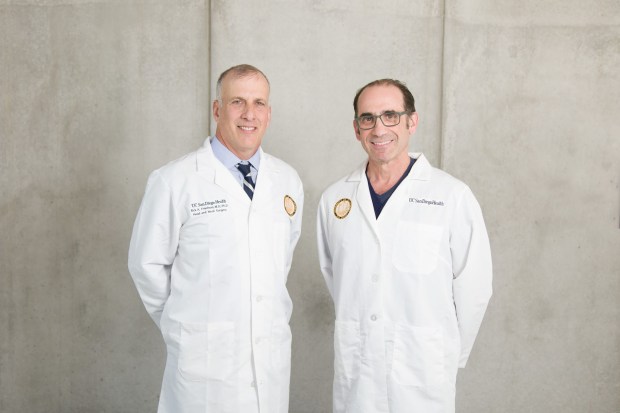 Sean Wolfe’s acoustic neuroma team at UCSD Health was Dr. Rick Friedman (left), a neurologist who specializes in skull base surgery, and Dr. Marc Schwartz, a neurosurgeon specializing in skull base tumors. (UC San Diego Health)
Wolfe met criteria that allowed him to receive cochlear implantation following his acoustic neuroma surgery in October 2024. That option is considered highly specialized because of the tight coordination it requires among surgeons, audiologists and rehabilitation specialists.
Cochlear implants bypass damaged inner-ear structures and directly stimulate the hearing nerve with electrical signals.
Friedman said Wolfe’s natural hearing could not be saved, so doctors opted for a single-sided cochlear implant for people with hearing loss in one ear.
“Single-sided cochlear implants have only recently become FDA-approved and approved by some insurance companies, [but] not by all,” Friedman said. “There’s a lot of variability in the outcome.”
Wolfe described the activation of his cochlear implant as a “very tense and emotional moment.” He heard high tones through his right ear, which he had been unable to do for some time. When he covered his left ear, he could still understand what was being said to him.
“Seeing and hearing Sean, I’ve been smiling the whole time,” Friedman said. “It makes all the hours of my youth that I spent in training worthwhile.”
Reacclimation
Though the procedures were successful, sounds are “more robotic and artificial” to Wolfe than before. Now he’s in hearing rehabilitation, an adjustment process led by daily listening exercises with the goal of adapting to a new way of hearing.
As he recovered from surgery, he stayed at UCSD Health’s La Jolla Family House, which offers housing for patients whose treatment was administered far from where they live.
Music has helped him readjust.
“During my recovery time, I listened to a bunch of records, just getting my ears used to hearing music,” Wolfe said. “I have my good ear, which I think helps inform my brain about what I’m hearing in the bad ear through the CI, so I can kind of make a whole picture over time.”
Last month, he released two remixes of the band Still Machine’s song “Echoes Within.” He’s still working on new music, too.
One release is waiting in the wings, and he’s toyed with the idea of making music targeted to CI users, designed so it’s easier on their implants.
“I think there’s a lot of interesting things to go and explore, and I’m going to … keep working,” Wolfe said. “I think because of this, it hasn’t made me stop.” ♦