
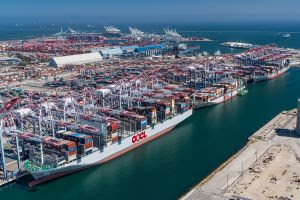
The Port of Long Beach on Friday, May 15, unveiled a $3.5 million high-tech cyber command center that will combine the port’s existing protections and detection technology with new programs that are emerging.
Port CEO Noel Hacegaba presented the Cyber Defense Operations Center addition during a virtual news briefing that included participants from the U.S. Coast Guard. The California Governor’s Office of Emergency Services and other federal, state and local agencies are also among the partners.
“The Port of Long Beach is no stranger to hackers trying to cripple our operations,” Hacegaba said.
Ransomware, nation‑state hackers and supply chain attacks have become a daily reality for U.S. ports, he said.
And those attempts come in continually, Hacegaba said, affecting safety and trade.
“Supply chain security is key to supply chain resilience,” Hacegaba said, “and with data and digital infrastructure being an ever-increasing part of maritime trade, effective cybersecurity is more important than ever to the global supply chain.”
The center is a state-of-the-art facility that features enhanced technological capabilities for around-the-clock cybersecurity monitoring and defense, and offers the highest level of resiliency to the many data networks that are critical to port operations. On average, the port blocks or stops an attempted cyberattack every three seconds.
The new center enables the port to double the number of on-site staff focused on safeguarding the port’s digital supply chain and further leverage its in-house and contracted resources.
The port’s new Cyber Defense Operations Center, officials said, will further enhance and add to the protections already in place as hackers become more sophisticated.
The launch of the new center, Hacegaba said, matters not only for the port but also for the regional and national safety, and for the economy. Incidents that begin in one domain, Hacegaba said, can quickly move seamlessly into another making early detection critical.
Enhanced technology and more personnel will be dedicated to the operation of the new center, Hacegaba said, which will provide protection to critical data and prevention through early alerts.
“As cyberattacks become more sophisticated, we need to stay ahead of the curve with technology that allows us to detect cyber criminals,” said Long Beach harbor commission President Frank Colonna. “This center will play a major role in keeping one of the nation’s busiest seaports safe from cyberattacks.
“These are criminals who want to access our systems and sow chaos,” Colonna added. “We will not allow that to happen.”
U.S. Coast Guard Rear Adm. Jeff Novak, who has been the commander of the Southwest Coast Guard District since July, said collaboration among partners provides a needed foundation for port and waterway threats.
“This center is a physical embodiment of that,” he said.
A cyber intrusion into what is the busiest port complex “could cause global disruption,” he said.
And with the growing integration of systems that control vessels, cranes and other operations, Novak added, that danger “only expands.”
The Coast Guard, ports and other law enforcement and security partners, Novak also said, are already strategizing — and will maintain what he called a “rock-solid” collaboration — in planning for several high-profile upcoming events, including the World Cup and 2028 Olympic Games, which could be potential targets for both virtual and physical threats.
During the briefing, Hacegaba also provided April cargo numbers at the Port of Long Beach.
Nearly 818,000 twenty-foot equivalent units, or TEUs, were handled by the port last month, he said, making it the port’s third best April on record.
But it was also a 5.7% dip from April 2025. That month a year ago came in as the busiest April in history at the port, Hacegaba said. The port ended the 2025 calendar year just shy of a record 10 million TEUs.
During the first part of 2025, Hacegaba said, shipments were arriving in larger-than-usual quantities as a way for importers to avoid pending tariffs that were set to come online.
In other numbers from April, Long Beach dockworkers and terminal operators handled nearly 390,000 TEUs in imports, down 7.1%, while exports soared 26.7% to nearly 119,000 TEUs compared to April 2025.
Empties — containers being sent back to China — fell 12.6% to 309,000 TEUs.
Hacegaba stressed in his remarks the importance of strengthening the port’s data security to keep $300 billion worth of annual trade moving safely and smoothly.
“In our industry, the only certainty is uncertainty,” he said, “and because we are part of the global supply, we must prepare for potential issues that may affect cargo movement.
“With recent supply chain disruptions adding volatility and instability to global trade,” Hacegaba added, “it’s even more important for our port to remain a safe harbor in the sea of trade and geopolitical uncertainty to keep cargo moving.”