
Beautiful San Diego, the second largest city in California, is shuddering through challenging times. Amid city deficits, federal budget cuts and emotional and fiscal consternation over the war in Iran, the LGBTQ+ community is facing, what to some, is an ego-driven tiff and, to others, is a deep dispute over transparency and trust between the San Diego LGBT Community Center and Stonewall Generation seniors who want to know what’s happening with an $18.9 million gift their late friends bequeathed the Center for senior services, programs, and housing.
While this may seem like some niche soap opera that will blow over with enough delay, the circumstances are darker and more dire than the drama reveals. On the surface, exchanges between the two camps appear politely professional. But there is a deep, widening, and hardening chasm developing between those who fought for gay liberation when homosexuality was still a criminal perversion, and the Center board and staff committed to protecting vulnerable LGBTQ+ youth who only know Trumpian cacophony in a nihilistic world.
The feud is growing so loud that it is drowning out the fiscal winds banging outside the Center door, harbingers of massive tornadoes threatening to obliterate the house. The “what ifs” are near: what if government funding is cut to the quick and donors start questioning their once-firm trust in Center management?
Particularly painful: a source overheard some Center youth dismiss the Stonewall Generation seniors: “They’re just bitter old racist cis queens causing all the trouble.” What happens if a significant number of gay white men act on what is now just a whispered feeling: “Why should I care about the Center? They hate us!”
Who’s going to fund the Center without an engaged and unified community?
The terrible irony is that without recognition of the stakes and the need for authentic negotiation, the feud may render the Center complicit in Project 2025’s erasure of LGBTQ+ people.
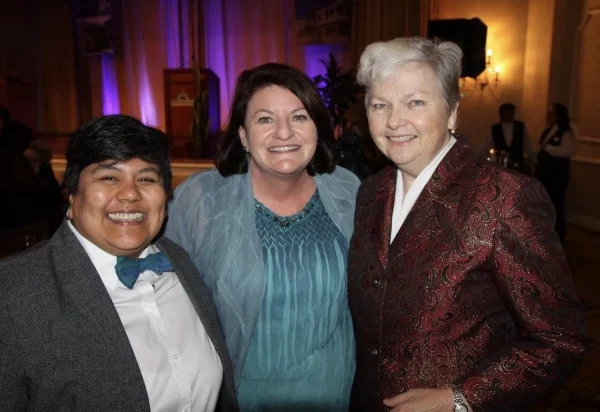 San Diego City Council member Georgette Gomez, Toni Atkins, Chris Kehoe Oct. 2017 (Courtesy the San Diego LGBT Community Center Facebook page)
Context: The Gathering Storm
San Diego was once a bastion of conservative Republicanism, but its political landscape has skewed blue over the past two decades, led in part by trailblazing out lesbian political icons Christine Kehoe and Toni Atkins, who paved the way for Todd Gloria to become the first out LGBTQ+ person and the first person of color to serve as the city’s mayor.
But with the historic honor comes grave responsibility, including Gloria’s proposed $2.2 billion budget for the new fiscal year with significant cuts to close a projected $146 million deficit. “Find the money elsewhere,” protesters at City Hall screamed at a Monday night meeting on April 20th.
In early April, Trump revealed his full discretionary budget request for fiscal year 2027 – obviously not including expected requests for the Department of Homeland Security in the aftermath of the incident at the White House Correspondents Association dinner. The budget would reduce nondefense discretionary spending by $73 billion, including $33.5 billion in funding cuts for the Department of Housing and Urban Development (HUD), according to a bipartisan policy analysis.
Despite promises not to cut safety net programs — and an added $174 million in prospective renovations to his $400 million gilded ballroom — Trump later said it’s “not possible” for the federal government to fund Medicare, Medicaid, and child care costs, adding that the states should “take care” of those programs while the federal government focuses on the military. The food assistance program SNAP has already dropped 2.5 million people.
Steve Rattner, a prominent economic analyst, told MS NOW that Trump’s proposed budget is a reincarnation of Project 2025. If passed, the budget would be the most dramatic re-structuring of federal government spending “since certainly the New Deal and who knows when beyond that.”
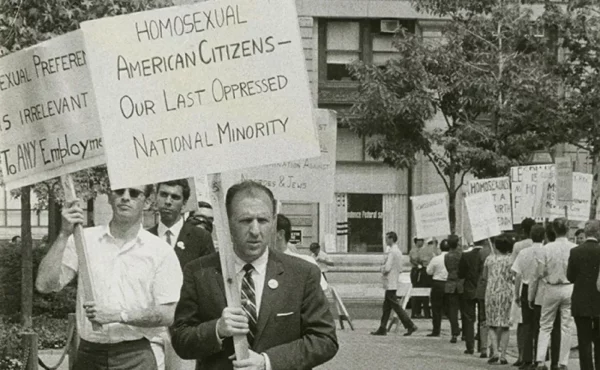 Frank Kameny leading protest at Independence Hall, Philadelphia, 1965 (Photo Kay Tobin, via NYC Public Library)
The proposed cuts are real, deep, wide, and cultural. Preparing for America’s 250th anniversary, Trump issued Executive Order 14253, Restoring Truth and Sanity to American History and ordered a sweep of the Smithsonian Institution: “Museums should begin implementing content corrections where necessary, replacing divisive or ideologically driven language with unifying, historically accurate, and constructive descriptions across placards, wall didactics, digital displays, and other public-facing materials.” Historic narratives to be “corrected” include exhibits about slavery, the violent Manifest Destiny ruination of Indigenous people and the relatively new recognition of LGBTQ+ history.
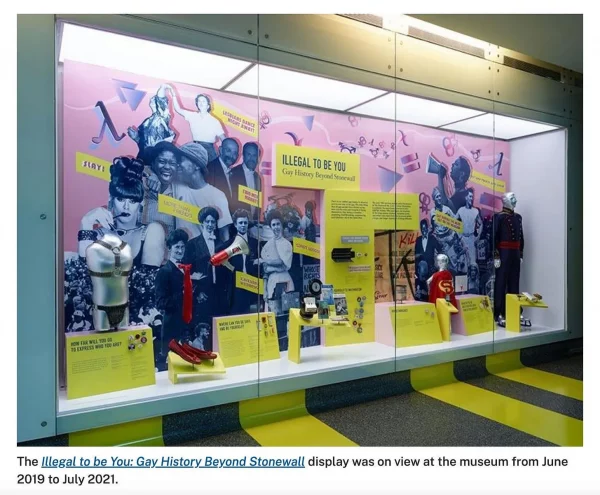 (Photo Courtesy of the Smithsonian)
But not all anti-LGBTQ+ cultural attacks are happening behind closed doors. Last year, San Diego woke up to the Union-Tribune headline: “Chucky Lozano’s injury, homophobic chant temper San Diego FC’s soccer celebration.” SDFC coach Mike Varas decried the one-word chant as “palabras discriminatorias” or “discriminatory language.”
The infamous homophobic soccer chant recently resurfaced in Mexico, which is co-hosting the 2026 World Cup with the US and Canada. FIFA has scheduled eight matches this summer in LA’s SoFi Stadium, including the highly coveted U.S. Men’s National Team (USMNT) opening match. Think security and Border Patrol will care about a little sports-related gay-bashing during Pride season?
Violence is in the air, with winds picking up speed, veering toward the vulnerable.
The Feud, in Summary
The San Diego LGBT Center is aware of the pending fiscal crisis. On July 3, 2025, the Center issued an urgent preemptive warning to its 106 employees of possible layoffs around Sept. 6 in anticipation of federal cuts. Center spokesperson Gus Hernandez told the San Diego Union-Tribune that about $4.4 million of the Center’s $15.5 million budget comes from federal grants from HUD and the Department of Health and Human Services (HHS).
“It’s very precarious right now with the federal funding,” Hernandez said. “We’re not putting on rose-colored glasses … We think it will happen to us.”
It didn’t. There were no layoffs. The Union-Tribune noted the Center’s growth from 63 employees and a budget under $5 million in 2015 to 106 on staff and more than $15 million in July 2025.
“The nonprofit’s tax filings have been audited every year since 2011, and from 2021 to 2023, the audits found repeated deficiencies in The Center’s financial reporting. The Center’s most recent audit, for the fiscal year ending June 2024, came back without any concerns,” the Union-Tribune reported. “The Center did not immediately respond to questions about why it took so long to correct the deficiencies, but Hernandez blamed the problems on rapid and unexpected growth at the Center.”
“We’ve been growing a little bit faster than we anticipated,” Hernandez said. “Every year, we’ve just been growing and growing and adding programs and adding services. And I think in that growth process … we weren’t keeping up our accounting to match that growth.”
A handful of Stonewall Generation seniors pressed the Center board for a more complete and thorough explanation of why their published Financial Statements and Annual Reports from 2021 to 2023 show changing descriptions of what the seniors assume is the $18.9 million gift from the estate of Maurice Thimot and M. Rust Rawnsley.
On Tuesday, April 21, Ted Callam, Charles “Chuck” Kaminski, and Elaine Lewis of Pride Across Generations and 120 community supporters issued a press release calling for attendance at the Center board meeting on Tuesday, April 28, 6:30 PM at the Center Auditorium. They said Note 15 in the Center’s 2025 audit “raises serious questions.”
The audit “shows that nearly $1 million was reclassified as donor-restricted — retroactively to 2023,” they reported. “In plain terms: funds previously treated as unrestricted are now being acknowledged as restricted all along. The amount closely matches the annual income associated with the Thimot–Rawnsley Fund bequest.”
And that, they said, “creates urgent questions for the community,” including “Who is advising these decisions on behalf of our community?”
“This is not about speculation. It is about transparency, accountability, and honoring donor intent. The stakes reach beyond one fund. This affects trust in the Center and confidence across San Diego’s senior LGBTQ+ community,” they said. “We are not asking for more. We are asking for clear answers — and for what was already meant for our community.”
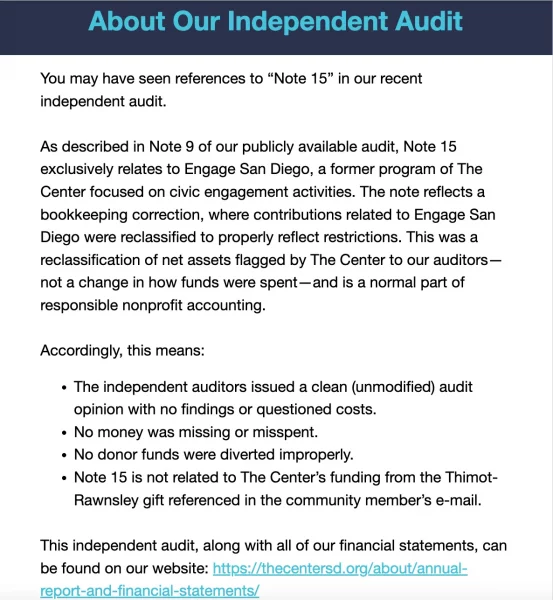
The board responded two days later, via an April 23 email from longtime Center board member Sue Reynolds, who thanked the leaders for their letter and promised to pass it along to the board treasurer and the rest of the board. She then noted the message attached at the end of a promotion for the Dining Out for Life event held that night, which “responds to the questions/issues you posed.”
Here’s the Center’s message:
The Center closed with a promise to be transparent:
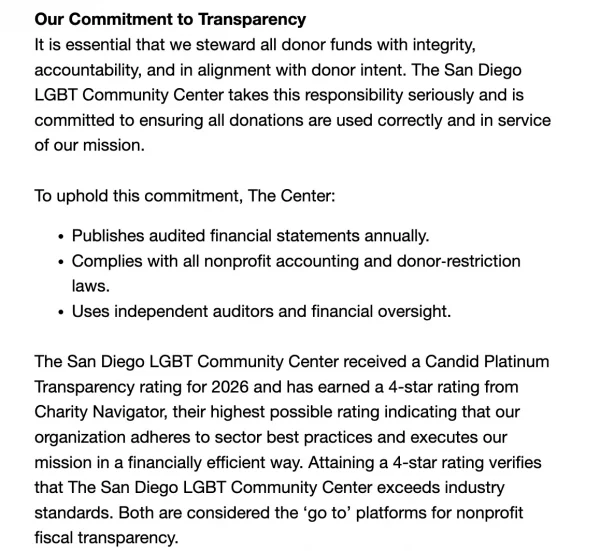
And herein lies the crux of the feud.
The Center may be transparent with the government and general public about its numbers, but these Stonewall Generation retired professionals – who are not accountants – are transparently honest and quick to fix a misconception.
“In our previous email, we pointed out Note 15 in the 2025 audit report. The Center clarified that the Note refers to another Center program and not to the Thimot Rawnsley Fund. If only the Center would respond as rapidly and as clearly with regard to the Fund questions we have asked them, we would then expect these issues raised to be resolved,” Kaminski wrote to supporters Sunday night.
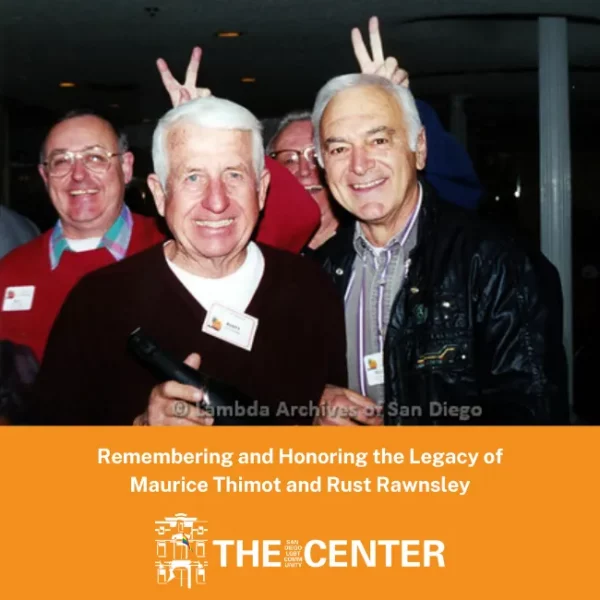 (from Lambda Archives of San Diego)
The Stonewall Seniors have been asking about the donation since Center CEO Cara Dessert first announced it in the Center’s June 13, 2022, newsletter.
“This amazing couple has created a legacy for our community’s future, directing The Center to establish a fund, The Maurice J. Thimot and M. Rust Rawnsley Fund (the Thimot and Rawnsley Fund). The purpose of the Thimot and Rawnsley Fund includes investing in our LGBTQ seniors. We look forward to stewarding this fund by investing in our senior services, exploring long-term investments in capital projects, and soliciting feedback from our community,” Dessert wrote.
“Once we have a full understanding of the fund and any proceeds from the fund itself, we look forward to sharing more with our Center community and seeking input about our future!” she continued. “We are deeply grateful to Rust and Maurice for their confidence in The Center, their generosity, and their care for our San Diego LGBTQ community, especially our seniors. Stay tuned for more information about the Thimot and Rawnsley Fund at The Center!”
The Stonewall Seniors expected their input to be solicited and questions answered such as: could the $18.9 million and the interest it generates be used for something other than senior housing and programs, as the late gay couple had often publicly discussed? In the March 31, 1990 issue of Update discussing SAGE, for instance, Maurice J. Thimot specifically talked about housing.
There’s also precedent. When Dr. Delores Jacobs announced her retirement as the Center’s chief executive in June 2018, for instance, “more than 200 interviews and focus groups, [and] feedback was solicited regarding characteristics sought in the new Center chief executive, led by Board Co-Chair Joyce Rowland,” the Center announced.
The Stonewall Seniors say the Center has given varied explanations about the gift, the first $10 million of which came in 2022, the remainder in 2024, and they want to see the language of the Thimot-Rawnsley estate trust to find out how their bequest was to be used.
“It’s four years of interpretations, four years of shifting explanations, four years of telling this community to trust them without ever producing the one document that would actually answer the question,” said Ted Callam, who served on the Center’s senior advisory committee before it was disbanded and replaced with new members.
Center officials initially said the gift would be used for community programs and spaces with an emphasis on seniors. There was also talk of expanding the building, according to Callam, Kaminski, and Lewis. But that did not come to fruition. Then, last December, Center leaders said the gift was restricted to seniors, housing, and housing-related services and could not be used to establish a senior center.
Earlier, the Center’s board of directors had approved an annual draw of $350,000 from the bequest to fund housing navigation, rental assistance, and eviction prevention. Center officials further said interest income may be used for certain interconnected services, on the basis that seniors are part of everything the group does. But now the $350,000 draw has been paused until the Center hears from its attorneys and consultants.
In a recent newsletter, Center officials said they are “awaiting final guidance and will continue providing transparent, quarterly updates, with our next update scheduled for this summer.”
“We’ve watched the story change,” Callam said. “So senior programs and services, then senior housing, then housing and related services, and now ‘we’re awaiting guidance.’”
At the Center’s March 24 board meeting, several seniors spoke up, including Tom Kirkman, who ran San Diego’s SAGE Center from 2000 to 2009, when Thimot was on the board of that organization.
“Maurice and Rusty were very interested in the quality of life for seniors,” Kirkman told LGBTQ Freedom Fighters. He believes they would have wanted their bequest to support senior services, although he hasn’t seen whatever document governs that. “I’m looking forward to seeing that document,” he said. (San Diego’s SAGE organization, now disbanded, was independent and not affiliated with the national group of the same name.)
LGBTQ+ seniors initially offered to help the Center decide how to spend the bequest, Lewis said. “They said, ‘Yes, we want the community involved. Yes, we’re going to talk to the community,” she recalled.
Both Lewis and Callam have experience in designing surveys, and they decided to create one, only to find that the Center had sent one out already. That survey was useless because it didn’t ask if respondents were part of the LGBTQ+ community, she said.
Kaminski has filed three ethics complaints with the California attorney general’s office over the handling of the bequest. A staff member responded that the AG’s office does not have the resources to investigate every complaint filed and that it does not investigate certain types of complaints. The staffer also told Kaminski that the AG does not comment on ongoing or potential investigations, which was the same answer LGBTQ Freedom Fighters received.
As for the legalities concerning the Center’s use of the funds: If there are written restrictions on a donation’s use, the terms are legally binding. Only the donors, not the recipient, can impose such restrictions. But the terms do not have to be shared publicly, according to the National Council of Nonprofits.
“Because this was a complex, multi‑property estate, we conducted an extensive, multi‑year due diligence process with legal and accounting specialists. We are implementing a clear strategy that strengthens current services benefiting LGBTQ+ seniors while ensuring long‑term organizational stability and compliance with donor intent,” Center spokesperson Hernandez said.
“Over the last nearly four years, The Center conducted a careful, thorough review of the $18.9 million bequest, which was received in full in September 2024. This review included monitoring the progress of the sale of 21 domestic and international properties and consultations with multiple specialists, who at times had differing opinions on the scope of the bequest’s intent,” he continued.
“To ensure that this extraordinary gift is used in the way it was intended, we assembled a team of experts that includes our attorneys and auditor. It took time to organize the team and for them to align on how the full gift could be utilized to maximize the benefit to the community. As we near the end of this long process, we are awaiting final guidance to ensure our shared interpretation follows all regulations related to charitable assets. We have paused the use of gift funds until that final guidance is confirmed,” Hernandez said.
The Center gave a similar answer to Manuel Reyes, an aide to San Diego City Council member Jennifer Campbell, who represents the district where the center is located. Callam, Kaminski, and Lewis did not find the answer satisfactory.
In a letter to Reyes and Campbell, they emphasized that the Center should release the original bequest language and questioned why, if the bequest required interpretation, it had taken so long. They also wondered if the funds had been used for purposes other than the donors intended.
Lewis, Callam, and Kaminski of Pride Across Generations said the Center has disrespected seniors in other ways. There used to be a drop-in room dedicated to seniors. “It was the perfect room, because it has an outside entrance, and there were always seniors in there, and there were snacks and conversation, and if somebody needed help, they could go in and ask,” Lewis said. But it was turned into an office, and senior resources were moved into a hallway off the library, which was inaccessible because of meetings in the library, and “even to get past the front desk, you had to ask permission and have some reason to be there,” she said.
The disbanding and replacement of the senior advisory committee is another sore point with the three. Center officials said they wanted a new model, but someone with the Center did comment that the earlier committee was “too white and too cisgender.” The new committee’s members and meeting dates are not made public, according to Kaminski, Lewis, and Callam. How do you get community information to a multi-layered secret committee, and how do you find out results?
“I have served on the boards of many nonprofits over nearly 50 years and I have never seen anything like this,” says out former KNBC4 reporter Garrett Glaser, who signed the Pride Generations’ March 15 letter to the Center board and senior leadership.
That letter says, in part: “When seniors ask questions about governance, finances, and mission alignment, they are not being disruptive—they are exercising their right to understand how an organization that claims to serve them is being run. Treating those questions as something to be managed or silenced undermines trust and excludes the very community the Center exists to support.
“Trust and transparency are earned through consistent integrity, not rhetoric. Until the Center demonstrates genuine accountability, transparency, and meaningful engagement with LGBTQ+ seniors, trust remains broken.”
So, who is asking what happens if and when that fiscal tornado hits?
Pride Across Generations requests your presence and possible participation in the Center’s board meeting on Tuesday, April 28 at 6:30 PM in the Center Auditorium. The theme: “Honor the Past. Secure the Future. Moments like this define institutions. Let’s show up—for transparency, accountability, and trust.”
The meeting will also be available on Zoom.
You can reach Pride Across Generations at: [email protected]
This is a cross-post from Karen’s LGBTQ+ Freedom Fighters Substack.