
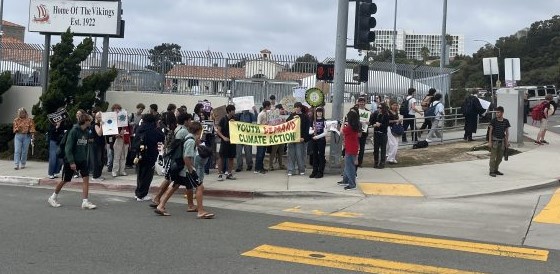
They keep trying.
Students locally and around the world have been taking to the streets and courthouses attempting to pressure governments and polluters to get more serious about reducing pollution and taming global warming.
They’re acting like their future is at stake which, sadly, it is. Perhaps more than their elders, younger people see climate change as affecting their health, where they live and even whether to have children.
The activist ethos of young people is fueled by years of gloomy reports and growing physical evidence of how climate change exacerbated by human-generated greenhouse gas emissions are affecting the planet.
More intense wildfires, stronger storms and rising seas that are encroaching on continental coastlines and shrinking islands have been attributed to climate change, despite more prominent denialism in high places, such as the White House.
The actions of young people on this front have produced mixed results so far, though what ultimately happens remains to be seen.
Students staged a walkout at schools in San Diego County and across California on Friday in support of the “Polluters Pay Climate Superfund Act.” Their hope is to unlock Assembly Bill 1243, which has stalled in Sacramento amid powerful opposition.
Earlier this month, a federal judge dismissed a lawsuit by nearly two dozen young people who claimed executive orders by President Donald Trump on energy and the environment violated their constitutional rights.
Intriguingly, the judge nevertheless may have opened the door for further legal challenges regarding climate change.
Our Children’s Trust, a public-interest firm that organized the case, also helped young people win a landmark climate case in Montana state court and a settlement in Hawaii.
And students on several South Pacific islands won a major ruling in international court that said nations have legal obligations to prevent climate harm, though the court does not have the power to enforce its opinion.
That young people are concerned about how climate will affect their future is no surprise.
A survey published late last year by the Lancet Planetary Health concluded a large majority of young Americans are worried about climate change, with more than half saying global warming may affect where they live and whether to have children.
The research was led by New York University’s Grossman School of Medicine and several other universities. The study was funded by Avaaz, a U.S. nonprofit that advocates activism on climate change, human rights, animal rights and other issues.
The news on the climate front has been grim for some time, with heat-trapping carbon emissions pushing global temperatures toward “tipping points” beyond which scientists say increasing levels of damage will be irreversible.
There are glimmers of hope. Increasingly, some experts have been eschewing the near-total focus on doom scenarios and calling for working more toward adapting to a warmer world while continuing to try to reduce the carbon emissions causing it.
Microsoft co-founder and philanthropist Bill Gates, long an advocate of combating climate change, recently shifted his outlook somewhat, saying global warming will have “serious consequences” but “it will not lead to humanity’s demise.”
“Climate change is serious, but we’ve made great progress,” he said in a recent memo. “We need to keep backing the breakthroughs that will help the world reach zero emissions. But we can’t cut funding for health and development — programs that help people stay resilient in the face of climate change — to do it.”
Meanwhile, Bloomberg this week reported that global emissions of greenhouse gases are expected to fall by about 10 percent by 2035, compared with 1990 levels, representing the first decline ever forecast by the United Nations.
But the report says the world remains “well off course” in keeping global warming below the threshold leaders committed to when they signed the Paris Agreement a decade ago.
It’s hardly likely any of that will temper the outlook and activism of young people on climate change.
Legal challenges by young people and others have been springing up in the U.S. and around the globe.
In the lawsuit against Trump’s executive order, the judge “reluctantly” dismissed the suit, saying it lacked a legal basis and was too broad in scope.
But Judge Dana Christensen said the plaintiffs had successfully argued that climate change constitutes a “children’s health emergency.” Legal experts told The New York Times the ruling offered guidance to shape other suits to avoid the problems this one faced.
Students at a law school with campuses on several Pacific island countries, including Fiji, Samoa and Kiribati, made their case to the International Court of Justice, which issued an advisory opinion that said countries must protect people from the “urgent and existential threat” of climate change.
The Pacific Islander students aren’t dealing with merely future or abstract impacts of climate change, various news reports have pointed out. Cyclones have hammered economies, rising seas have displaced families and washed cemeteries into the ocean, while the salt water has ruined crops.
Closer to home, hundreds of students walked out of an estimated 20 schools in San Diego County in support of AB 1243, which aims to make fossil fuel companies pay into a fund, the amounts calculated by how much their emissions impact the climate.
The protests were similar to past student action against gun violence, particularly in schools, and immigration crackdowns.
Whether you agree with them or not, the students should be lauded for their engagement — taking nonviolent action to get their voices heard, seeking to change laws and trying to make the world a more livable place.
After all, instead of protesting, these students could have done more traditional things, like cutting class to go to the beach or otherwise goof off.
Kids these days.