
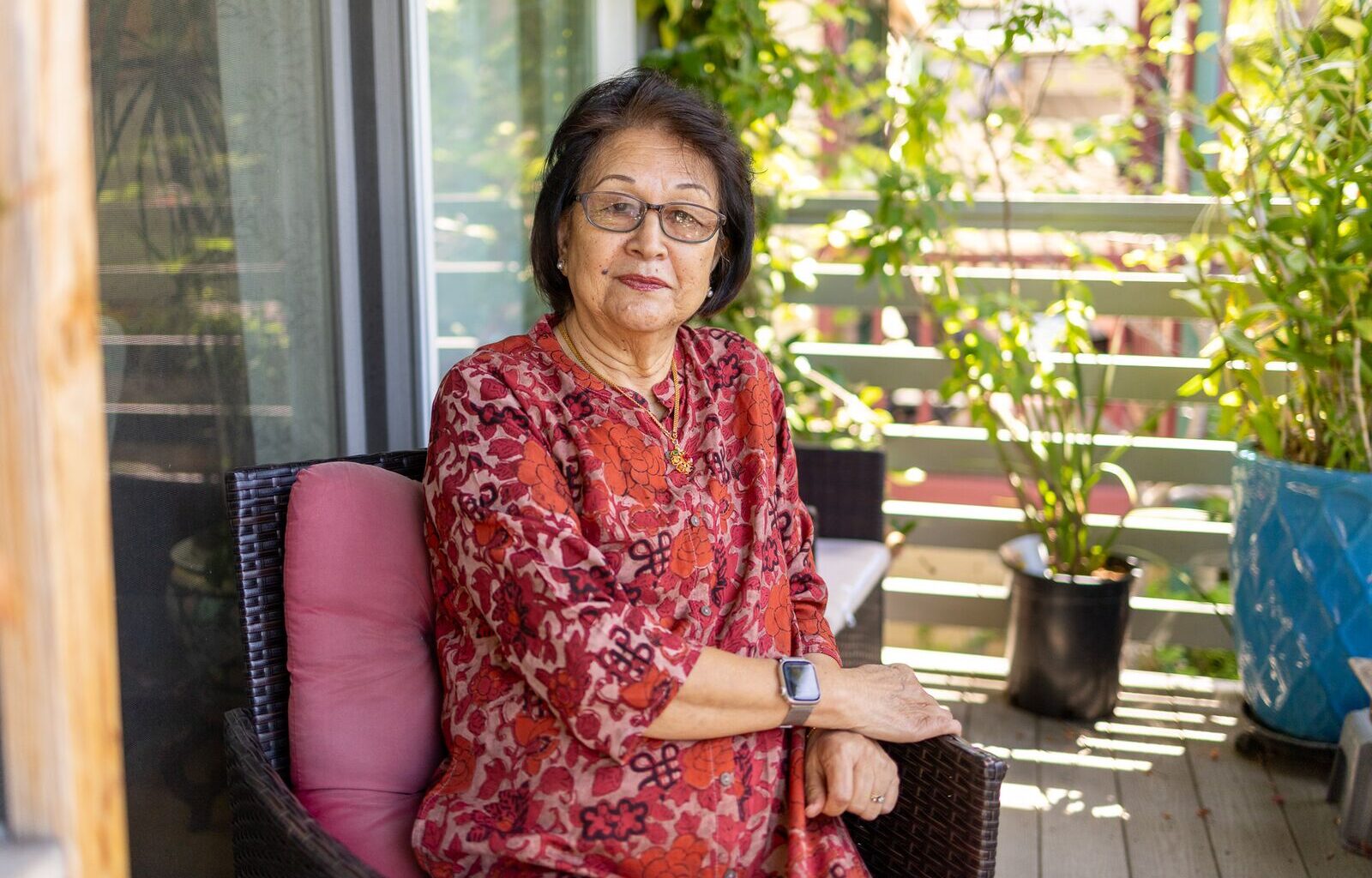
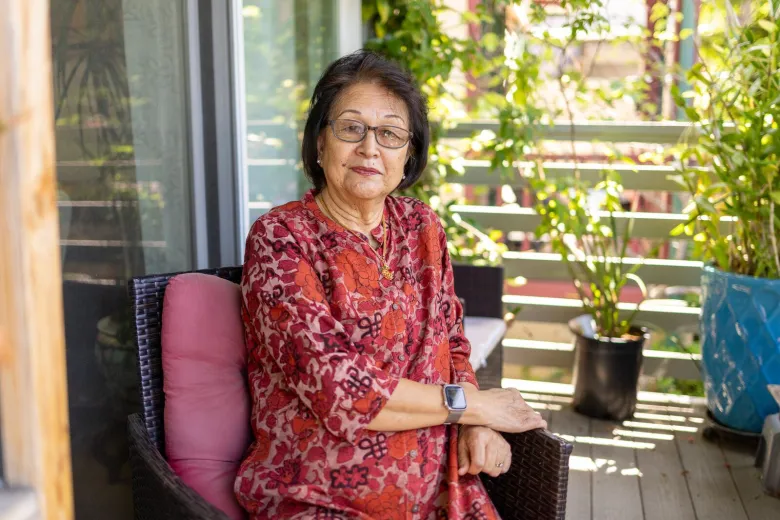
 Usha Lama at her home in North Berkeley. Credit: Sara Martin for Berkeleyside
This story was told by Usha Lama to Joanne Furio in an interview. It has been lightly edited.
When I first moved here in 1976, it was hard in the beginning, trying to bridge two cultures. I grew up in Kathmandu in Nepal. I had a very humble beginning. I grew up in a family of eight: my parents and my four brothers and a sister. My father was a schoolteacher and later on he became a civil servant. Education was important in our household.

Amplify Berkeley is our new series featuring stories told by Berkeley residents in their own words. Got a story to tell? Let us know.
At the time, Kathmandu was a small city. It’s in a bowl, a valley, surrounded by mountains. I wasn’t really raised in a religious tradition. We practiced our Hindu prayers, our daily routines, but my parents were very liberal.
A typical day started very early with rituals and prayers. After that, they would start cooking, more of a brunch than a breakfast. We ate very healthy food that was simple and fresh like rice, lentils, and vegetables. We never had leftovers; everything was cooked fresh and eaten that day. Once a week, on a Saturday, we had meat that was fresh cut at the market. It was usually chicken or goat because at the time Nepal was mostly a Hindu country. That has changed; it has become much more diverse.
The time to report for work in a government job was 10 o’clock, so people ate a full meal before they went to work. They’d have a light snack at two or three o’clock, and they’d go to bed early. In those days, by eight o’clock it was dead silent. There were fewer cars. We walked to school, a very normal thing over there, surrounded by the beautiful backdrop of the Himalayas. It’s such a rich culture and region, and we took it for granted; it was just a way of life. People over here spend a lot of money to go to the mountains. For us, it was a daily thing.
I went to college in India and majored in political science, but eventually changed direction. I started working as a flight attendant for Royal Nepal Airlines and worked there for four or five years. I actually met my husband, Dorji, on a flight when he was heading to visit his family in Kathmandu. My family knew his family, who were Tibetan Buddhist and living in the city, and his mother had told me about him. After finishing his engineering degree at the Indian Institute of Technology Kharagpur, he applied to come to the U.S., which at that time was inviting skilled workers. He had already been living in the U.S. since 1971, and got accepted right away. We fell in love, got married, and decided to move here together when I was 24.
Before committing, my future brother-in-law, who was living in San Francisco, invited me to check it out before I moved. Because I was working for the airline, I was able to make a quick visit. My visiting the U.S. was a family discussion, and agreed upon. I thought it was so beautiful. It was going to be such a change in life. In those days I was very bold. I was young, and it was so appealing.
We lived in Mountain View for the first eight years. It was a difficult transition. I had so much in my heart that I left behind. I missed the beautiful scenery of Nepal, the cultural festivals and community gatherings. In Nepal, it feels like a way of life to have celebrations all year round.
In the U.S., I was basically trying to fit in. It was challenging in those days, because there were not very many Nepali or Tibetan people here. At the time, I knew only six, including my two brothers-in-law. That was the hardest adjustment, not seeing familiar faces.
I also struggled with the language. Even though we spoke English in Nepal, here it’s spoken at a faster pace. I had difficulty understanding the tone. I didn’t understand the jokes. Going to a restaurant was stressful — they’d describe so many kinds of salad dressing! I felt uncomfortable asking for directions. Everything was intimidating in those days, even simple things like using a vending machine. It was so different from what we had in Nepal, a big adjustment.
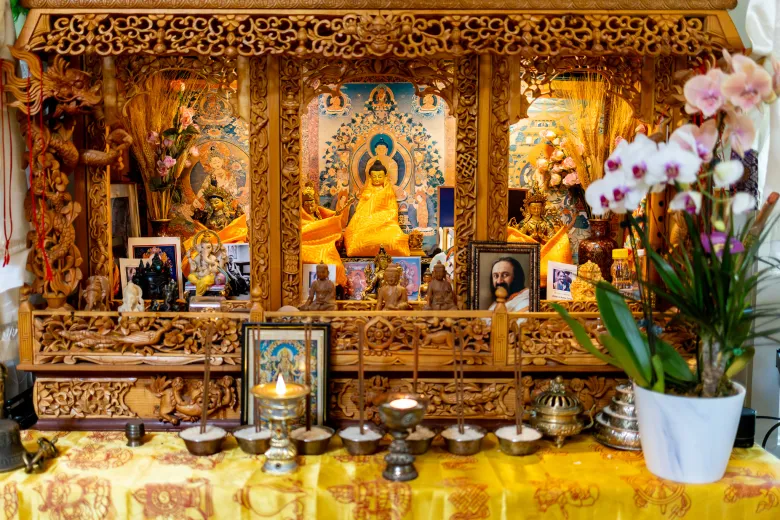 The family altar that Usha Lama shares with her husband and daughter at their home in Berkeley, CA. Credit: Sara Martin for Berkeleyside
But people here were encouraging. They would tell me how well I spoke English and ask how long I had been here.
While I was navigating and adjusting to American life, I also wanted to preserve parts of my own culture and values. To me, the most important value I wanted to pass on to my daughters was respect for older people, your parents, people in general. That is the most important thing, and something I hope doesn’t get lost.
After Mountain View, we moved to Fremont and lived there for 35 years. My two daughters grew up there. On the peninsula I worked for corporate travel agencies, and by the time my children were leaving home, in 1989, I had enough experience to start my own business, Third Eye Travel. I used to advertise in the San Francisco Chronicle and had an 800 number. We specialize in the Himalayan region: Tibet, Nepal, Bhutan and India. I also do Thailand and Cambodia. It’s pretty much a full-service agency.
In the 1990s and early 2000s, it was mostly Americans going from here to Nepal because the Nepali community here was still very small. But as more people chose to make their home here, eventually, people started traveling back once they’d settled and made enough money. For some people it took years to go back.
When I was growing up, when you went to the mountains and looked out from the temples, it was all green with a lot of rice paddy fields. Now it’s all high rises. So many people came from the remote villages to Kathmandu to make a living, their fortune, and it has become overcrowded. When I go back now, it’s all buildings and housing, schools, and lots of restaurants, of course. It has simply become very crowded.
Building community at Berkeley’s Himalayan Fair
We decided to move to Berkeley in 2019, right before COVID. Berkeley was appealing to both my husband and I because a lot of the Tibetan community was here, the monasteries are here, and a lot of Nepali people also live in this area. Since I arrived 49 years ago, the Nepali community in the Bay Area has about tripled. Most live in El Cerrito, Richmond, and in the South Bay in Fremont, Sunnyvale and San Jose. I don’t feel the loneliness that I felt when I originally moved here. I’m pretty much settled and have my own group of people. We now live in North Berkeley, in a two bedroom single-story home, with a separate unit in the back. I’m still operating the business, but now we are completely home based.
The entire Himalayas were there — the cultural dances, the music. It was so connected. Arlene put out the prayer flags around Live Oak Park. There was the smell of cooking and Tibetan incense. I felt transported, immediately.
Over the years, something that’s helped me stay connected to my culture is the Berkeley Himalayan Fair. We’ve been going since it began in 1983, long before we lived in Berkeley. My husbands’ brother used to own the Tibet Shop in San Francisco for many years. When you have a shop like that, a lot of people from the region are aware of it. He’s retired now, but it’s because of him that we started going to the fair. When [the mountaineer and Berkeley resident] Arlene Blum started the fair, it was just a small get-together. I would go just to feel at home. It was a beautiful gathering, where I felt a sense of belonging.
It was so beautiful to see the familiar faces and the culture. There would be a person making the Indian dishes, the pakoras and momos, and steamed dumplings. The entire Himalayas were there — the cultural dances, the music. It was so connected. Arlene put out the prayer flags around Live Oak Park. There was the smell of cooking and Tibetan incense. I felt transported, immediately.
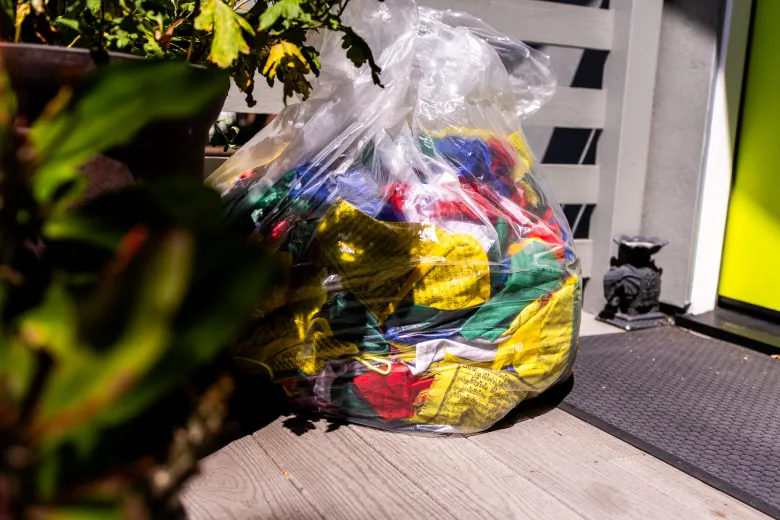 A bag of Himalayan prayer flags sits on the porch of Uma Lama’s home, waiting to be used at the Himalayan Fair. The colorful, rectangular cloths are traditionally strung along mountain ridges and peaks to bless the surrounding countryside. Their colors represent the sky (blue), air (white), fire (red), water (green) and earth (yellow), and feature woodblock-printed mantras and images. Credit: Sara Martin for Berkeleyside
When the festival became yearly, Arlene asked, “Why not let vendors from the Himalayan region come?” My brother-in-law was one of the earliest, and I started to come as a vendor as well, after I started my business. Now, I’m one of the oldest vendors. My daughters grew up going to the fair every year. My daughter Rinchen, who works in marketing, helps with the fair’s social media.
The festival brings together diaspora from all over the region. It starts with Tibetan Buddhist monk prayers. There’s another group representing Hindu culture, whose members chant and sing hymns. This is how we start, with ritual and ceremonial things — not too religious, but having respect for the environment and the divine. Then it takes off with dances and songs from different cultures. It’s so diverse and beautiful, and goes all day long. People love to sit there for hours, and they come from as far away as Sacramento. One vendor comes from Washington state and another from Portland, Oregon. This year we’re trying out a new food vendor from northeastern India called Manipur. We have six food booths with Nepali Newari, Indian, and Tibetan dishes, so people get to eat foods from the different parts of the Himalayas.
Because I was a longtime vendor, Arlene asked if I would join a committee. I said, “Well, this is so beautiful, and I want to give something back to the community. I want to be part of it.” So I’ve done vendor management since 2011. Now we have 40-45 vendors, double the size of what it was before.
The vendors sell handicrafts, statues, jewelry, prayer flags, religious paintings and tankas, Tibetan buddhist paintings, Tibetan rugs, clothing like pashmina scarves, and Ayurvedic products. There are NGOs represented, and nonprofits.
Over the years, the Himalayan Fair has given so much to charities, but lately that’s been pretty difficult because our operating costs have gone up. The city permits have gone up, and we rely mostly on vendor fees. We sell raffle tickets to raise extra money. There is no entry fee, and we haven’t raised the vendor fee for years because vendors are also struggling.
The festival is so important for our community, and we want it to keep going. It brings us together every year to celebrate our heritage. It’s such a deep-rooted festival in Berkeley. I want people to come and support the Himalayan Fair.
This year’s Himalayan Fair will take place May 16 and 17 in Live Oak Park.
We know that most readers don’t get to the end of the article. But you did! To support our in-depth, rock-solid reporting, please consider making a donation to our nonprofit newsroom today. We rely on our readers — particularly the ones who read the whole story!
“*” indicates required fields