
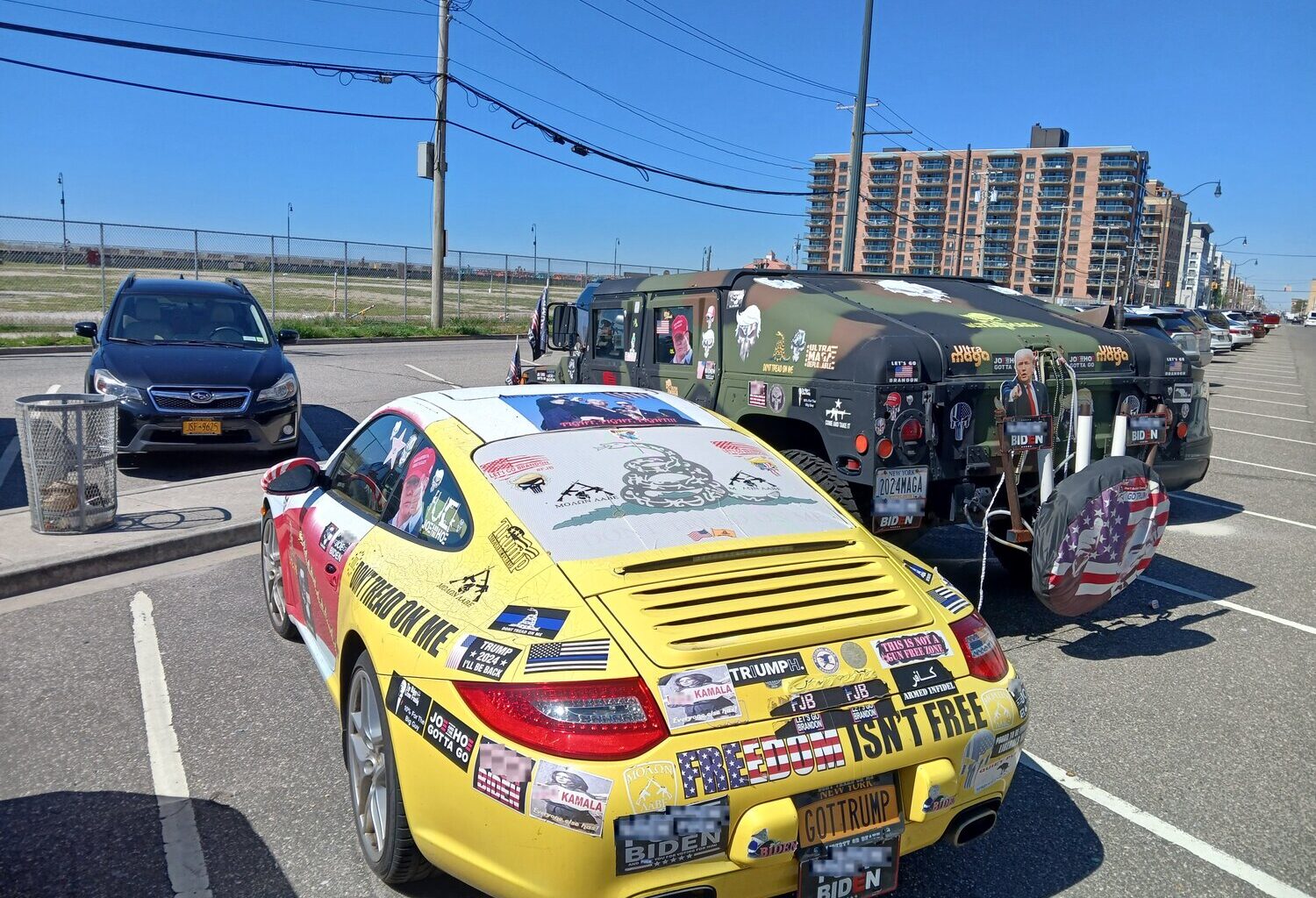
Michael Wasserman, of Long Beach, has rejected a $50,000 settlement offer from the city, and so a years-long lawsuit over Wasserman’s public display of politically themed flags on his vehicles will continue.
“With the court’s help, the parties reached a settlement,” Howard Miller, a legal representative of the city, wrote in a May 1 letter to U. S. Magistrate Judge James Wicks, of the Eastern District of New York, who is overseeing the case. “Counsel for the parties then agreed to the specific language of a written settlement agreement. Unfortunately, Mr. Wasserman appears to be refusing to sign the settlement agreement.”
In March 2021, Wasserman was issued a summons by the Long Beach Police Department for displaying multiple flags on a vehicle while on public roads — the decorations were predominantly political, displaying pro-Trump and anti-Biden sentiments and slogans. That May, Wasserman filed a $25 million lawsuit against the city, the Police Department and several individual officers, including Ronald Walsh, the police commissioner at the time. In March of this year, the all-Republican City Council unanimously voted to approve a $50,000 payment to settle the lawsuit.
Wasserman’s attorney, Andrew Campanelli, said that his client believes he is being selectively prosecuted because of the political messages displayed on his flags, not for merely flying them. Campanelli claims that Wasserman is the only resident to receive a citation for violating Section 3-7, subsection D of the city’s code of ordinances since it was enacted in 1989.
The statute states, “No sign shall be erected, affixed or maintained within the perimeter of any public mall, or upon any public street or public property.” Section 3-3 of the ordinances denotes nine exemptions from the regulations, including, for example, flags and emblems of nations and religious organizations.
“There is no question that the sign law is unconstitutional,” Campanelli said. “It actually regulates flags based on content, and you absolutely, positively cannot do that. The way it does that is, it imposes all these restrictions on signs — and it classifies flags as signs — but then it exempts from those restrictions a number of signs like signs for countries, signs for organizations, a whole slew of them. They are literally regulating signs not based upon height, size or location, but on content.”
The city maintains that the initial summons was based on the ordinance’s prohibition of displaying signs on public streets, which include parking spaces. At one point, Wasserman displayed more than 20 politically themed flags on three vehicles he parked on East Broadway, in addition to inflatable accessories on the street-facing balcony of his apartment.
“There are American flags all over the place,” Campanelli said. “There’s Italian American flags and Irish American flags on businesses and residences, on both public and private property, all without citations. There was a Gay Pride flag at a restaurant on the boardwalk forever and nobody ever got cited for a violation of flag law, except Mr. Wasserman.”
Attorneys for both parties returned to Eastern District Court in Central Islip last Friday to continue seeking a resolution but left without coming to an agreement. Without continued negotiations, a trial remains a possibility. Both Miller and Corporation Counsel Greg Kalnitsky, the city’s official legal adviser, declined to comment on the case, citing the ongoing litigation.