
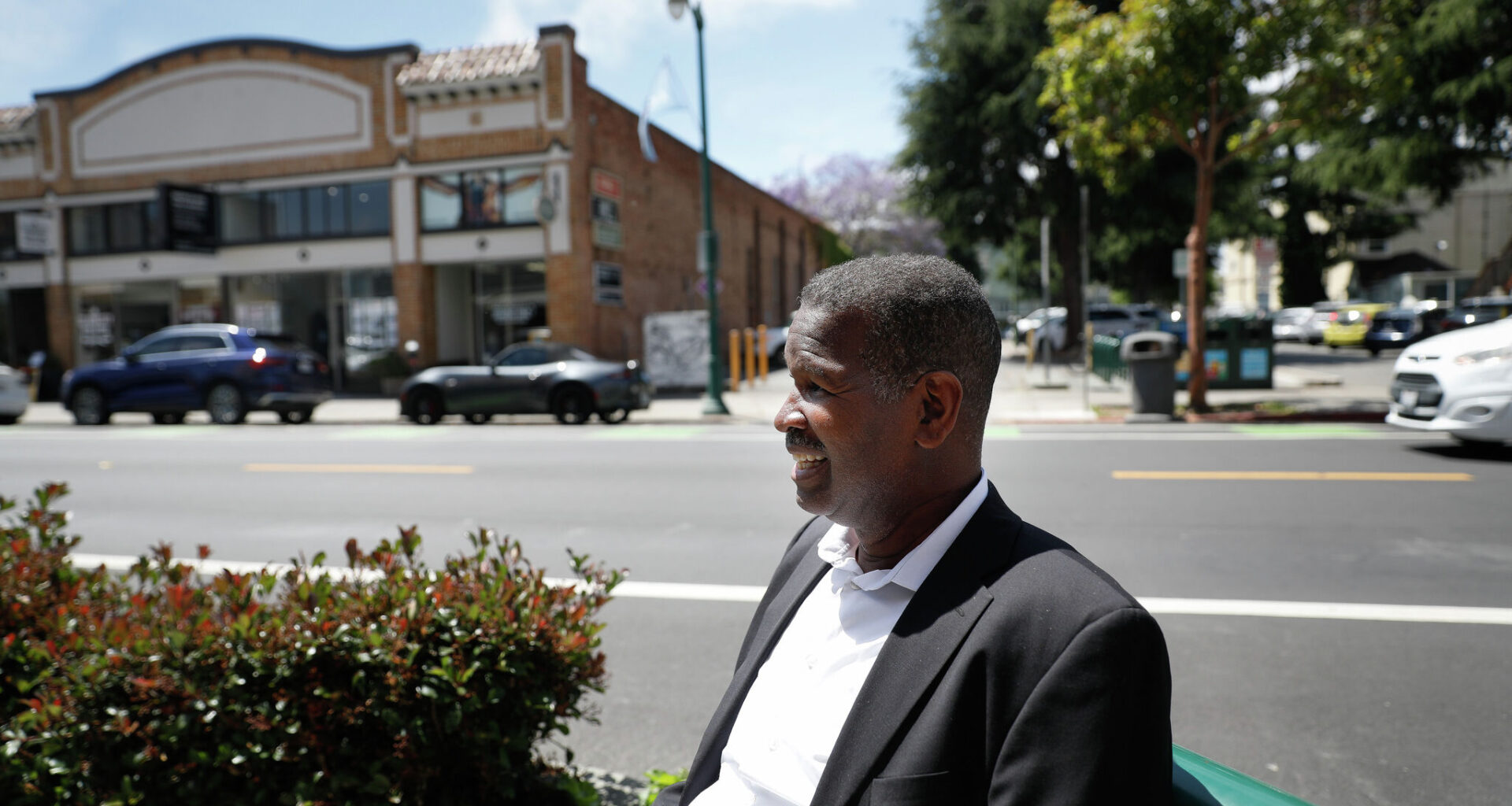
Barack D. Obama Shaw, who is running for governor of California, looks down Central Avenue in Alameda. He changed his name in 2013, inspired by the former president.
Lea Suzuki/S.F. Chronicle
A little-known candidate for California governor was campaigning on a street corner in Alameda this spring when a middle-aged man spotted the candidate’s name on a sign, climbed out of his pickup truck and snatched the candidate’s microphone.
“You’re not Barack Obama,” he yelled. “You’re a fraud!”
The man was right about one thing: Barack D. Obama Shaw is not the former president, nor is he related to the more famous Obama in any way. But that is his real name — he legally changed it in 2013 — and he really is on the ballot for California governor, running as a Democrat.
Article continues below this ad
A tall, smooth-talking music teacher with a slight Texas twang and a salt-and-pepper mustache, Obama Shaw is one of 61 candidates in a wide-open field. While strolling down that same street Tuesday where he was once accosted, the 56-year-old Alameda resident remained bullish — not only about advancing past the June 2 primary to November’s general election, but of winning the entire thing.
“It’s definitely possible,” Obama Shaw said of his chances of becoming the highest-ranking public official in the nation’s most populous state. “I’m stronger on paper than all these candidates with more money.”
San Francisco Chronicle Logo
Make us a Preferred Source to get more of our news when you search.
Add Preferred Source
This highly unlikely candidacy is fitting for one of the more dysfunctional governor’s races in modern California history. For months, Democrats fretted they’d be shut out of the November election with so many candidates splintering the vote. That no longer seems likely, but more people are nonetheless rethinking the state’s jungle primary system, in which all candidates appear on the same ballot and the top two vote-getters of any party move on to the general election.
Barack D. Obama Shaw’s name is one of 61 listed randomly on the ballot for California governor.
Lea Suzuki/S.F. Chronicle
Little more than a month after allegations of sexual misconduct against front-runner Eric Swalwell forced him to drop out and tossed the polls into chaos, voters must now sift through a lengthy list of candidates as they attempt to decide: Who deserves to lead California through this critical period?
Article continues below this ad
Modest barriers to entry on the ballot, such as a roughly $5,000 fee or 6,000 signatures, paved the way for a cast of characters with satirical-sounding names like Obama Shaw, Thunder Parley and Livingforgod Andcountry Demott. They may not draw many votes, but they still contribute to a ballot crowded with candidates who have little realistic chance of advancing.
Now, long-ignored calls to overhaul California’s election system are growing louder. Democratic consultant Steven Maviglio recently filed a proposal with state elections officials to end the nonpartisan top-two primary and shift back to a traditional primary as soon as the 2030 election.
That change wouldn’t just keep the ballot more manageable: The current list of candidates for governor ranks as the state’s longest ever, aside from a 2003 recall and special election that featured 135 candidates. Reverting to a traditional primary would also prevent voters from again having to worry about two Republicans dueling for governor in a solidly blue state.
Further complicating the current list is its arrangement: randomized in nonalphabetical order out of fairness. Obama Shaw, with his fewer than 350 Instagram followers, minimal donor support and a thin campaign platform, sits atop some of California’s roughly 23 million mail-in ballots.
“My son and I were voting together the other day, and we were having the hardest time finding our preferred choices,” said John Pitney, a politics professor at Claremont McKenna College. “It’s frustrating.”
Article continues below this ad
Since its implementation in the 2012 elections, the top-two system has been a source of consternation for California voters. Defenders say it encourages candidates to reach out beyond their partisan bases. But since everyone shares the same primary ballot, the problem is sheer volume. Outsiders with little political backing often enter the fray to capitalize on a fragmented field, share their message with a wider audience or boost their name recognition.
These fringe candidates almost never have a viable shot at getting elected, but they do take away votes from bigger-name candidates while confusing voters along the way. Richard Winger, the publisher of Ballot Access News, which has tracked every state’s ballots for four-plus decades, said this 61-person field was “on pace” to become California’s most confounding race since 1934.
That year, after two failed runs as the Socialist Party’s gubernatorial nominee, renowned author Upton Sinclair switched to the Democratic Party and won the nomination, but lost the election to the Republican incumbent.
“What might make this year’s ballot especially interesting to me is just the number of publicity hounds in it,” Winger said. “These are people who really just want to make a name for themselves.”
The name of California governor candidate Barack D. Obama Shaw has been a source of confusion and consternation for some.
Lea Suzuki/S.F. Chronicle
Shaw insists he isn’t one of them. A diehard fan of his namesake, he said he felt compelled to run for governor because he saw a “divided country that needs to be unified.”
Article continues below this ad
It was a sunny Tuesday afternoon in downtown Alameda. As passersby stole furtive glances at that middle-aged Black man seated on an outdoor bench in a white button-down shirt, black suit coat and gray slacks, they almost certainly had no clue they were looking at a gubernatorial candidate.
Obama Shaw, who said he supports himself by teaching music lessons, emceeing community events and working as a life coach, didn’t have enough money to mount much of a campaign. State financial disclosures show the former Army reservist certified that he didn’t need to file taxes for the past five years. Obama Shaw has no political experience beyond a 2022 run for mayor of Alameda, which he lost with 6% of the vote.
On the rare occasions he has knocked on doors or campaigned in the streets, he has often encountered hostility, if not outright abuse. During that March incident with the man driving the pickup truck, he said he was so worried about his personal safety that he had police intervene.
“The Obama name has millions of supporters,” Obama Shaw said, “but it has plenty of haters, too.”
Born Cecil Shaw III, he grew up in a musical family in Houston. His grandfather, Cecil Sr., was a renowned gospel singer in the 1950s who counted Ray Charles as an admirer. His father, Cecil Jr., was an accomplished recording artist in his own right, performing on “Soul Train” in 1974 before producing music for many well-known singers.
Article continues below this ad
Eager to make a living doing movie soundtracks, Cecil III moved to Los Angeles in 2006. But after the project he was working on stalled out, he ended up living in his green van, washing himself in a McDonald’s bathroom each morning, and digging ditches for several dollars an hour.
“I’m not the kind of person who’s going to beg for anything,” Obama Shaw said. “I was willing to pay my dues.”
The grind never really stopped. In 2009, just as he was starting to rebuild his life as a real estate agent, the housing market crashed. By the time he walked into a Houston-area courthouse on Jan. 4, 2013, he was desperate for a fresh start.
For years, Shaw had idolized Barack Obama. He read every book he could find about the 44th president. He rewatched Obama’s most memorable speeches whenever he needed a spark of motivation.
After reviewing Shaw’s name-change application, a judge looked up at Shaw and, with a bewildered facial expression, asked the obvious: Are you trying to run away from something? Maybe an arrest or a debt?
“No, your honor,” Shaw recalled saying. “I feel that this new name will create a new empowering context for the rest of my future.”
Still, he said he included the “D” in “Barack D. Obama Shaw” on the gubernatorial ballot because he wanted to make it very clear that he wasn’t that Barack.
Asked what the middle initial stands for, Obama Shaw puffed out his chest. “People say I look a lot like Denzel Washington,” he said.
Barack D. Obama Shaw, who is running for election for governor of California, holds his donation can in Alameda. He has little funding but secured a place on the ballot, which requires 6,000 signatures or a roughly $5,000 fee.
Lea Suzuki/S.F. Chronicle
With the primary less than three weeks away, Obama Shaw’s platform remains light on details. On his personal website, he offers vague proclamations about being a “uniter, not fighter.”
This is in stark contrast to some other fringe candidates. In interviews with the Chronicle, a half-dozen such people detailed their plans for tackling some of California’s most vexing problems: an affordability crisis, mounting homelessness, even complex issues related to climate change.
“I don’t trust that the people who got us into this mess can necessarily get us out,” said Parley, a San Jose-based market analyst also on the ballot. “I would rather deal with a long list of names than a short list of handpicked insiders.”
Parley’s superhero-like first name, Thunder, is a childhood nickname he made legal as a young adult. In early 2024, after a surge in homelessness in his San Jose neighborhood, he said he quit a lucrative tech job to travel around the state looking for answers.
What he heard from people — concerns about paying monthly bills and having their voices heard — drove Parley to assemble a hefty platform. His campaign website now features tens of thousands of words outlining what he’d do if elected governor.
“I really wish I was up on those debate stages,” said Parley, a Democrat. “I know my policy. I have real solutions. I just need to get my name out there more.”
Christine Sarmiento, a public health nurse and operations manager in Los Angeles, decided to join the ballot as recently as January. While talking with her husband about whom they should vote for, she found that none of the 10 or so candidates receiving media coverage seemed genuine to her.
Now juggling a grassroots campaign with two jobs and the needs of her five boys, she isn’t worried about how many people vote for her in the primary. “If someone doesn’t think I’m qualified to be governor, that’s fine,” said Sarmiento, who has no party affiliation. “This was just something I had to do for myself.”
The question now is whether campaigns like these will become less common. Eric McGhee, policy director and senior fellow at the Public Policy Institute of California, a nonprofit think tank, said that would probably depend on whether Republicans surprise folks by confirming Democrats’ lingering fears and sending two candidates to November’s election.
In the meantime, Obama Shaw is just pleased the top-two primary makes it easier for relative unknowns like himself to appear on the ballot alongside political heavyweights. All he wants is an opportunity.
“The happiest I’ve ever been in my life was seeing Barack become president,” Obama Shaw said. “If I get elected governor, I’ll be even happier.”