
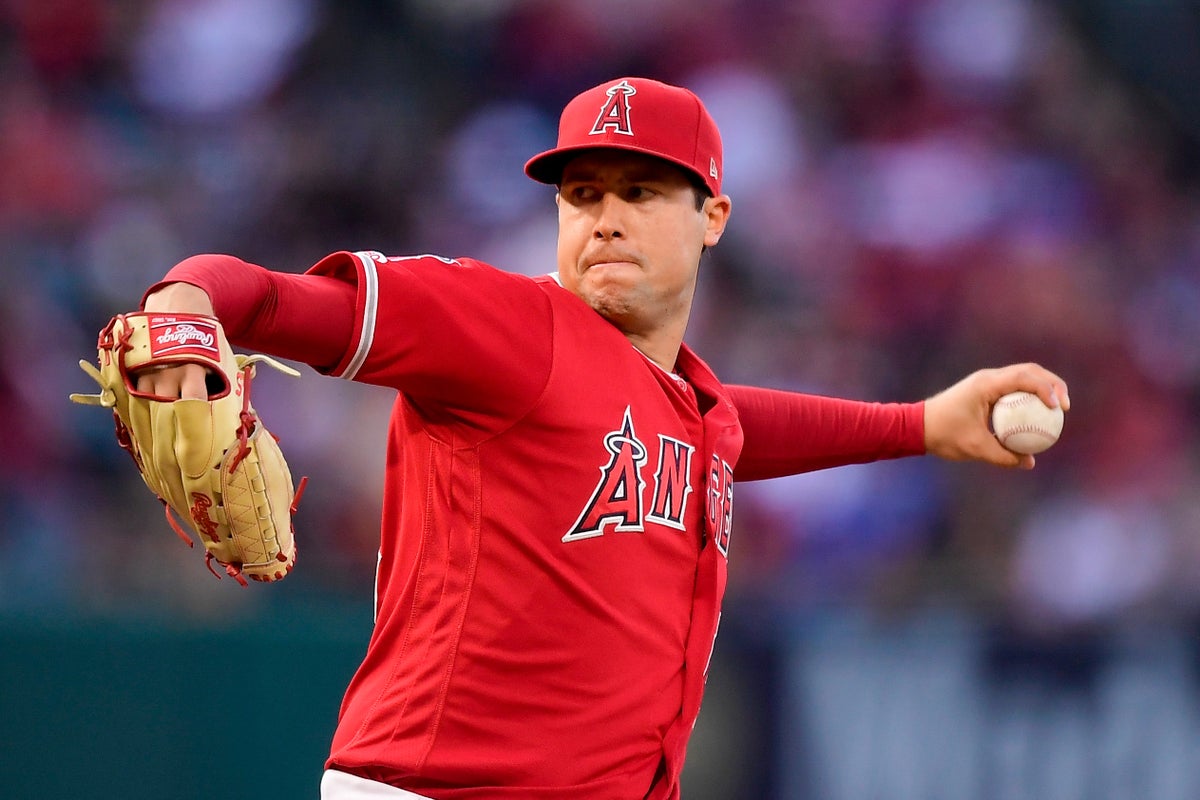
SANTA ANA, Calif. — The job of a Major League team’s public relations staff is to highlight the positives. But on Wednesday afternoon in Orange County Superior Court, an Angels attorney used the team’s PR statistician to argue a central argument in their defense: That deceased former pitcher Tyler Skaggs was not very good at his job.
While much of this wrongful death civil trial is litigating who was at fault for Skaggs’ death, both sides are simultaneously arguing a very different question: How valuable was Skaggs as a pitcher? And how valuable would the 27-year-old have been over the course of his career?
As with so many things, this debate over the stats of a man who threw his last pitch six years ago comes down to money. Skaggs’ family is seeking between $75 million and $118 million in lost wages as part of a larger statement of damages. The Angels will suggest a number between $0-$30 million, according to a source with knowledge of the defense’s thinking.
Skaggs died on July 1, 2019, after ingesting a fentanyl-laced pill provided by then-Angels communications director Eric Kay, who is currently serving a 22-year federal prison sentence.
Matt Birch, who has been in Angels PR for more than a decade, testified that Skaggs was not in the All-Star Game mix, always struggled in the final two months of every season, and was rarely the subject of media interview requests.
“The No. 1 (pitcher) is what’s known as your ace,” Birch testified. “That’s your best pitcher that you want starting on Opening Day or in big games. Tyler stacked up as one of our back-end of the rotation guys; he would be in that four or five spot.”
Skaggs family attorney Daniel Dutko used that line of questioning to press Birch during his redirect examination.
Dutko pulled out a printed version of the Angels’ 2019 pitching staff from the website Baseball-Reference.com, and entered it into evidence. Birch’s characterization of Skaggs as the Angels’ fourth or fifth best starter — citing his ERA — did not hold up.
Skaggs’ 4.29 ERA was the best of the starting rotation. He was also on pace to finish with the most innings on the staff. On a team with very poor pitching, Skaggs objectively had the best statistical profile.
“You would agree with me that the best pitcher on Angels baseball in 2019 was Tyler Skaggs,” Dutko asked.
“He’s one of the better pitchers,” Birch said, to which Dutko responded by asking him to point to a better one.
What ensued was a long back and forth, where Birch would not agree that Skaggs was the team’s ace, stating that the ace was more based on name recognition, reputation and other non-statistical factors.
These are the kind of debates that might in other circumstances be had in a barroom or at the proverbial water cooler. The reality is, however, that Skaggs’ pitching stats are now extremely important to the matter at hand.
“The jury needs to understand exactly how much the family lost,” Dutko said in an interview with The Athletic. “The loss of love and the loss of companionship is a really important component of the case, but that’s a number that no one can quantify. But there is a clear value on his earnings.”
Los Angeles-based healthcare lawyer Harry Nelson, an outside expert who also spoke with The Athletic, offered a similar sentiment.
“Economic losses are built on hard data, on contracts, on projections,” Nelson said. “Emotional damages — how this affected all the people close to Tyler — there is no formula for that. A jury can’t quantify grief by a dollar amount. By contrast, the economic harm still requires projection, but those can be quantified.”
The Angels declined an interview request on this topic. In a court filing, the Skaggs side has criticized the Angels’ process in assessing potential future earnings, writing it is “so unsound that they seem to have been arrived at without reliance on any analysis or methodology.”
The Angels plan to utilize longtime former MLB GM Dan Duquette to argue their version of damages. According to a source familiar with the defense’s thinking, he will argue that Skaggs could have earned nothing if he was found to be abusing pills illegally. The team believes he would have maxed out at $30 million in arbitration and free agency.
The Skaggs lawyers will call Dr. Daniel Rescher, a sports economics professor, and Jeff Fanell, formerly of the MLB Players Association, who will argue that Skaggs had a long and productive career ahead of him.
Skaggs family lawyers alleged in a motion to prevent Duquette’s testimony that the Angels compiled a list of 18 comparable pitchers, whom the Skaggs lawyers argue are “not comparable.” Seven of them are relievers, they said, and five did not play past the age of 27.
Dutko said the Skaggs’ number is based on comparisons formulated by a model created by Rascher, “who did an analysis of every left-handed pitcher of the last 25 years, then did an analysis based on WAR, who was most comparable to Tyler.”
But even before all the experts and all the math, both sides have been utilizing other witnesses to lay the groundwork for their argument. On Wednesday, it was the Angels questioning Birch, their in-house statistical savant. The week prior, the Skaggs side questioned Angels superstar Mike Trout to push their perspective.
“Nasty,” Trout said of Skaggs’ curveball, saying the movement on the pitch makes it “basically unhittable.” He added that he thought Skaggs would have been in the mix for the 2019 All-Star Game.
According to The Athletic’s MLB contract expert, Tim Britton, the best comparison for Skaggs’ potential contract is former big leaguer Danny Duffy. Like Skaggs, Duffy is left-handed. He was the same age and had similar statistical production to Skaggs in 2017, when he signed a 5-year, $65 million extension with the Royals.
Adjusted to inflation, Britton said, Skaggs’ contract extension would be in the range of $70 million.
Finding comparisons is not an exact science, of course. Skaggs still had another year of arbitration before reaching free agency. It’s also possible that Skaggs would have tested free agency, which Duffy did not, and that easily could have led to a higher or lower contract value.
There’s also the question of what Skaggs might have grown into, in time.
“He was generally improving his strikeout-minus-walk rate with every year in the big leagues,” said Eno Sarris, The Athletic’s pitching analytics expert. “From 2018-19, he was in the 60th percentile in K-BB, surrounded by lefties like Madison Bumgarner, J.A. Happ and Mike Minor. He was comfortably above average in a powerful predictive statistic.”
Sarris said that Skaggs’ curveball compares best with Yankees ace Max Fried, and his changeup to Dodgers star Blake Snell. There were problems there, however, especially with fastball velocity and fastball command, where he ranked quite low — an issue that led to increased home runs and walks allowed.
“He didn’t have great fastball velocity, even for 2019, as his 91.5 mph fastball ranked 108th out of 140 starters with at least 80 innings that year,” Sarris said. “His command faltered from time to time, as evidenced in his slightly larger-than-average home run rate and some of the fluctuations in his walk rate.”
At the same time, that package had staying power.
“He was at the very least an average starting pitcher,” Sarris said, adding that modern-day pitching coaches and technology would likely have assisted him significantly. “It’s likely that he’d still be starting in the league now, when he’d be 34.”
When Skaggs was still pitching, the Angels’ PR staff continually highlighted his accomplishments. In the game notes from June 29, 2019 — the day of his last start, and two days before his death — one of the headers on a graphic about Skaggs was titled “Leading The Staff.” It noted that he had the most wins, innings pitched and was second on the team in strikeouts.
“Had streak of six straight starts allowing one-or-fewer earned runs from June 3 — July 12, 2018, which was tied for second longest in Angels history,” said one of the game notes. “Looking to become the first Angels pitcher to win four consecutive starts since Hector Santiago won his final six starts for the Club in 2016,” said another.
On May 2 of 2019, the Angels’ TV partner posted an interview with Skaggs highlighting his stretch of success and newfound comfort level.
But now in court, the Angels are on the other side of an argument that wouldn’t be out of place on sports talk radio: insisting that their former first-round pick, and starting pitcher of five seasons, wasn’t very good.