
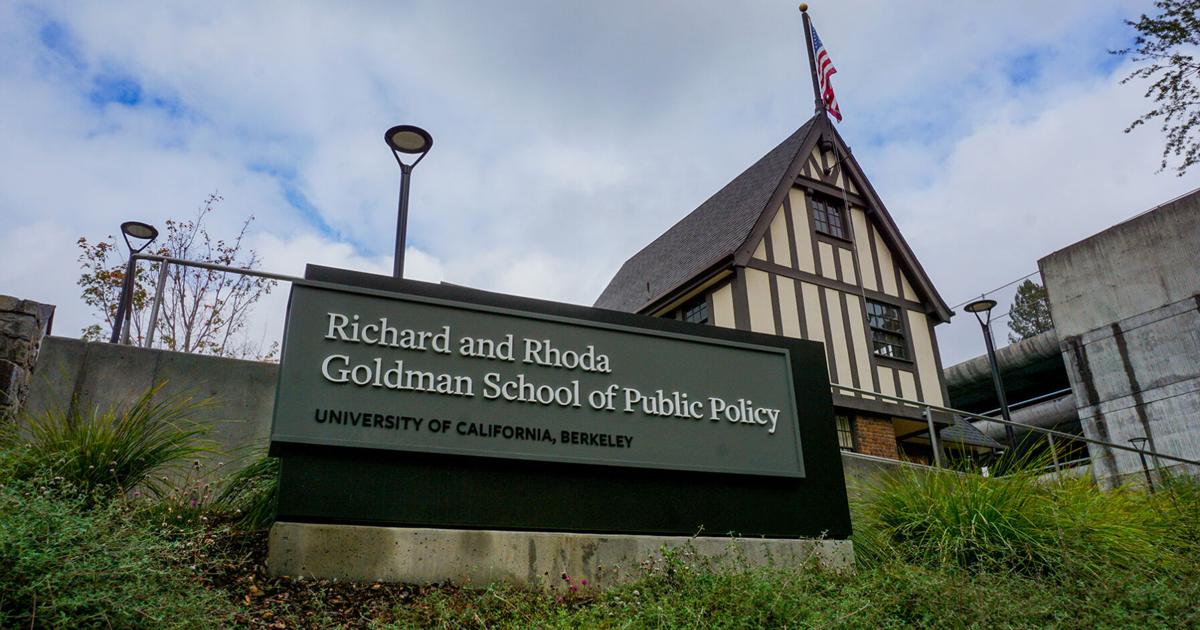
The Berkeley Risk and Security Lab, or BRSL, launched a research project aiming to map U.S. and Chinese artificial intelligence development and the countries’ growing AI race.
Through the program, student and professional researchers at the Goldman School of Public Policy will examine the trajectory of each country’s AI development, their efforts to “undermine” each other and potential security risks, according to its website.
“I think one of the main focuses for us on this project is to reduce the ability of the US to find itself in a strategic surprise,” said Leah Walker, executive director for BRSL.
Researchers involved in the project will review literature relating to the growing competition between the U.S. and China over AI development and conduct interviews, examining the decisions of both sides’ policymakers, stated Walker.The lab will also develop an exercise where participants can walk through a hypothetical AI crisis, exploring different resolutions through discussion and analysis.
Policy research such as this can reduce uncertainty in the geopolitically-charged space of AI development, providing likely answers to problems that may arise, Walker noted.
During a two-hour summit in South Korea on Thursday, U.S. and Chinese presidents Donald Trump and Xi Jinping worked to come to a deal over a number of trade issues, including Chinese restrictions on the export of rare earth metals.
“I think a really good example is we saw lots of surprise over the past three weeks over these Chinese rare earth elements export controls,” Walker said. “I wasn’t thrilled to see that surprise because there are a number of us in the policy side that have been trying to communicate to the industry and to the government that these export controls were likely going to come one day.”
The project is supported by a $604,395 grant from the Future Life Institute, or FLI, according to Hamza Chaudhry, AI and national security lead. FLI is a philanthropic and research nonprofit dedicated to guiding technology towards “benefitting life and away from extreme large-scale risks,” according to its website.
“(BRSL) is one of the best centers in the country looking at questions of national security, geopolitical competition and tech policy,” Chaudhry said. “So they seem like a very obvious choice for us.”
The grant will cover the lab’s various expenses, including organizing four workshop discussions with research and policy experts, as well as travel costs to facilitate discussions with officials in Washington, D.C., Walker said BRSL was in conversation with government officials, but did not provide specifics about who.
Both Chaudhry and Walker emphasized the importance of this work in order to avoid the mistakes of previous arms races such as the Cold War,which Walker referenced multiple times.
“So much of the focus on the so-called AI race between the United States and China is about who wins,” Chaudhry said. “And I think one of the things that we’re trying to do is help fund important work that shows that racing itself might lead to both sides losing.”