
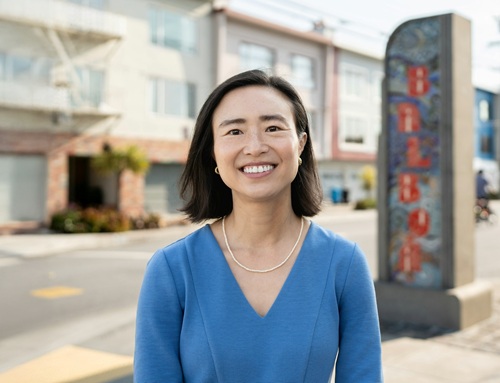
Chan Has Earned Progressive Support
With polls showing Scott Wiener far ahead in San Francisco’s race for Congress, the only question is whether he faces Connie Chan or Saikat Chakrabarti in the November runoff. The choice among these two self-identified progressives should be clear.
Chan has spent years in the trenches working to improve San Francisco; Chakrabarti parachuted into a city where his sole accomplishment is self-funding his campaign. That a candidate with no local track record could be winning support against two candidates with successful records reflects more than his self-funded campaign; it reveals San Francisco’s changing electorate over the past decade.
Chan’s Strong Record
Connie Chan has also earned the right to represent San Francisco in congress. Chan has served in one of the city’s hardest jobs: Chair of the Board’s Budget Committee in years of massive deficits. It’s a job that forces hard decisions that can turn long-term allies against you.
Budget Chair is a great position to be in when the economy is booming. But that has not been the case for recent budgets.
A year ago the mayor’s office sought to cut $4.4 million from code enforcement and other tenant services (the Tenderloin Housing Clinic, which I head, was among the impacted groups). Chan quickly intervened. She set up a process that restored the funds. She’s never sought public credit for this action. I’m sure there are countless other budget savings she has ensured without seeking credit.
Last week, the SF Standard broke a major story challenging Mayor Lurie’s $5.9 million OpenGov contract to expedite permits. Chan chaired a hearing on May 13 where she aggressively questioned city officials on what the city was getting for its money. She fought to protect city funds, and to make sure taxpayers got the most for their money.
There’s a reason Nancy Pelosi continually speaks highly of Chan. Chan has alsobeen labor’s biggest Board ally, winning overwhelming union support.
Declining Focus on Local Politics
Chakrabarti has benefited from the electorate’s declining focus on San Francisco politics. Four factors have caused this.
First, the city’s steadily rising housing prices. Many who once moved to San Francisco to focus on activism have been priced out of the city.
Second, the steep decline in newspaper readership. During the heyday of local political activism in the 1970’s through the merger of the SF Chronicle and Examiner in 2000, three free newspapers covered local news.
Today, local news is hard to find. The SF Chronicle and SF Standard are behind paywalls. The SF Independent, whose coverage likely elected Frank Jordan in 1991, closed in 2005. The SF Examiner does not have the full newsroom coverage of its past. Mission Local is likely the chief news source for local politics for the under forty-crowd, and its expansion to more neighborhoods will help.
Today’s young voters get their local news from Instagram and other social media. Daniel Lurie’s understood this. It helped get him elected and promotes his popularity. Social media enables a wealthy candidate like Chakrabarti with no local track record to reach voters.
Third, and perhaps most importantly, San Franciscans are understandably focused on Donald Trump. Trump’s assault on democracy and the Supreme Court’s support for Jim Crow laws and overturning the rule of law has left many San Franciscans riveted on national issues. It’s hard to convince people that a battle among local Democrats matters when Trump is starting wars, rousting immigrants, and turning the United States into a modern Confederacy.
Finally, the working to middle-class residents of San Francisco who bought homes before the price hikes of the late 1990’s were the backbone of local political activism. That demographic has steadily shrunk. Newer arrivals have much higher incomes and are less directly threatened by evictions, displacement and other city issues that promoted attention to local politics.
Voters without deep roots in San Francisco or in particular neighborhoods aren’t bothered by candidates who parachute into districts where they have done nothing prior to running. That’s how Michael Lai almost got elected supervisor in D11 in 2024. It’s how Saikat Chakrabarti can potentially make the runoff.
Chakrabarti’s Campaign
Progressive opponents of Chakarabarti cite his support for moderate candidates in local supervisor races. And AOC’s refusal to endorse him despite their past working relationship (AOC knows enough not to endorse a replacement for Nancy Pelosi not backed by the Speaker Emeritus).
But more troubling is Chakrabarti’s attempt to represent San Francisco in Congress despite doing nothing in his life to solve the city’s problems. In contrast, his top two rivals have spent years working to improve the city.
Scott Wiener’s has been the most impactful California legislator since the Speakership of Willie Brown. Like Chan, he has unquestionably earned the right to represent San Francisco in Congress.
Wiener will be heavily favored in the fall against either opponent. But who he faces will speak volumes about San Francisco’s future.
A Wiener-Chan runoff is what San Francisco deserves.

Randy Shaw is the Editor of Beyond Chron and the Director of San Francisco’s Tenderloin Housing Clinic, which publishes Beyond Chron. Shaw’s new book is the revised and updated, The Tenderloin: Sex, Crime and Resistance in the Heart of San Francisco. His prior books include Generation Priced Out: Who Gets to Live in the New Urban America. The Activist’s Handbook: Winning Social Change in the 21st Century, and Beyond the Fields: Cesar Chavez, the UFW and the Struggle for Justice in the 21st Century.