
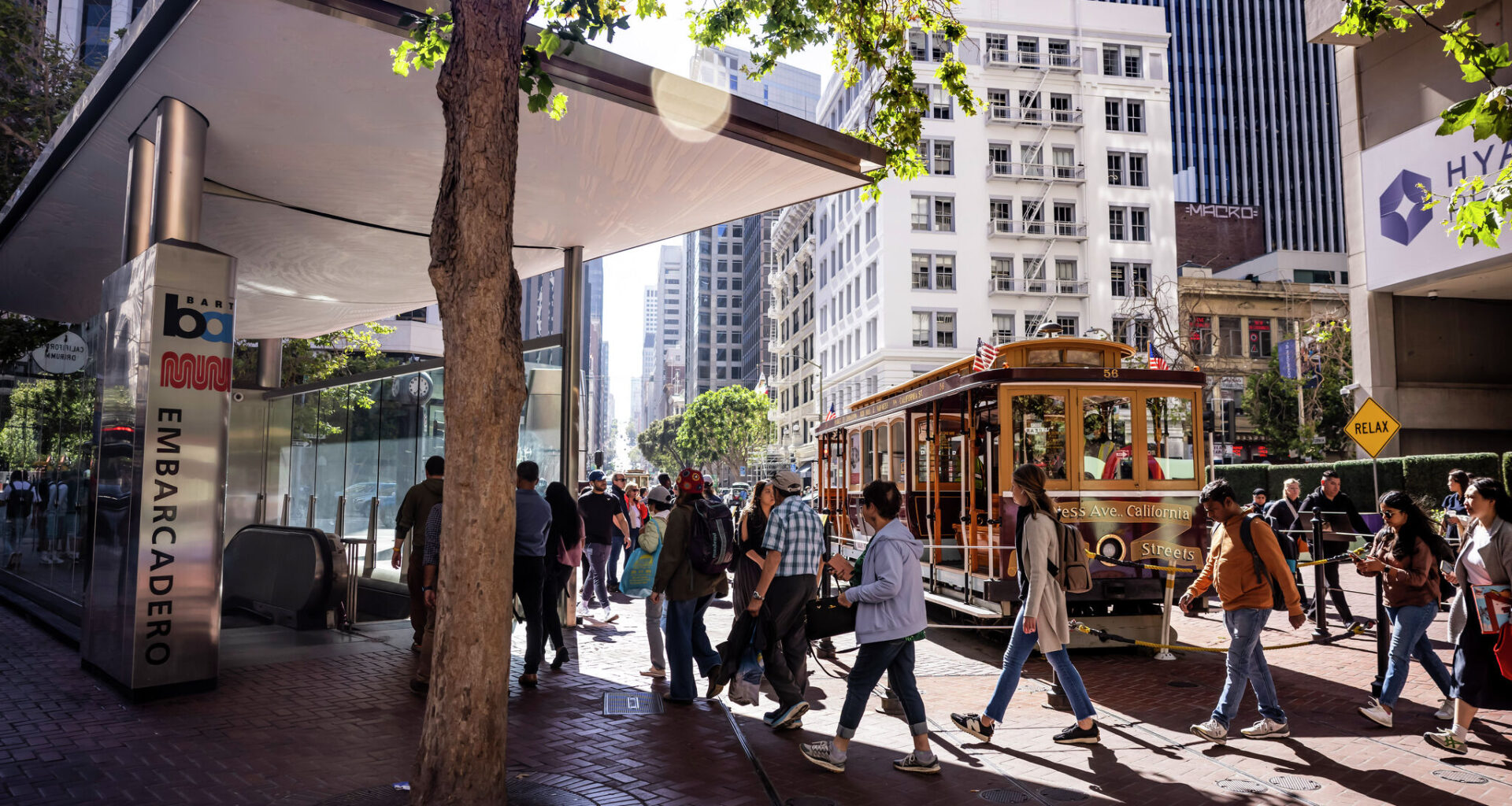
BART patrons enter Embarcadero Station in 2025. BART ridership is increasing, and San Francisco’s economy is improving after the passage of Prop M in 2024, which reformed the city’s business tax system. Prop C risks undoing those gains.
Carlos Avila Gonzalez/S.F. Chronicle
It wouldn’t be a San Francisco election without a set of dueling ballot measures intentionally designed to confuse voters.
In 2022, then-Mayor London Breed tried to streamline affordable housing permitting via the ballot, only to have that measure sabotaged by a competing effort from progressive members of the Board of Supervisors. Two years ago, Propositions D and E battled it out over commission streamlining.
This year, in the June primary, Proposition C is the latest poison pill — conjured up to counteract Proposition D, the “Overpaid CEO” tax that doesn’t actually tax CEOs.
Article continues below this ad
Understanding Prop C requires a bit of a backstory.
In 2024, in response to an economy crippled by the pandemic, San Francisco did the hard work of rewriting the city’s business tax system. That effort, Prop M, passed with nearly 70% of the vote. It was a sweeping, carefully negotiated overhaul designed to strike a balance: provide relief to small businesses, maintain competitiveness and still generate the revenue needed to bring the city back from its doom loop.
San Francisco Chronicle Logo
Make us a Preferred Source to get more of our news when you search.
Add Preferred Source
That compromise seems to be working. San Francisco’s economy has reached an “inflection point,” according to a recent report from the Office of the City Controller. Empty offices are finally filling, and BART ridership and foot traffic are improving significantly.
Yet in November 2025, labor groups announced their intention to throw aside Prop M’s compromise. That effort became Prop D on the June ballot, which would spike taxes on grocery stores and other high-revenue employers in the city.
Article continues below this ad
Prop C is an explicit counterproposal that asks voters to incrementally alter the 2024 deal with small expansions of policies that are already in place. Its proponents largely come from the city’s business community and include the San Francisco Chamber of Commerce and the advocacy group Advance SF. The measure would increase the gross receipts tax exemption threshold for small businesses from $5 million to $7.5 million in annual revenue. It would also accelerate a previously negotiated increase in San Francisco’s “Overpaid CEO tax” (a gross receipts tax on companies with executives making 100 times or more the median employee pay) that was scheduled for 2028, to take effect in 2027 instead.
Supporters frame the measure as a way to retain companies and stabilize the local economy, which sounds reasonable. But it risks deepening the very problems it claims to solve.
Despite its improving economy, San Francisco is still facing a stubborn budget deficit, rising inequality and ongoing crises in housing, homelessness and public health. Yet Prop C would reduce the city’s tax base.
The city controller estimates that Prop C would cut tax revenues by between $30 million and $40 million annually. A separate report from the city economist notes it would provide some marginal private sector gains — by adding 90 jobs and a gross domestic product increase of $20 million on average over 20 years. But the reduction in revenue would, in aggregate, have contractionary effects on spending and employment.
Article continues below this ad
Prop M was meant to provide predictability: a modernized, more stable framework after years of piecemeal tax policy. That effort is working.
Revisiting the rules so soon undermines that goal. If San Francisco wants to project stability and seriousness to the businesses it needs to fill its still-depleted downtown, it should let its new system work before rewriting it again.
Moreover, large revenue cuts during a budget crisis don’t make much sense.
The editorial positions of The Chronicle, including election recommendations, represent the consensus of the editorial board, consisting of the publisher, the editorial page editor and staff members of the opinion pages. Its judgments are made independent of the news operation, which covers the news without consideration of our editorial positions.
If both Prop C and Prop D pass, only the one with the most votes takes effect.
Article continues below this ad
We believe the city is better off if neither goes forward.
Reach the Chronicle editorial board with a letter to the editor: www.sfchronicle.com/submit-your-opinion.