
Just two months ago, when head coach Tim Miles stood at the post game media table in Las Vegas after the Spartan’s Mountain West tournament loss to New Mexico, his message wasn’t just about the game or the hard-luck season.
It was about the sport itself.
After watching his undermanned Spartans battle for a half before the Lobo’s roster depth, size and resources ultimately asserted themselves, Miles distilled San Jose State’s challenge with unusual bluntness.
“With NIL and the portal, it’s like unrestricted free agency every year,” Miles said, before delivering the harder truth: San Jose State was operating near the bottom of the Mountain West financially.
“It’s hard to compete unless we can get up into the top third of the league,” said Miles at the Thomas & Mack Center back in March.
That wasn’t frustration. That was framing.
In hindsight, it was also foreshadowing.
Because while outsiders were watching a gritty season end, Miles had clearly been working behind the scenes on the bigger game of donor cultivation, institutional pressure and making the case that modern college basketball requires far more than coaching acumen and culture. It requires infrastructure. It requires retention capital. It requires visible ambition.
So when SJSU announced its transformational $4 million philanthropic commitment weeks later, it felt less like surprise and more like strategic validation.
Miles had already told you what “modern reality” was.
Now the university is finally trying to respond to it.
Internally, the clearest expectation is player retention.
In today’s ecosystem, finding overlooked talent is only half the battle; keeping that talent is the real test, of course.
SJSU’s biggest basketball problem has not simply been roster construction, but roster vulnerability.
Strong seasons can quickly become recruiting brochures for wealthier programs. This is why the new financial commitment matters beyond symbolism. It creates at least a fighting chance to stabilize rosters, improve NIL positioning and reduce the annual fear of becoming a developmental stop for someone else’s contender.
We all know this. But externally, this gift may be judged even more visibly.
Facilities are no longer cosmetic. They are recruiting arguments.
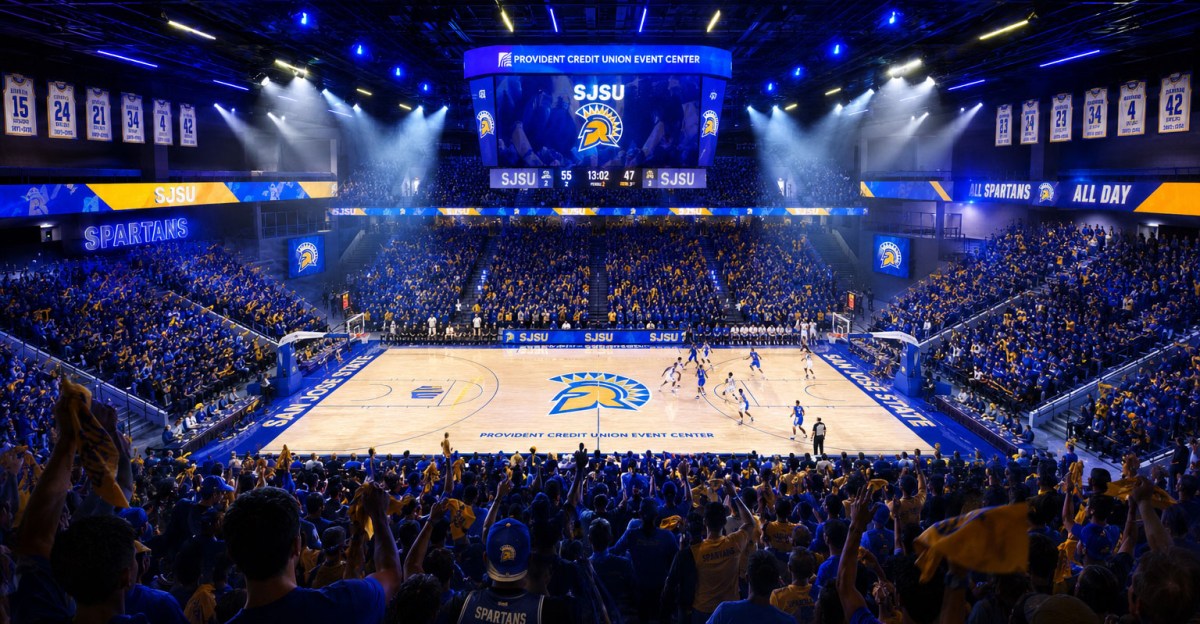
In the vibrant AI-generated image created for this article, the prompt was to create an image that is not just considering high-cost architecture. It needs to mainly consider the cost-effectivness of creating a true vibe.

AI-generated San Jose State basketball facilities based on the MWCConnection article, “Knowing the cost of keeping up – a $4M commitment is the first real answer for SJSU basketball” AI image generated for mwcconnection.com
One of compression, darkness, lighting, student concentration and thus, identity.
For years, Provident Credit Union Event Center has too often felt like a functional venue in a conference where atmosphere can become identity. The Pit at New Mexico overwhelms. Viejas Arena in San Diego weaponizes pressure. And Grand Canyon built spectacle into a strategic advantage.
San Jose State does not need to replicate all that overnight, but it does need to evolve from merely serviceable to distinctly aspirational.
That means tangible upgrades from court design, lighting, sound, premium spaces, student-section intentionality and game-night production. It must all become part of this next chapter. Recruits need to feel progression. Fans need to see proof. Silicon Valley, perhaps more than any market, responds when vision becomes visible.
And that is where this gift becomes both opportunity and obligation.
Because $4 million is meaningful, but it is not self-sustaining.
The next real financial step is ecosystem building: Silicon Valley corporate sponsorships, recurring donor pipelines, alumni collectives, premium seating reinvestment and broader basketball-specific fundraising that turns one landmark donation into an ongoing architecture.
In all, Miles’ post-game New Mexico comments were also about the price of relevance.
Now San Jose State has made its first major and most signifcant investment.
The next questions come when this true competitive infrastructure starts to take hold and the Spartans are finally in the conversation for the long-haul.