
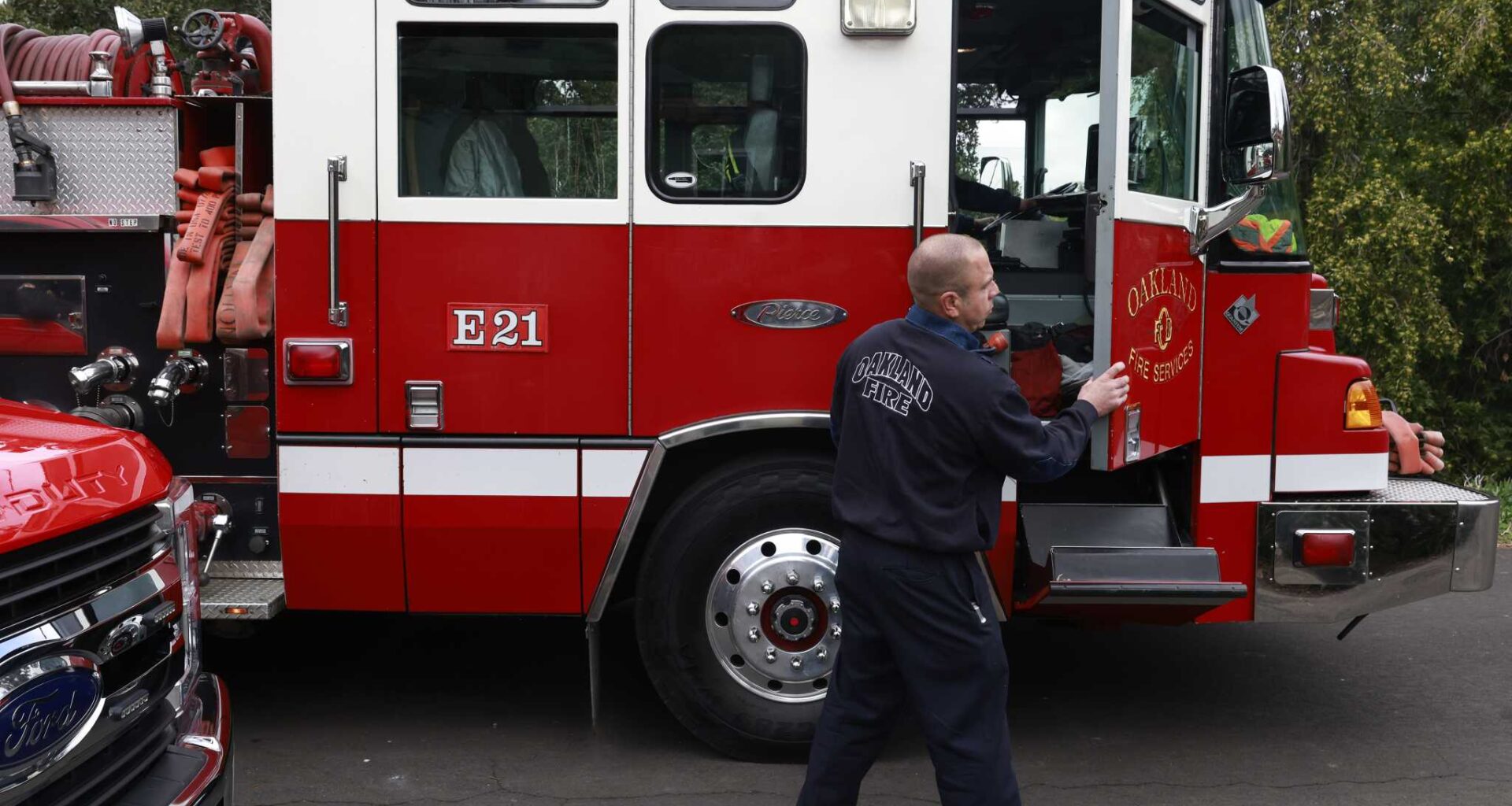
Oakland Fire Lieutenant Matt Amormino jumps into the engine to respond to a call in January 2025. A parcel tax before city voters in June would help fund equipment and stations for the fire department.
Jessica Christian/The Chronicle
Oakland Mayor Barbara Lee delivers her State of the City address at City Hall in October.
Yalonda M. James/S.F. Chronicle
Oakland Mayor Barbara Lee’s first budget proposal delivers a blunt message to voters weighing yet another city tax: Without new money, Oakland can avoid layoffs of city staff, but not deeper deterioration in basic services.
Lee has released a $2.27 billion midcycle budget that does not assume passage of Measure E, a June parcel tax expected to raise about $34 million a year. But her proposal also made clear what the city cannot afford without additional revenue: keeping aging fire equipment from threatening firehouse operations, preserving shelter beds for the homeless, expanding illegal dumping crews and restoring police staffing.
If approved, the parcel tax would cost $191 for single-family homes, and $131 per multifamily unit.
Article continues below this ad
“It’s crystal clear to me that we as a city lack the resources to provide the basic services that residents need and deserve,” Lee said at a press conference on Thursday. “Measure E is an opportunity to stem further deterioration of essential city services.”
Oakland continues to wrestle with a persistent budget crisis. In June 2025, City Council approved a two-year budget with a $40 million revenue shortfall, relying on a future parcel tax to help close the gap, alongside ramped-up business tax collection and parking enforcement.
San Francisco Chronicle Logo
Make us a Preferred Source to get more of our news when you search.
Add Preferred Source
Without the parcel tax, Lee’s budget still anticipates enough funds to restore senior center hours from three to four days a week, maintain staffing at libraries and recreation centers and keep existing levels of police staffing. It doesn’t anticipate any layoffs — but it would require the city to keep a number of positions frozen. The city would also likely have to shut down 190 shelter beds, and potentially close fire stations.
If voters approve the tax, the city would have enough funds to maintain existing service levels, as well as increase the number of budgeted police officers to 700 from 678, and add 11 new staff to address illegal dumping and encampments. The city could also restore some of the shelter beds the city closed in the last year due to funding constraints.
Article continues below this ad
As Lee urged voters to pass the parcel tax, she touted recent progress on bringing down violent crime, including a 58-year low in homicides.
“This budget protects that momentum,” Lee said.
City Council is scheduled to begin budget deliberations June 1 and must adopt a balanced budget by June 30.
Even if the parcel tax passes, it still doesn’t solve Oakland’s long-term structural deficit, driven by rising retiree pension liabilities and insurance costs. To cover expenses, the city has drawn down reserves and relied on one-time funding sources, including federal COVID-19 relief funds. In 2024, officials expected to close a $60 million budget gap through the sale of the Oakland Coliseum, but when the sale didn’t close, the council authorized tapping restricted funds to help balance the budget. The Coliseum deal still has yet to close.
Those chronic financial pressures have contributed to triggered credit downgrades that drove up the city’s borrowing costs and delayed bond issuances intended to fund street improvements and affordable housing.
Article continues below this ad
Measure E is the fourth new tax to come before Oakland voters in three years. So far, they haven’t turned any down. In April 2025, voters approved Measure A, which raised the city’s sales tax from 10.25% to 10.75% and is expected to generate about $30 million a year for the general fund over the next decade. In November 2024, voters approved a special assessment on properties in the Oakland Hills to fund wildfire prevention, as well as Measure NN, which increased parcel taxes to help pay for public safety services.
Oakland, like many California cities, relies heavily on special taxes to fund services because of Proposition 13, the 1978 law that capped property taxes as 1% of a property’s assessed value at the time of purchase, with a cap on yearly increases of 2%. Many cities rely on parcel taxes and additional sales taxes to maintain existing services.
As of the 2023 fiscal year, Oakland was collecting some $2,086 in taxes per resident — the highest per-capita revenue collection among cities of its size, according to a report by SPUR, a Bay Area public policy group.
Some property owners could still see modest savings because a longtime property tax that has helped pay for police and firefighter pensions is winding down. The end of that tax means that, even if Measure E passes, around 60% of single-family homeowners end up paying less in property taxes in 2027 than they did the year before according to Oakland finance department projections.
Article continues below this ad
Though proposed by Oakland officials as part of the budget process, the council got Measure E onto the ballot as a citizens initiative. Critics of the measure say it was a loophole that lowers the threshold required to pass to a simple majority, rather than the two-thirds needed for parcel taxes if council had moved to add it to the ballot directly.
The citizens initiative was largely funded by a political action committee backed by Oakland’s public employee unions, which has spent over $500,000 on the measure. Leading the opposition is The California Association of Realtors, as well as real estate firms such as Carmel Partners (which developed the downtown Atlas residential tower), the Martin Group of Companies, and David Friedkin of Friedkin Property Group.