
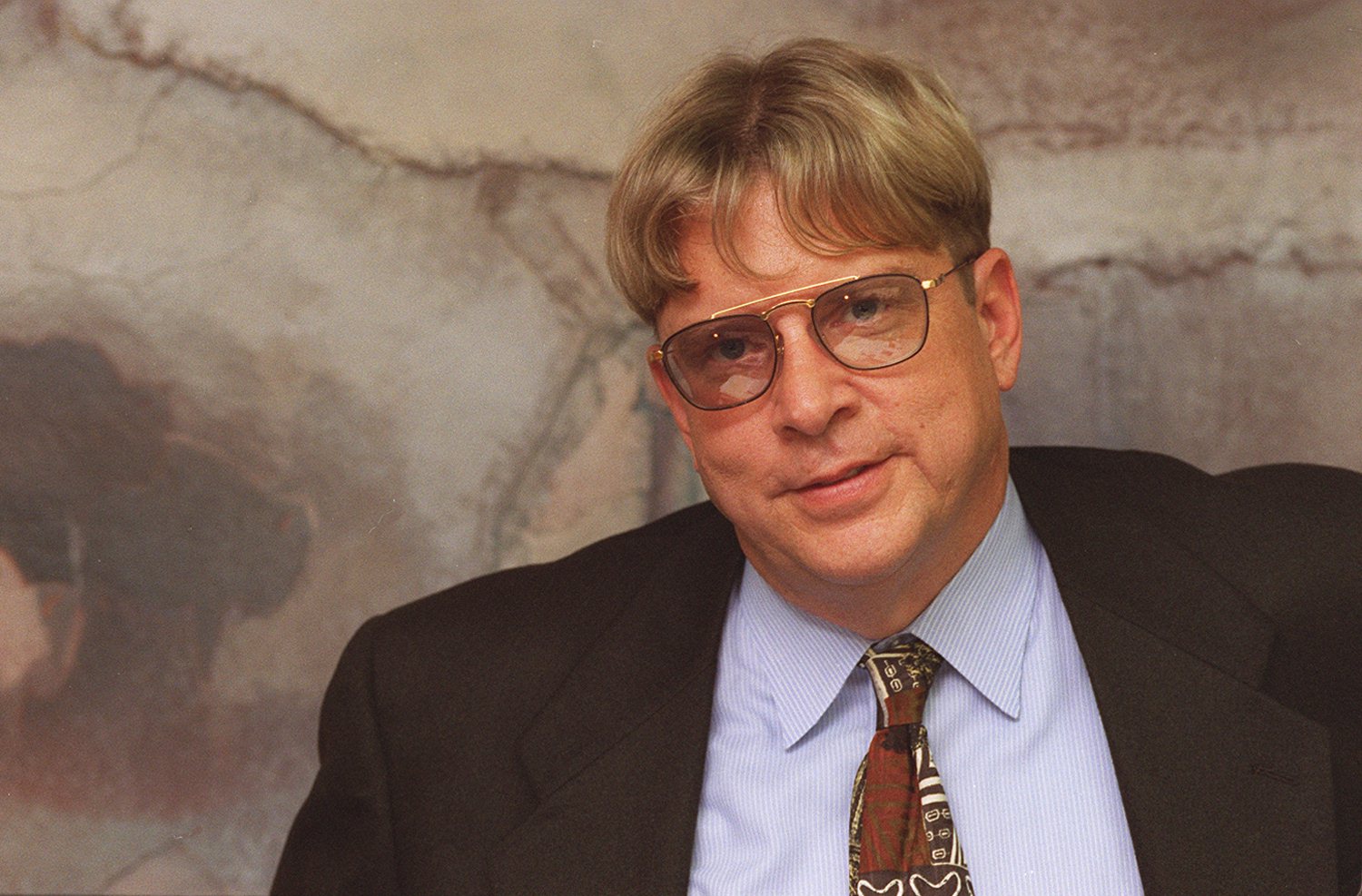
Jack Davis, a “king-maker” in San Francisco politics who died Friday, is seen here in the 1990s.
MICHAEL MACOR
Then-Mayor Willie Brown walks and talks with Jack Davis, his campaign manger, in Chinatown.
LIZ HAFALIA/STAFF
Political consultant Jack Davis, who died Friday, is photographed in 1996.
MICHAEL MACOR
Jack Davis, the longtime San Francisco power broker and consultant whose strategic instincts and antics helped shape the city’s politics for decades, died Friday, according to multiple reports.
Davis died in hospice at his Mission District home of cancer, according to reports. He was 79.
Known for his political acumen and deep relationships, Davis sometimes used bare-knuckle, old-school tactics to get the results he wanted, from mayoral races to ballot measure campaigns in a career that began in the late 1970s.
Article continues below this ad
As a consultant — one not unwilling to switch sides or put himself center stage — he was instrumental in shaping San Francisco’s political trajectory through the 1990s, influencing downtown development, policing and labor relations, as well as helping to draw lines between moderate and progressive Democrats that still haunt the city’s politics today.
Davis was responsible for three successful mayoral campaigns: Frank Jordan’s upset victory in 1991, Willie Brown’s history-making win over Jordan in 1995 and Gavin Newsom’s ascent to the political stage in 2003, long before he became governor.
But Davis wasn’t a typical consultant. He was well-known for his LGBTQ+ activism and outlandish behavior, as an eccentric character with counterculture habits who sometimes shocked people around him. His boozy 50th birthday party, which featured a live sex act, caused a stir nationally and may have cost Davis political points as he sought to help build a new stadium for the San Francisco 49ers.
“The irony of Jack’s career is that he was at heart a champion of the underdog, and he worked for the wealthy and the establishment,” said political consultant Jim Ross, who got his first job in politics working for Davis on Jordan’s 1991 mayoral campaign.
San Francisco Chronicle Logo
Make us a Preferred Source to get more of our news when you search.
Add Preferred Source
Ross highlighted the contrast between Davis’ ruthlessness in politics and joie de vivre in his personal life, recalling his lavish parties and the time he brought a drag queen as a guest to a San Francisco Giants game back when that elicited pearl-clutching.
“It was his way of saying, I might work for you, but I am not like you,” Ross said Tuesday.
Born in the coal-mining town of Tamaqua, Penn., Davis grew up in a family that ran a funeral parlor and lived above the chapel.
Article continues below this ad
While attending American University in Washington, D.C. in the late 1960s, Davis was exposed to the political activism that was sweeping college campuses across the country. He protested against the Vietnam War and joined the Students for a Democratic Society and the Gay Liberation Front. At 24, Davis came out as gay to his father.
“He told me I wasn’t welcome in his home or his town,” Davis told the Chronicle in 2000. “So I did what any self-respecting gay person would do in 1972 — I moved to San Francisco.”
On Davis’ first night in the city, his car and all of his belongings were stolen while he was at The Stud, the now-iconic gay bar on Folsom Street. He eventually found work at a bookstore, then at Macy’s, before he met San Francisco businessman Clint Reilly, who hired Davis to work at his political strategy firm.
By the 1980s, Davis was out on his own, managing Michael Hennessey’s successful bid for sheriff and Quentin Kopp’s upset victory to snag a state Senate seat over the “dean” of the Assembly, Lou Papan. In 1991, Davis learned he was HIV-positive. He had, by that point, lost about 80 friends to AIDS.
After Davis’ own diagnosis, one of his political rivals told the Chronicle, “it was like he had nothing left to lose. Consequently, he would use all means to achieve his ends.”
Article continues below this ad
The same year, Davis helped Jordan to run against then-Mayor Art Agnos in what he described as a “retribution” campaign. Then, he turned around and led Brown’s win over Jordan in 1995. He helped to re-elect Brown in 1999 and went on to work for Newsom until their relationship soured.
In 2000, he told the Chronicle that he wanted his tombstone to have the same words he had chosen for the name of his 45-foot boat: “Election Knight.”
“Nothing more profound than that,” Davis said.