
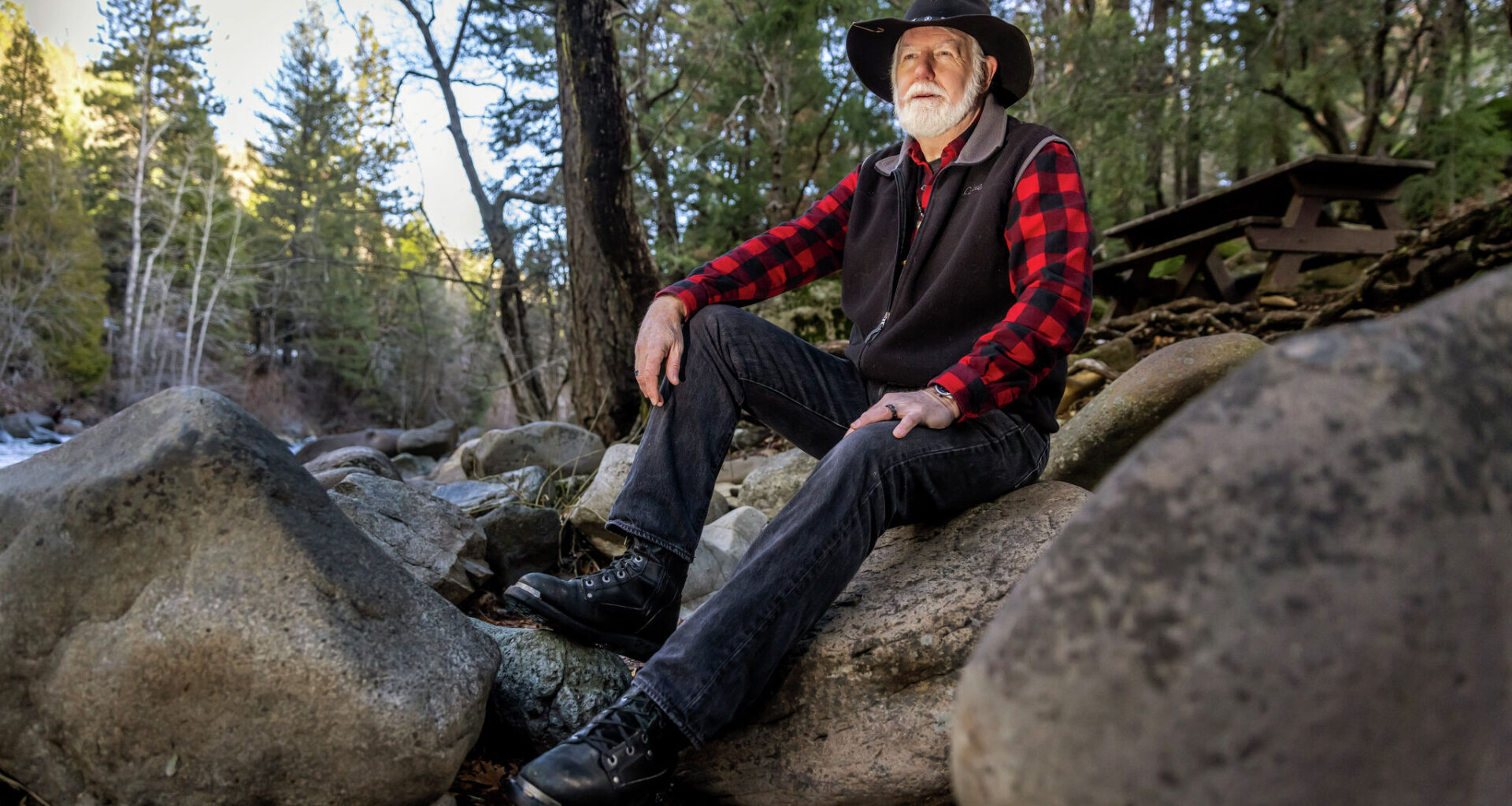
Tom Stienstra, San Francisco Chronicle outdoors writer emeritus, at the Dunsmuir Botanical Gardens in Siskiyou County in 2023. Stienstra is fighting cancer that was first discovered in his lungs and then in his brain. After five brain surgeries and immunotherapy infusions, he’s on the mend, and doctors are optimistic with his progress.
Carlos Avila Gonzalez/S.F. Chronicle
Tom Stienstra wrote about his numerous brushes with death, including six brain surgeries to treat Stage 4 cancer and a brutal assault in Menlo Park, during his tenure as the Chronicle’s outdoors writer. He has written a book, excerpted here, called “Heaven Delayed: One Man’s Survival of Sixteen Near-Death Encounters,” about those experiences. It will be published by Wellstone Books on Tuesday, May 26.
My first glimpse of the afterlife was after a hatchet attack when I was working in a gas station as a 21-year-old San Jose State student, where a group of people visited me in an arc around a gurney as I was carried unconscious into an ambulance. In that encounter, I recognized none of them. The next glimpses of the afterlife were during brain surgery at Stanford Hospital when my life stopped. I was visited first by Waylon Jennings and Merle Haggard, then later, by my longtime pal Jeffrey Patty. All three had long passed.
I’ve been lucky in life to make great friends, most of them regular folks, and some well-known. In my most recent visit to the afterlife, country music legends Waylon (Jennings) and Merle (Haggard) showed up in my dream. They were seated along a table at an icy flat spot atop 14,000-foot Misery Hill near the foot of the plug-dome summit of Mount Shasta (14,179 feet). Over the years, we found times to connect. Waylon died in 2002, Merle in 2016. In my dream vision, they were happy and light, and good friends, so unlike their personalities as I’d known them.
Article continues below this ad
Tom Stienstra’s new memoir published by Wellstone Books is designed by Alicia Feltman with original art from the San Francisco Chronicle’s John Blanchard.
Wellstone Books
When alive, away from the stage, these fellows were often cantankerous and independent, even when famous and popular. Merle even had a baseball hat that said “Asshole” on the front of it, and he loved the thing, and even gave one to Hank Williams Jr. Merle would often wear that hat when going out for breakfast in Redding, and then would tell people who recognized him that “I’m not Merle Haggard.” He’d grin and tell them his real name was “Larry Lang.”
Heaven Delayed: One Man’s Survival of Sixteen Near-Death Encounters
By Tom Stienstra
(Wellstone Books; 218 pages; $25)
The Heaven Delayed Cancer Survivor Foundation
To learn about how to donate to the Heaven Delayed Cancer Survivor Fund, go to www.heavendelayed.org.
Truth is, Waylon and Merle didn’t much like each other, over a money dispute from a poker game, Waylon once told me. But in heaven, they were friendly and connected; buddies.
San Francisco Chronicle Logo
Make us a Preferred Source to get more of our news when you search.
Add Preferred Source
“Ask me what you’ve always wanted to know,” Waylon said.
Article continues below this ad
“This is your chance,” added Merle. “Ask him why you can’t sing ‘Good Hearted Woman.’”
“Good point,” I said in this dream-vision encounter. “I’ve never been able to sing that song right.”
Waylon and Merle both smiled, big and happy. In the dream, this was hard for me to understand, how they had become friends. In the afterlife, all was forgiven.
“For ‘Good Hearted Woman,’ don’t try to sing my parts,” Waylon said.
Sitting alongside, Merle beamed.
Article continues below this ad
“You can’t sing like me,” continued Waylon, as happy as I’ve ever seen him. “Call up Jimmy Limo and have him do my parts. He can do it fine. Then you do Willie Nelson’s parts. Together, you and Jimmy Limo can do ‘Good Hearted Woman.’”
About two months later, I was released from a recovery center, and with my wife Denese driving, we headed for home. One of the first things I did was track down Jimmy Limo and tell him about the visit from Waylon in the afterlife.
To my surprise, Jimmy was already dialing up the song. “I’ve already worked up ‘Good Hearted Woman,’” Jimmy said. I then booked him to play at a private party I was hosting called “Never Say Die.” From across America, only those who had blessed me with their best wishes were invited. Jimmy Limo is one of the best one-man bands in America, and in the middle of his show, he called me up on stage to jam with him for a few songs. Just like out of the dream, the first was “Good Hearted Woman.” It was just like Waylon told me in his visit with me in the afterlife. Let Jimmy sing Waylon’s parts and I’d sing Willie’s parts. Waylon was right. It worked like a dream.
In another dream when my life stopped during surgery, I also received a visit from my longtime hiking-camping-fishing buddy, Jeffrey Patty. It was Jeff who saved my life from drowning in remote Blue Creek in the Klamath wildlands when we were hired to conduct a monthlong expedition to find Bigfoot. He died of cancer more than 25 years ago.
In that dream-vision, Jeffrey, all smiles, light and happy, told me to go to Apple Jack’s bar. Apple Jack’s is something of a dive bar in a little town called La Honda in the remote redwood forests of the South Peninsula, where Jeff and I would occasionally stop in after an adventure in the area. We loved that place. We could always “hide out” at Apple Jack’s. No one would ever recognize us.
Article continues below this ad
Jeff was often cantankerous and quiet, and sometimes sullen and withdrawn. At six-foot-five, 220 pounds, he was bigger than me, and we’d often create quite a stir, especially with cops, when we walked into a place like we owned it. In the dream, Jeff smiled big — I never remembered him so happy — and then he explained what he wanted me to do.
“Order a Pabst Blue Ribbon on draft, tip big, then sit down and watch for a sign from me,” he said.
In the hospital, as I reviewed the encounter, I realized that I didn’t even know whether or not Apple Jack’s had Pabst on draft. On a weekend before a Monday surgery, Denese drove us out from Stanford to La Honda. She parked at Apple Jack’s, just as I had requested. Inside, I saw that we were the only ones in the place.
True to the dream, I complied with Jeff’s instructions. To my surprise, they did have Pabst on draft. I ordered one and my wife and I took a seat in a darkened corner. For an hour, we were the only ones in the place. We sat inside, waiting and looking. If there was a sign, though, it was too subtle to discern. Regardless, I did take comfort that my old friend, long passed, was still watching out for me.
At some point in life, nearly every person wonders, “What happens next?” or “What happens to you after you die?” A few of us have a piece of the answer. We’ve experienced situations where life stopped, at least for a bit, when we saw glimpses of the afterlife.
Article continues below this ad
It’s happened to me three times. The most recent encounters were during a week of brain surgeries and a moment where excessive blood and fluid required doctors to insert a drain tube to prevent a seizure. During that week, I learned, my life stopped twice. Dr. Steven Chang of Stanford Health Care brought me back to life.
There’s something to these dream visions, I’ve learned. These are not typical dreams, but when you are near death, you might be invited to experience glimpses of the afterlife. This impression, of out-of-place oddballs finding their way, has been shared with me by others who have experienced near-death encounters and then are visited by friends who had long passed. Garrett Lee, who I met at an Ace Hardware, said he has experienced seven near-death encounters and had the same phenomenon, that is, meeting people who were often crusty and miserable when alive, but happy and friendly in the afterlife.
“Living is hard,” Lee said. “The afterlife is a reward. In these experiences, everybody is happy, friendly and relaxed. Having experienced this has made me unafraid of death. I’ve seen enough to know it’s going to be better. I am not afraid to die.”
I’ve had at least 16 near-death experiences. After I emerged in the ICU after a week of brain surgeries (as part of cancer treatment), Dr. Chang visited me. With his comfortable intellect, mastery and demeanor, I knew I was in good hands. But in the end, there was an additional motivation to write this book: to share what I’ve seen in my glimpses of the afterlife.
Those dream-visions helped me hold onto hope that no matter what was ahead, life or death, I would be OK. On my long solo walks in wildlands, I often quietly sing a favorite verse written by Melanie Safka: I am being guided. I have got a guider. I am being driven. I am not the driver. My nightly dreams are much like that. I’ve always experienced long, detailed stories with vivid colors, smells and extended conversations, like short movies. I am often the viewer of the dream more than a participant, and I can often remember my dreams in detail.
From the dreams, what keeps resonating is how happy and friendly all three of my pals were. How they provided soulful advice. I’ve kept replaying how Waylon and Merle, off stage, and Jeffrey, at work, were often unhappy, and at times even surly. When Jeff was alive and we were pals from college, to roommates, to canoe trips to campsites, this character imperfection never bothered me. After all, at times I could often be the same, and he not only would put up with me, but my oddball moments humored him. Some days I even admired their coarse attitudes; it separated them from the general public. After my life stopped and was brought back, those two dreams have shaped my outlook of death.
It also reminded me of one night at South Lake Tahoe with Waylon, when he was railing against a television evangelist who preached religion and then asked you to send him your money.
“If I need his approval to get into heaven,” Waylon said, “I’m going to have to take a pass.”
Like many, I felt just the same. There are thousands of organized religions, and some of them despise each other. Waylon, Merle, Jeff and I were never active churchgoers, yet we were all spiritually strong. Many paths, one truth, that is my mantra.
It was a happy day, at Cal Expo in Sacramento in January 2025, when Dusty Baker, left, was inducted into the California Outdoors Hall of Fame, joining his fishing buddy Tom Stienstra.
Courtesy of Tom Stienstra
I told my friend Dusty Baker how for years I had prayed for others, but never for myself, and that I had been given so much in my life, I felt humbled to ask for more. I wondered, I told him, how I was still alive when others had passed. Dusty, who also had his life saved in a cancer surgery at Stanford, identified with these impressions.
“I too wondered for a long time why my life had been spared,” Dusty said. “You probably are going through the same thing. I’ve got to the point now that I believe we have been saved because there is more for us to do. We’re still alive to do it.”
Another time, he put his faith in perspective. “Keep your goal in your mind, body and soul,” Dusty said. “Keep living and enjoying every moment.”
If you were nearing the end of life, how would you respond? According to one of my best friends, Gary Bostwick, the answer is to throw the idea of a “Bucket List” out the window.
“When you face the end of your life, the most important thing is to look back with no regrets,” Gary said. “If you’re lying there and knew you had one minute to live, would you regret anything you didn’t do? When you’re alive, you want to make sure that you have done everything you really wanted to. The key is to have no regrets. As you look ahead, that attitude can help you decide what to do and what not to do with your time.”
Gary uses this guide to make his daily choices. This outlook can become an important question for many.
Gary Bostwick is well known across the country, famous for beating Johnnie Cochran (known for the O.J. Simpson trial). Earlier, as a young engineer, he helped, with Lee Iacocca, develop the Mustang for Ford as a concept car. He quit Ford and signed up to work in the Peace Corps, where he felt more personal value. Turns out he was inspired by a speech he’d heard. Turns out the speaker was John F. Kennedy. These days, he gets pitched legal cases nearly every day and has found a key to take them on or not.
“You only accept the cases that have a profound effect on you and provide inspiration for the right thing to do,” Bostwick said. “Imagine that you are on your death bed, one minute to live. Is there anything you didn’t do that you regret? That’s how you decide what to do, and what not to do.”
There’s a lesson in there about life.
Another renowned attorney pal, David Hicks, best known as a lawyer, mediator and justice for many major cases, has a similar outlook.
“As each day comes, you should be as happy as possible, because you don’t know if you’re going to wake up tomorrow,” Hicks said.
In a poker game together, Dave stood up and put his arms out. “This is how long you might live,” he said.
Then he opened his right hand and wiggled his thumb and little finger.
“This is what you’ve got left.”
I asked Steven Griffin of Michigan, something of a crazy genius and a wise soul, also my muse and canoe pal, how does he manage to be so happy all the time.
“I only do what is enjoyable,” Griff said. “If I can’t create fun out of it, I don’t do it.”
Tom Stienstra, San Francisco Chronicle outdoors writer emeritus, walks to his home in McCloud in 2023. Stienstra is fighting cancer that was first discovered in his lungs and then in his brain. After five brain surgeries and immunotherapy infusions, he’s on the mend and doctors are optimistic with his progress.
Carlos Avila Gonzalez/S.F. Chronicle
With a glimpse of the afterlife, consider this: Three nonreligious but spiritually powerful, and mostly surly men (out of the public eye), all with unmatched talent, aptitude and cleverness— and all three long past death—ended up in a place in my dreams where they were happy, light-hearted and provided kind wisdom. Their visits during my temporary loss of life convinced me that there must be some magic out there.
If you share this leap of faith, you can then consider that, despite their flaws, yet commitments to spiritual powers, that they all ended up in a good place.
I believe these visits were real. As I look to the future, powered by my spiritual strength, just as for Gerrett Lee, the fear of death is gone.
Like most people, I want to go to heaven. I’m just not real eager to sign up for the trip.