
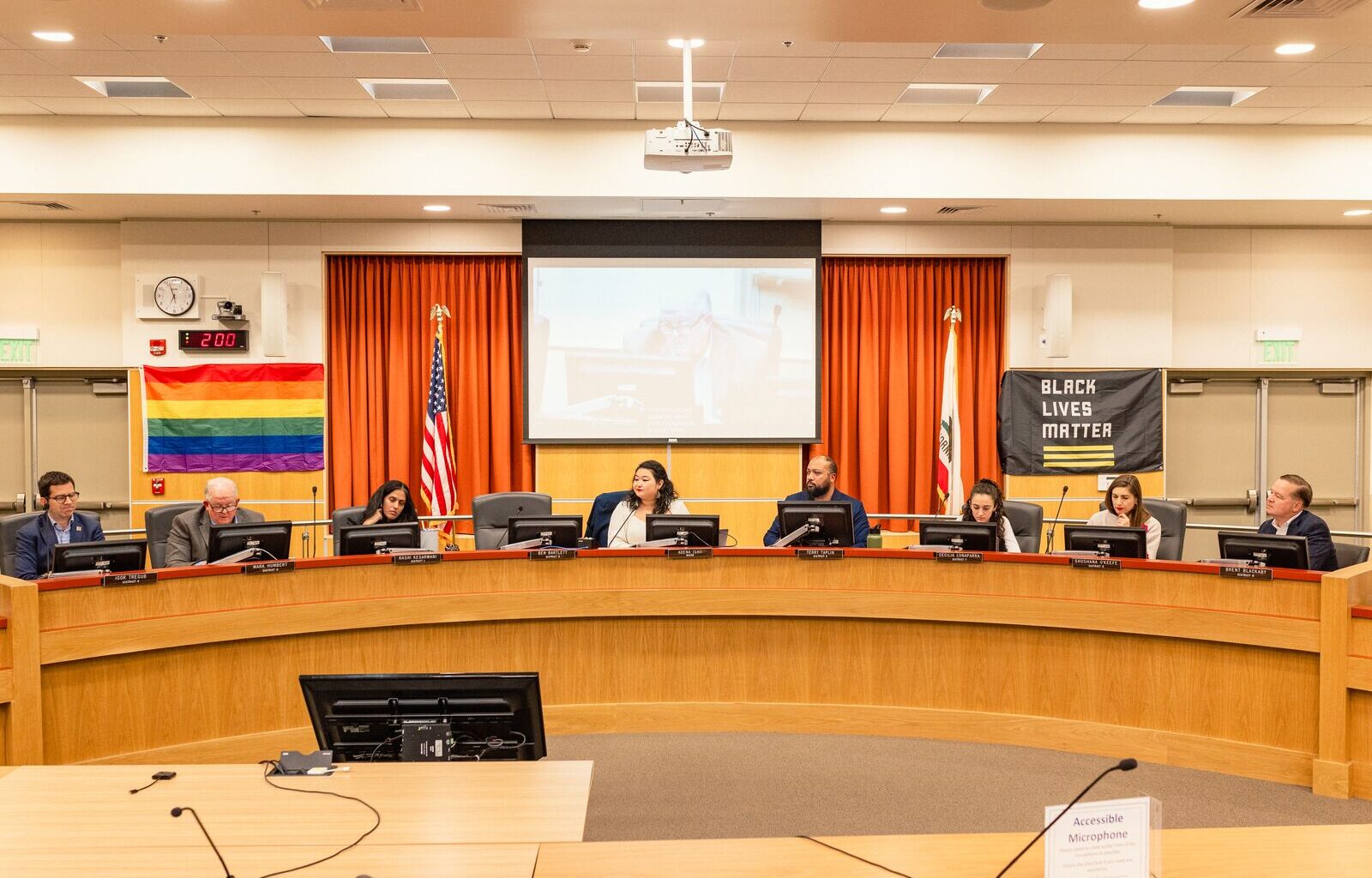
 Members of the Berkeley City Council are seen in a 2025 file photo. Credit: Ximena Natera, Berkeleyside/CatchLight Local
Berkeley leaders’ plan to balance a nearly $30 million budget deficit includes cuts to homeless services and community health programs that advocates said would harm the city’s most vulnerable residents. It would force cutbacks on everything from pothole repairs to small business assistance. City employees would lose their jobs at a time of rising costs and sluggish hiring. And a worst-case-scenario proposal to close a North Berkeley fire station and slash police positions would lead to longer 911 response times.
But members of the City Council indicated at a meeting Tuesday night that they see few alternatives to most of those budget cuts.
“These are not easy decisions for any of us,” Mayor Adena Ishii said at the meeting. But after years of closing budget gaps with one-time maneuvers, Ishii said, the cuts are meant to “address the underlying structural deficit — to make changes that are really tough, but hopefully will create the ability for us to have a sustainable budget moving forward.”
Ishii and other council members signaled their support Tuesday for the budget balancing plan City Manager Paul Buddenhagen unveiled last month, even as they said they hoped to avoid layoffs, service cuts and the potential closure next year of the Berkeley Fire Department station on Marin Avenue. The council must adopt the two-year budget by the end of June.
Along with the steps Buddenhagen proposed, officials are also pursuing a plan to put a 0.5% sales tax increase before voters this November that would raise more than $9 million per year — enough to keep the station open and avert other cuts to fire, police and parks staff.
Even if the sales tax is approved, though, the city would still lay off the equivalent of 20 full-time employees, and cut another 130 vacant positions, under Buddenhagen’s plan.
Potential fire station closure would ‘put lives at risk,’ firefighters say
Fire Chief David Sprague described shuttering Fire Station 4 as a “nuclear option.” He said the station was identified for closure because it handles the second-fewest calls in the city and — unlike the least-busy station, on Shasta Road high in the hills — its territory could be more easily absorbed by other firehouses. While officials did not provide specific estimates for how the closure might affect 911 response times, Deputy City Manager David White told the council the plan to cut the station and jobs in the police and fire departments “materially reduces public safety service levels.”
 Fire Chief David Sprague described shuttering Fire Station 4 as a “nuclear option.” Credit: Kelly Sullivan for Berkeleyside
The union that represents Berkeley firefighters has pushed back on the budget plan, warning in a statement ahead of the council meeting that it “could put lives at risk by increasing emergency response times, reducing the number of available crews during major incidents, and weakening Berkeley’s ability to respond to fires, medical emergencies, wildfires, and disasters.”
City leaders hope those cuts won’t come to pass. Earlier on Tuesday, they directed staff to move forward with ballot language for the sales tax increase, which would bring the total levy in Berkeley to 10.75%.
A city-commissioned survey of 500 likely voters found 52% said they would vote yes on the sales tax, which can pass with support from a simple majority. That was within the survey’s 4.4% margin of error, but pollster David Mermin told the council the tax and a separate infrastructure bond measure city officials are considering this fall are “in a position to pass assuming there is a solid campaign.”
Even if the sales tax fails in November, the council could still amend the budget to prevent the station closure.
“I’m not comfortable voting on a budget that would actually close the fire station,” North Berkeley Councilmember Shoshana O’Keefe said, “but I understand this is a projection — sort of a loose plan for next year — and hopefully we won’t have to figure that out.”
Council looks for ways to lessen pain of budget cuts
The budget plan would also eliminate a wide range of city programs, including a seasonal homeless shelter that provides 25 beds for unhoused people during the winter, city support for an outreach worker focused on homeless residents downtown, a mobile crisis team that helps respond to emergency calls and a program in South Berkeley that aims to eliminate disparities in treatment for heart disease.
“These cuts fall hardest on residents with nowhere else to turn,” said Rent Stabilization Board Member Andy Katz, who spoke during the public comment period of Tuesday’s meeting in support of the health equity program known as Heart to Heart.
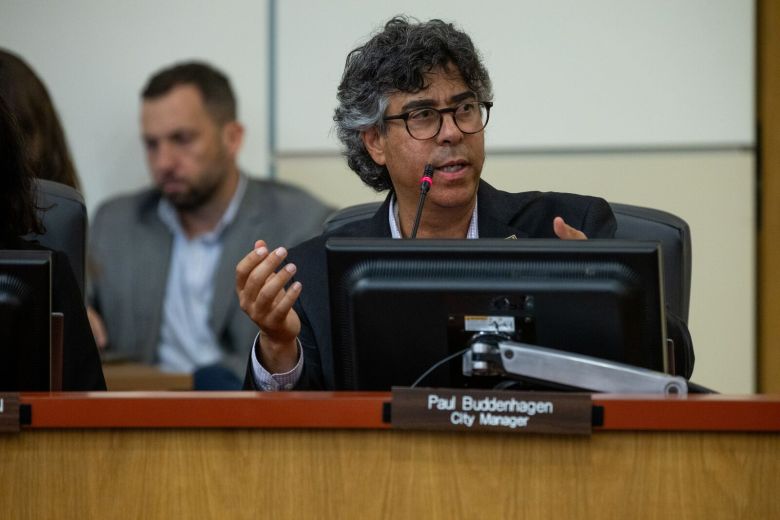 City Manager Paul Buddenhagen rolled out a plan for balancing Berkeley’s $30 million structural budget deficit last month. Credit: Estefany Gonzalez for Berkeleyside
Among the cuts are a staffer in the city’s Office of Economic Development assigned to work with small businesses and merchant districts, as well as the currently vacant position leading the Office of Diversity, Equity and Inclusion, which would be shut down.
Speakers from two unions that represent city workers told the council their members are fearful about the job cuts. One employee who spoke Tuesday night said she left another job to take a position with the Rent Board, only to be notified weeks into her new role that she could be laid off. Meanwhile workers who keep their jobs, many of whom have been stretched thin in recent years as city departments struggle with staffing shortages, would have to shoulder larger workloads.
“We’re not going to get any less 911 calls, we’re not going to get any less 311 calls,” said Rebecca Webb, the president of the clerical chapter of Service Employees International Union Local 1021. “All of this work needs to get done.”
Several council members said they will look to minimize the number of job cuts Berkeley enacts to balance its budget, though they offered few specific proposals to fund those positions.
The council is slated to consider increasing a wide range of city fees this year — everything from a parking ticket to permits for street festivals could become more expensive — but it’s unclear whether those steps would raise enough revenue to avert other cuts. Members approved several fee increases at Tuesday’s meeting, though they postponed to next month a vote on a package of changes to parking policies that includes raising citation amounts and extending meter enforcement to evening hours and Sundays.
Councilmember Rashi Kesarwani asked Buddenhagen to explore whether the city could limit the number of layoffs by eliminating more vacant positions instead.
“I want to make sure that that’s the right call,” Kesarwani said of cutting current employees’ jobs. “I don’t want to do that if we can find vacant positions and save those folks.”
Related stories
Layoffs, service cuts, sales tax hike: How Berkeley plans to close a nearly $30M budget deficit
April 15, 2026April 15, 2026, 10:29 a.m.
Berkeley approves budget that cuts $1.4M from affordable housing program
June 25, 2025June 25, 2025, 8:09 p.m.
Berkeley could extend parking meter hours, hike cost of tickets and permits
May 18, 2026May 18, 2026, 3:56 p.m.
“*” indicates required fields