
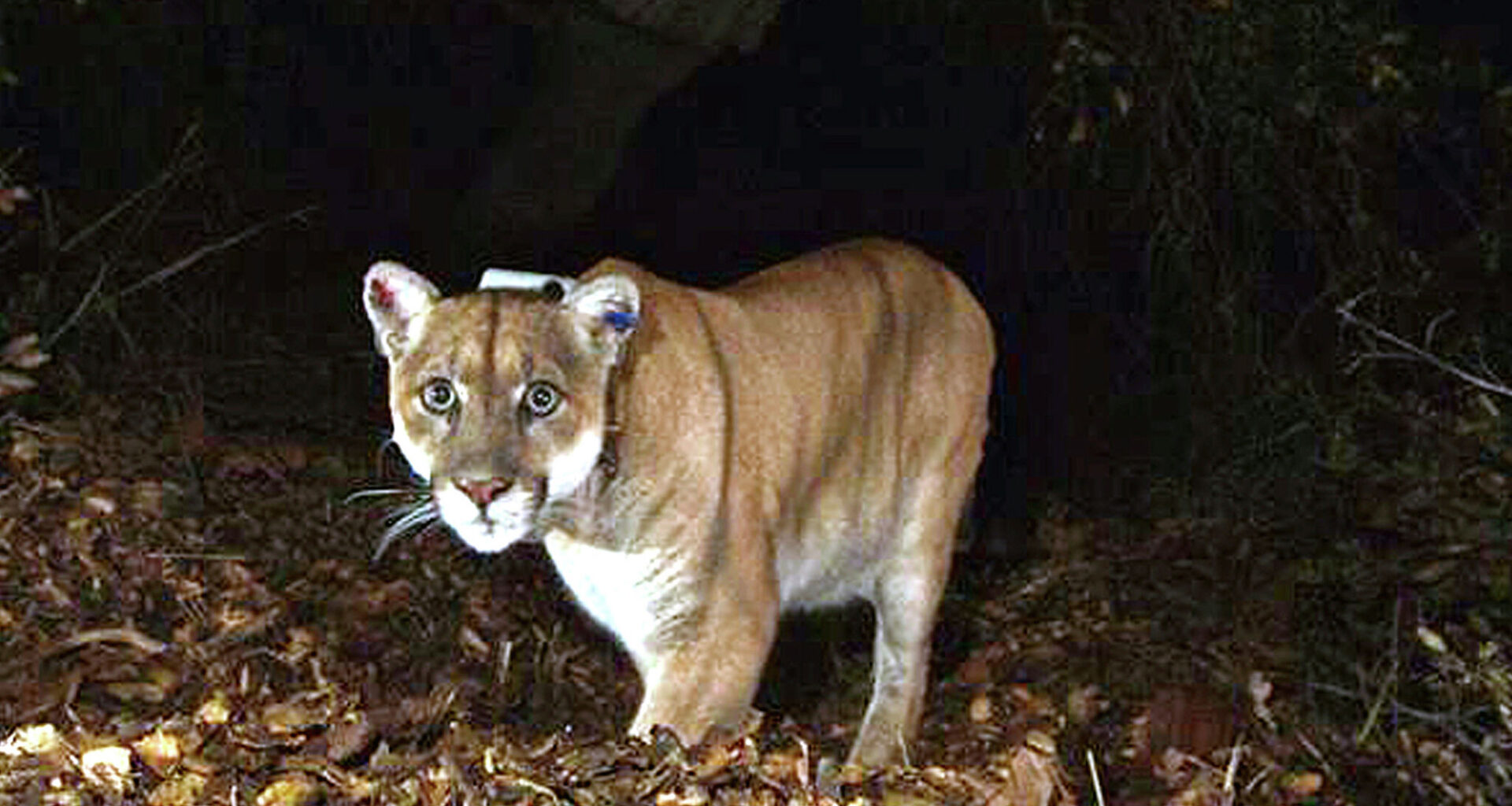
Mountain lions, like this one photographed in Griffith Park in Los Angeles, have been spotted more frequently outside of Susanville (Lassen County), where the sheriff recently issued a public safety warning.
AP
Last week, a California sheriff seized the attention of residents in the state’s far north — and beyond — when he warned of an “imminent” safety threat posed by a group of seemingly aggressive mountain lions.
The sheriff, in Lassen County, now says the threat from the big cats has faded, but according to state wildlife officials who responded to the widely publicized situation, there was never a threat in the first place.
“It’s just mountain lions in mountain lion habitat,” said Peter Tira, a spokesman for the California Department of Fish and Wildlife. “There haven’t been any depredations, no pets taken, no livestock taken. Our folks have determined that no safety threat existed.”
Article continues below this ad
While the sheriff’s warning was welcomed by many in the region, if only as a reminder to stay alert in cougar country, it also prompted a backlash from some who saw it as a calculated bid to spotlight a problem with mountain lions and push for greater predator control. The divided response highlights a long-running tension in rural California, namely over whether the state is doing enough to manage big carnivores. The friction has sharpened with the return of wolves to the state.
Lassen County Sheriff John McGarva issued the warning about mountain lions on Friday, citing an uptick in human-lion interactions over the past year. The run-ins were reported in a sparsely developed, mountainous area south of Susanville, called Gold Run.
San Francisco Chronicle Logo
Make us a Preferred Source to get more of our news when you search.
Add Preferred Source
In one incident, a resident in the Gold Run area encountered a mountain lion under his deck. Another time, a Gold Run resident said a lion stepped out from under a tree and took a step toward him, “making him feel threatened.” In another case, a group of mountain lions appeared to be circling a house.
McGarva told the Chronicle this week that he felt the danger rose to a level of needing to inform the public because of the frequency of the reports and how aggressively the cougars were acting. He said the animals often didn’t appear to be deterred by humans.
Article continues below this ad
“I grew up in California,” he said. “I’ve been around mountain lions my whole life. I don’t take these decisions lightly.”
He also said that his decision to issue a warning about the cougars had nothing to do with the broader matter of wolves and predator management.
McGarva last year similarly cited wolves as a public safety threat and requested state intervention to deal with the wild canine.
On Tuesday, the sheriff said that the U.S. Fish and Wildlife Service, which has helped with predator control in the region, had visited the Gold Run area and assured him that the mountain lion presence had waned and there was no immediate danger.
“For those who were really concerned and contacted me, I’m hoping they can breathe a sigh of relief now,” McGarva said.
Article continues below this ad
State officials, meanwhile, had dispatched a wildlife officer to the area on the Monday prior to the sheriff’s warning and, while finding evidence of the big cats, reported nothing out of the ordinary. It’s unclear why the sheriff sent out the safety alert after the officer’s visit.
What may have been perceived as a problem, state officials said, was likely a naturally behaving female cougar and her yearling offspring searching for food. One property in the Gold Run area, officials said, was home to several feral cats, which the lions may have been looking to prey upon. Also, the region’s deer population is up, which is another draw for the lions, officials said.
“A mountain lion sighting in mountain lion habitat is not a cause for intervention or response,” said Tira, with the California Department of Fish and Wildlife.
“We don’t want to minimize the concerns,” Tira added, noting that state officials have been helping the sheriff and residents make sure properties are adequately secured to ward off mountain lions.
The most recent confirmed report of a cougar attack on a pet or livestock in the Gold Run area was last summer, according to state records, when seven feral cats were killed. Two attacks on domestic animals were confirmed the prior year.
Article continues below this ad
Generally, Californians are not allowed to kill or harass mountain lions because of their status as a “specially protected species” under Proposition 117, a voter-approved 1990 ballot measure. There are exemptions for public safety.
Randy Robbins, a wildlife photographer who resides in Gold Run, was among those who feared the sheriff’s warning about mountain lions was really an effort to drum up support for shooting the animals or, at the very least, turn public sentiment against them.
“I kind of feel like most of us who live here in this little neighborhood can see through this, for the political football that it is,” he said. “There’s always been mountain lions around here. They’ve never been an imminent threat. This is an opportunity now (for the sheriff) to say California isn’t managing things well, look at all the trouble they’re causing.”
Mountain lion attacks on humans are rare. Since 1890, 29 people have been attacked in California, according to the state, six of whom died.
Robbins, like others, believes the recent issue with mountain lions blew up because of concerns about wolves, which have drawn the ire of ranching communities, including Lassen County, ever since the once wiped-out canine returned to California from other states last decade.
Article continues below this ad
While wolves have never killed a person in California, several of the 10 or so packs that now live across the state have preyed on cattle.
Killing a wolf, because of its listing under the federal Endangered Species Act, is also generally prohibited.
Richard Egan, Lassen County’s recently retired chief administrative officer and a longtime rancher, said the North State’s history with wolves and other predators understandably could have shaped McGarva’s response to the mountain lions in Gold Run.
“He’s got wolves, he’s got bears, he’s got lions, he’s got short funding, he’s got short staffing,” Egan said. “The reality is there’s a limited availability of native prey … and these predators are coming (closer) to urban areas.”
Egan also said that as sheriff, McGarva has a basic responsibility to make sure county residents are alerted to potential threats: “If you’re the sheriff, the last thing you want is to have the information, not disseminate it and then have someone get killed.”