
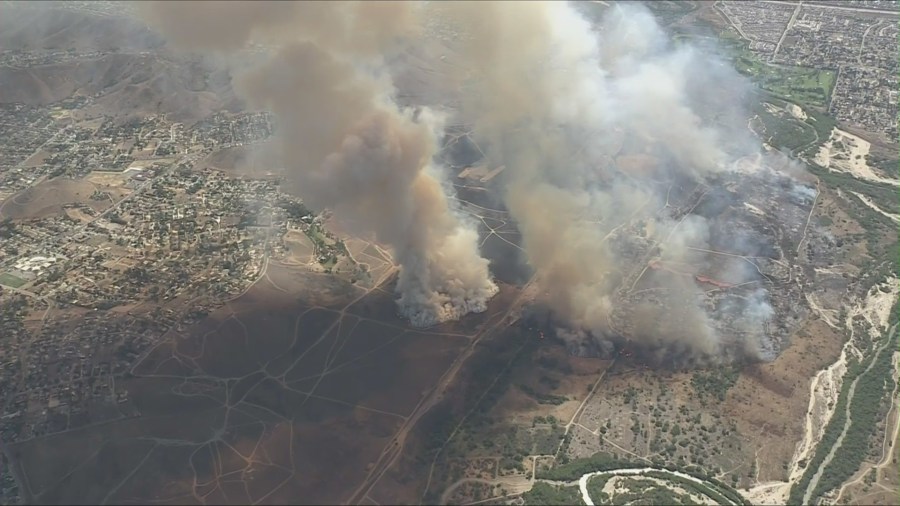
Multiple wildfires burning across Southern California have prompted health warnings for residents and a smoke advisory throughout the day Thursday.
Among the largest air quality offenders are the ongoing Sandy, Bain, Verona and Santa Rosa Island wildfires. Unhealthy air from those fires is affecting portions of Ventura, Los Angeles, Orange, Riverside and San Bernardino counties.
Official updates: Sandy Fire | Bain Fire | Verona Fire | Santa Rosa Fire
The smoke advisory is in effect through 10 p.m. Thursday, according to the Los Angeles County Department of Public Health.
Wildfire smoke is a mixture of small particles, gases and water vapor that can cause burning eyes, a runny nose, a scratchy throat, headaches and illness, including bronchitis.

An air tanker drops retardant on the Sandy Fire on Monday, May 18, 2026, in Simi Valley, Calif. (AP Photo/Ethan Swope)
People at higher risk, including children, the elderly, those with respiratory or heart conditions and people with compromised immune systems, may experience more severe effects such as difficulty breathing, wheezing, coughing, fatigue and/or chest pain, officials said.
Los Angeles County health officials are also asking schools and recreational programs in smoke-impacted areas to review the California Department of Education’s Get Smart About Wildfire Smoke, Clear Guidelines for Schools and Wildfire Smoke memo.
“This may include limiting or suspending outside physical activities, including physical education and after-school sports, until conditions improve,” officials said.
The following recommendations were offered to lower the harmful effects of bad air quality:
If you see or smell smoke, or notice particles and ash in the air, stay indoors to limit exposure, especially if you have heart or lung conditions, are elderly or have children.
Wear an N95 or P100 mask if you must go outside in smoky conditions for long periods of time in areas with heavy smoke or where ash is present.
Avoid using fireplaces, candles or vacuums. Clean dusty surfaces with a damp cloth and don’t smoke.
If you experience symptoms such as severe coughing, shortness of breath, wheezing, chest pain, palpitations, nausea or unusual fatigue, contact your doctor or go to urgent care. For life-threatening symptoms, call 911.
The following was recommended for pets:
Avoid leaving pets outdoors, particularly at night. Pets should be brought into an indoor location, such as an enclosed garage or a house.
If dogs or cats appear to be in respiratory distress, they should be taken to an animal hospital immediately. Symptoms of respiratory distress for dogs include panting and/or an inability to catch their breath. Symptoms for cats are less noticeable but may include panting and/or an inability to catch their breath.
Real-time updates and forecast air quality in your area can be found on the South Coast AQMD mobile app or on the SCAQMD website.
Copyright 2026 Nexstar Media, Inc. All rights reserved. This material may not be published, broadcast, rewritten, or redistributed.
For the latest news, weather, sports, and streaming video, head to KTLA.