
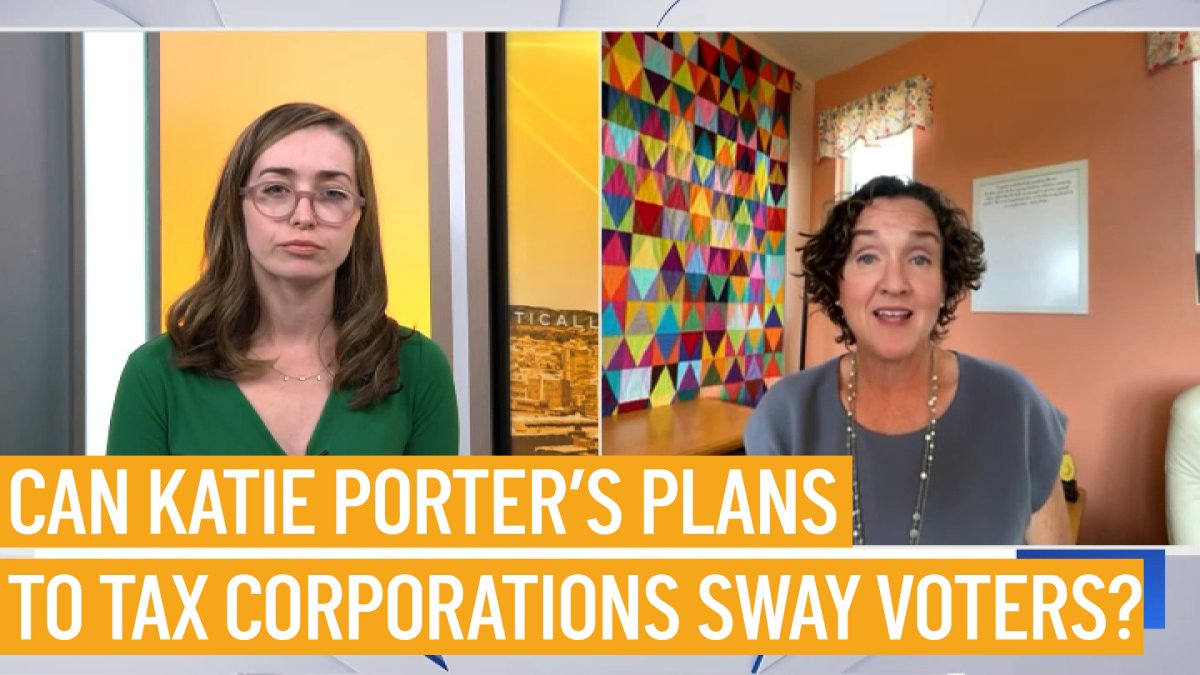
Former Southern California Representative Katie Porter has spent the year on the California campaign trail, resurrecting the corporate scrutiny that made her a rising Democratic star in congress. But she’s struggling in the polls. Is it too late for her to break through? She doesn’t think so. She tells Joey Safchik why – and details her housing and tax plans – on Politically Speaking. A transcript is below.
Transcript:
Safchik: Early voting is well underway, but that doesn’t mean voters are over enthusiastic about their choices. Some Democrats are waiting until the last minute to fill out their ballot, with plans to support whatever candidate appears to emerge as a frontrunner. That means all the candidates in the crowded field are working overtime as the clock is ticking to win hearts and minds. That includes former Congresswoman Katie Porter, who joins us now. Welcome back. Thank you for being here.
Porter: Of course.
Safchik: What separates you from the rest of this pack?
Porter: I think two things. Number one, that I don’t take corporate contributions. I think people are tired of candidates who promise to support workers and consumers and patients, on the one hand, and that are have their campaigns funded by those who are making life harder for everyday Californians. So I think the I’m the only candidate in this race, Democrat or Republican, that has never taken corporate contributions. The second thing is, a lot of candidates in this race are telling Californians that life here is that affordable. But Californians know that I’m the candidate here who pushes a shopping cart, who drives a minivan with 180,000 miles on it. And because of that, I am the only candidate with a concrete plan to reduce California’s cost. I would eliminate California’s state income tax for anyone earning less than $100,000. So just look at your pay stub. If you fall in that category, you’re probably struggling to make ends meet to afford housing here in California. Look at your pay stub and you can see exactly how much money you would have to spend. When I’m governor, I’ve also proposed tuition free college degrees here at our. You can see us use in combination with our free community college. We already have these are policies that will really bring down costs for Californians. I’m not making vague promises like I’ll get it done and I’m not a billionaire who doesn’t understand what it’s like to struggle with costs.
Safchik: There’s been so much mudslinging in this race. Do you think that some of the issues have been obscured? Has there been enough discussion of concrete policy?
Porter: No, I don’t think we’ve seen enough discussion of policy. And I invite Californians to watch any one of the 4 or 5 six debates that we’ve had here to see that I am a candidate, the only candidate at times who’s willing to answer the questions asked, who has a detailed plan for every one of the responsibilities that our governor will have? I think what candidates are concerned about and why they’re kind of in this waiting delay situation, is that they were worried at one time, I think back in February, for example, about whether two Republicans could get through. They cannot. Steve Hilton has led Chad Bianco by nearly double digits, well outside of the margin of error, whereas the Democratic candidates Sylvia Becerra, Tom Steyer and myself, we are within the margin of error. So Californians really just need to decide who do you think would do the best job as governor and then vote for them? Very, very few ballots have been cast, particularly at this stage in the election. And I think we’re seeing some of this information that’s coming out about candidates. It’s never fun to have to hear things that are negative about somebody who’s considering public office. But people do have a right to know and to ask reasonable questions about what candidate’s liabilities are. And so the corruption scandal that involved having your business chief of staff is something voters should know. They should make their own decision about how to weigh that. For example.
Safchik: Let’s be honest, you are not consistently polling at the top of the pack. So what gives you confidence that you can still break through?
Porter: Yep. I am within the margin of error of Tom Steyer. And I think we’ve seen the series lead has only been there now for about three weeks. Before that he was pulling down at 3% and 4%. So he went from a very low place to a much higher place very quickly. It’s partly because this field is unsettled. We’ve also seen that we’re seeing this from voters in terms of how slow they are to return their ballot, but we’ve also seen it in polls very, very few voters are sure of their first choice. So we’re seeing a lot of voters who are saying, I lean this way, I lean that way. But I’m also considering and my polling numbers have really shown, that I am going to be right there on people’s minds as they get their ballots. And I think people understand that if we want things to change in California, we have to elect a candidate who has been willing to push for change. At the same time, this is not a time for someone’s first gig in government with everything that we have coming at us from Donald Trump.
Safchik: If you had four years that tenure to fix one thing about California, what would it be?
Porter: Housing costs, making housing less expensive. That is the biggest bill that most families face. It’s an issue for our seniors on fixed income and who often have mortgages even after they’re retired. But it’s also a huge reason that young people are leaving the state because they can’t afford the rent, they can’t afford to buy a house. They don’t feel like they can afford to start a family here to get a bigger place to live because of housing costs. So if you’re serious about affordability, housing has to be your number one issue. It’s the number one bill that most people pay. And I think one thing that’s different about me than the other leading Democrats in this race is I have been willing to say what my number one priority is that it’s housing, not trying to make everything a priority, because if you do that, you’re not going to accomplish much of anything at all.
Safchik: How do you do it?
Porter: The biggest, the biggest way to reduce housing costs, the part that the governor has the most control over that is the easiest to do is to build housing faster. So there are a number of levers that you pull to make housing built faster. But we build in California two years slower for apartments and for homes than neighboring states. Nearby states like Colorado. And that delay that extra two years that it takes to build something here adds 20% to the cost. And it means that a lot of projects don’t get built at all because they’re too expensive to build. So speeding up construction, that’s permitting reform. It’s innovating construction. It’s in of its changes to the building code. It’s better accountability for decision making. So looking at impact fees, there are a lot of different strategies within that. But the goal is faster housing production because faster housing is cheaper housing. You’ve heard that phrase time is money. It’s I think it’s because we had a governor who wanted to work on housing right at the start and said he wanted to build more homes, but didn’t have a sense of what the levers were that you could pull. I think we’ve had some good work done in our legislature. I think there are no partners in the legislature that want to focus on bringing down housing costs. I also think we have started to see cities realize that if they’re not bringing down housing costs, if they’re not adding people to their city, there’s like their economy is not going to grow and they’re going to face revenue problems. So you’ve seen different neighborhoods, different areas of California take different approaches. We’ve seen some parts of San Diego County, for example, have success with ADUs, backyard dwellings. We’ve seen other places decide instead of a single family, let’s do duplexes. Let’s double the number of people on this lot. There’s going to be different strategies in different parts of California. But look, I’m from Orange County. Our economy here is generally very, very strong. And one of the reasons it has been strong for the last 20 years, much stronger than our neighboring areas to the north. And south. It’s because Orange County’s been building housing and building it quickly.
Safchik: Let’s talk about gas prices– sky high right now. Partly to blame on the war, but not entirely. What could you do as governor of California to lower gas prices here?
Porter: Yeah. So look, it was Trump’s war in Iran has added more than a dollar to gas prices in every part of the country. But you’re cutting that. People are really feeling that, right? Gas prices at $6. I drive a minivan. It is 100 bucks to fill it up. And it doesn’t even have that big a tank, so I get that. But California, you’re correct, had higher gas prices even before this war. And I think there are a couple reasons. One of them is that instead of funding roads and bridges out of things like the general fund, where our income tax goes, we’ve added gas taxes. One thing I want Californians to know about me is I’m not afraid to stand up to Democrats when they have bad ideas that would hurt people’s pocketbooks. When I ran in 2018, it was my first campaign. I successfully ran for Congress and flipped the district. I stood up to the entire Democratic establishment to oppose adding an extra $0.12 a gallon, because I knew that Californians didn’t need to be paying higher prices at the pump. So now when we hear some candidate say that they would suspend that tax or they no longer support it, I didn’t support it in the first place because I don’t think adding taxes is the right answer here. I think we should fund roads and bridges out of the general fund. The other reason our taxes, our gas prices, excuse me, are higher is we have a special fuel standard and our blend of fuel makes our air cleaner. It reduces the risk of respiratory disease. It reduces our health care costs on things like asthma. That is a good investment is worth paying a little bit more at the pump for. But we do have to bring down the cost of living in other areas so people can afford our higher gas prices.
Safchik: You mentioned wanting to eliminate the state income tax for people under a certain threshold. How would you compensate for that in a state that already has some budget strife?
Porter: Yeah. So look, our budget was about is about $320 billion annually. Let me tell you how much families earning, people earning less than $100,000, which is what it takes in a lot of parts of California for a family to live. They contribute those families earning less than $100,000 contribute $8 billion, 8 million out of 320 million. So but what does that money mean? And their lives? It’s all the difference in the world. Look at your paycheck and see what’s coming out for state taxes. And then ask yourself what you could do with that money. Would you be able to contribute to a retirement account? Would you be able to fill your tank all the way up? Would you be able to put some healthier groceries in your cart? How would I pay for it? I would pay for it by asking corporations in their most profitable years. So it’s not picking on big or small, and it’s not picking on any industry. It’s just saying, hey, corporations business. You do what we do when we make a little more and our income trips up, we go into a higher tax bracket. That’s what corporations should be doing right now. A small business that ekes out ten bucks a profit has to pay the same income tax rate as the largest, most profitable tech companies in our state. If you’re making banner profits that year, you should pay a little bit higher tax rate. And we could use that to give Californians real tax relief.
Safchik: $8 billion is still a nice chunk of change. Would any state services have to be cut?
Porter: No, because the proposal I have on the corporate tax to rate right now, we have a flat corporate tax. It’s 8.84%. Again, make a buck a profit. Make 500 million of profit. Still 8.84 if we made that just slightly graduated. And we said, for instance, the most profitable companies, companies with profits over $1 billion paid 9.5%, up from 8.84. That would generate enough money to replace all of that income tax help, all of that extra money we’re putting back in families pockets and actually leave enough leftover to pay to make two years at our UCS and CSU’s free. People compare that with community college and have a tuition free free college degree, which is something Californians used to have.
Safchik: I’m going to be completely candid with you. I’ve spoken to some voters who say they like your policy, but they have some inhibitions about your temperament. What can you say to assuage those fears?
Porter: Yeah. Look, I would invite Californians to watch the debate to see how candidates did when they were under questioning from other candidates, when they were under questioning from moderators or Republicans. I think what I showed in every one of those debates that I am good under pressure, that I am able to keep my wits about me. I didn’t interrupt, I didn’t shout over other candidates. I didn’t call names. I answered the questions and that is, those debates exist for a reason. They have long been considered kind of a fulcrum of figuring out who’s ready for the job. The other thing I’ll point to was the fact that I earned the endorsement of the San Francisco Chronicle. I earned the endorsement of the Sacramento Bee, Modesto Bee, Fresno Bee, and you get those endorsements because you were able to sit with the best journalists in our state for two hours and take on the toughest questions. And those endorsements are not given as a favor. They’re not given because somebody supported somebody back in the day, or somebody wants something they’re given because of the quality of a candidate’s ideas. The ability of that candidate to express those ideas and how that candidate performs under pressure. You know, I would say, look at my record in this race.
Safchik: In order to get anything done in Sacramento, famously, you have to be able to build coalitions. Would you be able to form those interpersonal relationships that are required to get legislation passed the finish line?
Porter: Absolutely. Look, I have the most number of union endorsements in that race. Those are coalition organizations. I have the support of the Teamsters. I have the support of the machinists. I also have the support of the National Union of Health Care Workers, UAW, which organizes workers on our campus. It’s a broad labor coalition. I also have the support of many congresspeople, Robert Garcia, Dave Min, Derek Tran. Why have they supported me? Because they know that not only am I a thoughtful policy leader, but I’m also someone who did the political work to help us win across California. And that’s something that’s different about me than about Tom Steyer or Xavier Becerra. I have spent time and energy helping Democrats win and donated money, raised money, grassroots money, not corporate money to help Democrats win all across the state and all across this country. That’s because I’m invested in creating a team that can get things done for Californians.
Safchik: What is the governor’s job going to be when it comes to taking the Trump administration to task when necessary?
Porter: Yeah, so look, first, this is the first time Donald Trump has come up in this interview. And I think that tells you something to which is that I am very focused on the work of the governor, which is making life better here in California, safer communities, better economic opportunity, lower cost of living. But make no mistake, I am tough. If Donald Trump comes for California, I will absolutely stand up to him and go toe to toe. People say they want someone who’s tough enough to take on Trump. That’s also a temperament quality that I have shown. I’m not someone who spent 30 years in politics going along to get along. I’m somebody who went to Washington and pushed Washington, pushed Democrats and Republicans in Congress to do better, to ask tougher questions, to call out things like price gouging and prescription drugs.
And so I will be fearless when taking on Donald Trump when he attacks Californians or denies those things like wildfire relief that we need.
Safchik: I’ve spoken to a couple of economists and political analysts who say Democrats have a habit of promising hypothetical money. We will help you with your down payment on a house, but people say, no, I actually need help paying my rent this month. What can you do to put dollars back in people’s pockets?
Porter: Yeah, this is exactly why I’m focused on tax relief. This is because just saying things like, I’ll make it affordable, which is what we’ve heard a lot of from Harvey or Basara or I’ll make sure does is not a plan, right? It’s asking people to just believe that he can go do something that our current governor that our past governor, Jerry Brown, couldn’t do. I have very concrete plans to put more money back in California’s pockets and to reduce some of the expenses, like tuition that Californians are facing and a plan to reduce the cost of housing and the California Yimby action. Said that I was the only candidate that correctly identified why housing in California costs more than it costs other places, which is we take longer to build. So I think I have a revenue plan. I have explained how I would change the corporate tax structure and like, are you worried? Good.
Safchik: Are you worried about driving corporations out of California?
Porter: No. And I was just going to say this. Look, corporations, when they when they take revenue in, they have a choice. If they take in revenue, that’s more than their expenses. If they generate a profit, they can choose to put that money into higher wages for their employees, which helps Californians make ends meet. They can choose to grow their business, which helps grow our economy and generate more tax revenue. They can choose to invest in research and development or expansion. All of those things are good, or they can take that money as profit and give it to their shareholders and their executives. If they realize it is profit, they’ll pay a higher tax rate. But the incentives on this tax are good for business because they incentivize business. Put money back into Californians pockets very quickly.
Safchik: Will you declare a state of emergency over the sewage crisis?
Porter: Yes, and I have been very clear about this. And one thing that’s different about me is I visited the Tijuana River long before I became a candidate for governor. I was grateful to have the chance to go there again as a gubernatorial candidate, but it wasn’t my first trip. And I understand it is a public health emergency. It’s also an economic emergency for those communities. We cannot simply point the finger at the federal government or at Mexico while Californians are breathing dirty, contaminated air.
Safchik: If Democrats do split the vote, will you bear any responsibility?
Porter: No. Look, Democrats are not going to split the vote. Republican Steve Hilton has pulled away from Chad Bianco. There has been a lot of up and down in movement on the Democratic side of the race. But on the Republican side of the race, that trend has been consistent and it has been strong. We are seeing Steve Hilton poll eight and ten points ahead of Chad Bianco. It’s pretty clear right now that that has been consistent. Steve Hilton has more money. He has more endorsements, he has more support, and it’s been steady this entire time. I think it is possible that we could see two Democrats get through, but there is no chance of seeing two Republicans get through. And look, I was willing to say that was a risk a few months ago when other Democrats weren’t willing to call that out as a problem. I don’t think it’s a risk now. And if I did, I would be making a different decision, perhaps about this race. And I think every candidate should be, been willing to do that back when I was all right.
Safchik: Congresswoman Porter, thank you so much for your time today.
Porter: Thank you.