
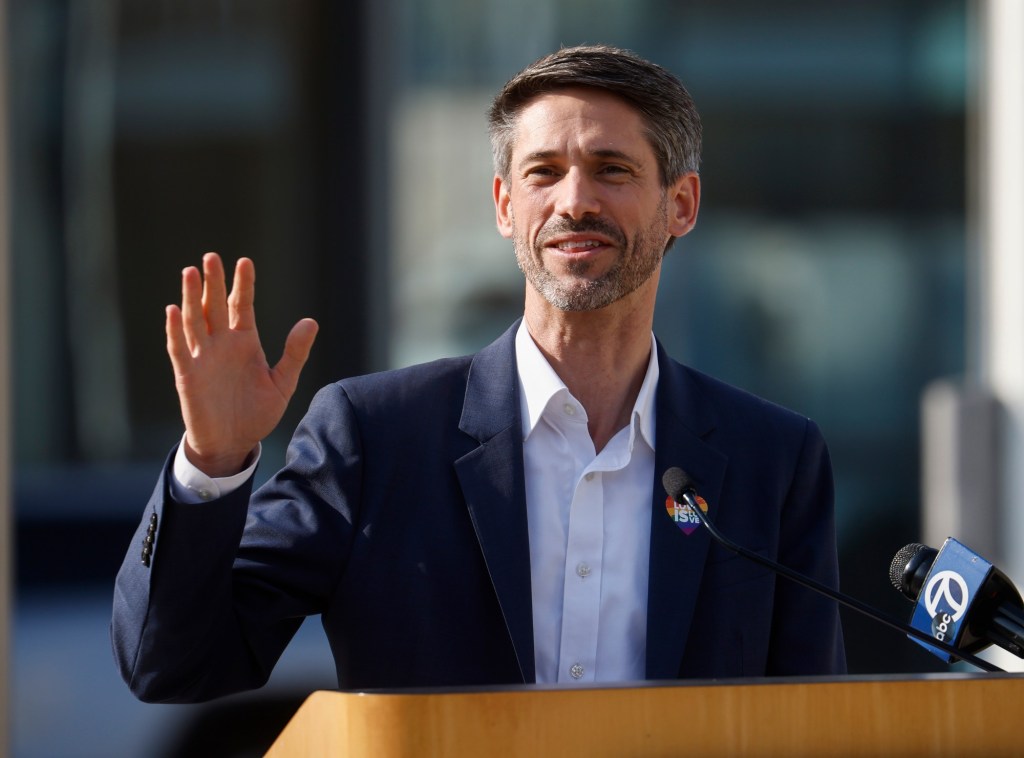
As San Jose Mayor Matt Mahan travels the state campaigning for governor, he’s still drawing the region’s second-most expensive salary for his day job despite missing more than a third of City Council meetings.Mahan earns a base pay of $228,005 as a full-time mayor, according to the city’s 2025 employee compensation report. San Jose is one of only three cities in the Bay Area that requires elected officials to serve full time and pay a matching full-time salary with benefits.
Only San Francisco sits higher in regional pay, although Mayor Daniel Lurie famously capped his own pay at just $1 a year, forfeiting his $364,582 salary. Meanwhile, Oakland Mayor Barbara Lee’s authorized base salary trails the group at $216,000.
Although Mahan contends that he has fulfilled his duties and highlights his gubernatorial run as potentially groundbreaking for San Jose’s influence in state politics, his campaign coincides with a role that demands a full-time commitment and highlights the tightrope officials must walk in carrying out their duties and separating that from campaigning.
It comes as San Jose faces critical challenges, including closing a $50 million budget deficit, which includes proposals to delay construction of a new fire station and reduce encampment sweeps.
The mayor’s absence has drawn mixed reactions, with some members of regional boards criticizing the missed meetings as a hindrance to public business, while council colleagues like Bien Doan told the Bay Area News Group editorial board recently that his campaign has had “no impact whatsoever” on San Jose’s ability to function.
Whether or not the city’s day-to-day services are suffering, the mayor’s pay remains the same despite his absences. The City Council meets on a weekly basis, not including committee meetings. If a councilmember is absent, they can be fined if unexcused. But the mayor is exempt from the policy, according to the city charter.
San Jose stands as one of the U.S.’s last large cities operating under a council-manager or “weak mayor” system, where a city council-appointed city manager oversees day-to-day city departments.
The mayor, elected citywide, acts as the spokesperson for the city, and is just one of 11 votes on a council where the other 10 members represent individual districts.
But much like other major cities, San Jose’s elected leaders receive full-time pay and control individual budgets to fund their own distinct operations.
In 2025, in addition to his salary, Mahan recorded $6,000 in cash allowances. The city also contributed $10,126 toward his medical, dental, and vision benefits, and $14,934 in retirement and pension plan contributions.
Mahan manages a $5.3 million office budget and at least 22 staff, according to his official website. Separately, the city provides $14.1 million for the 10 council districts, including at least 51 full-time staff.
Mahan, who has campaigned on a “back-to-basics” platform centered on bringing corporate-style metrics to governance, tried to institutionalize that philosophy last year by introducing a “pay-per-performance” proposal to withhold 5% of elected officials’ salaries if the city failed to meet specific targets. The council ultimately rejected the proposal 7-4, with critics rebuking the corporate standards tied to the system.
While Mahan seeks to hold the council accountable to strict performance metrics, his own record raises questions about his adherence to them.
Between Jan. 29 and May 12, Mahan missed seven of 19 council meetings or study sessions. Two absences were for a conference at Harvard, while three coincided with gubernatorial debates in San Francisco or Los Angeles. He skipped an additional April 20 session on permitting and arrived late or left early for two meetings he did attend.
Mahan’s spokesperson, Seamus Gann, defended the mayor’s performance and ability to balance his day job with campaigning.
He noted that Mahan continues to author policies “advancing city priorities in addition to five board referrals and letters to VTA focused on improving transit outcomes for riders across the county and 42 advocacy letters to federal and state officials on behalf of the City of San José.”
Mahan, meanwhile, framed the demands of his schedule not as a distraction, but as complementary to his goals in San Jose.
“I’m on a mission to make our city safer, cleaner, more affordable and more full of opportunity for all of my neighbors,” Mahan said.