
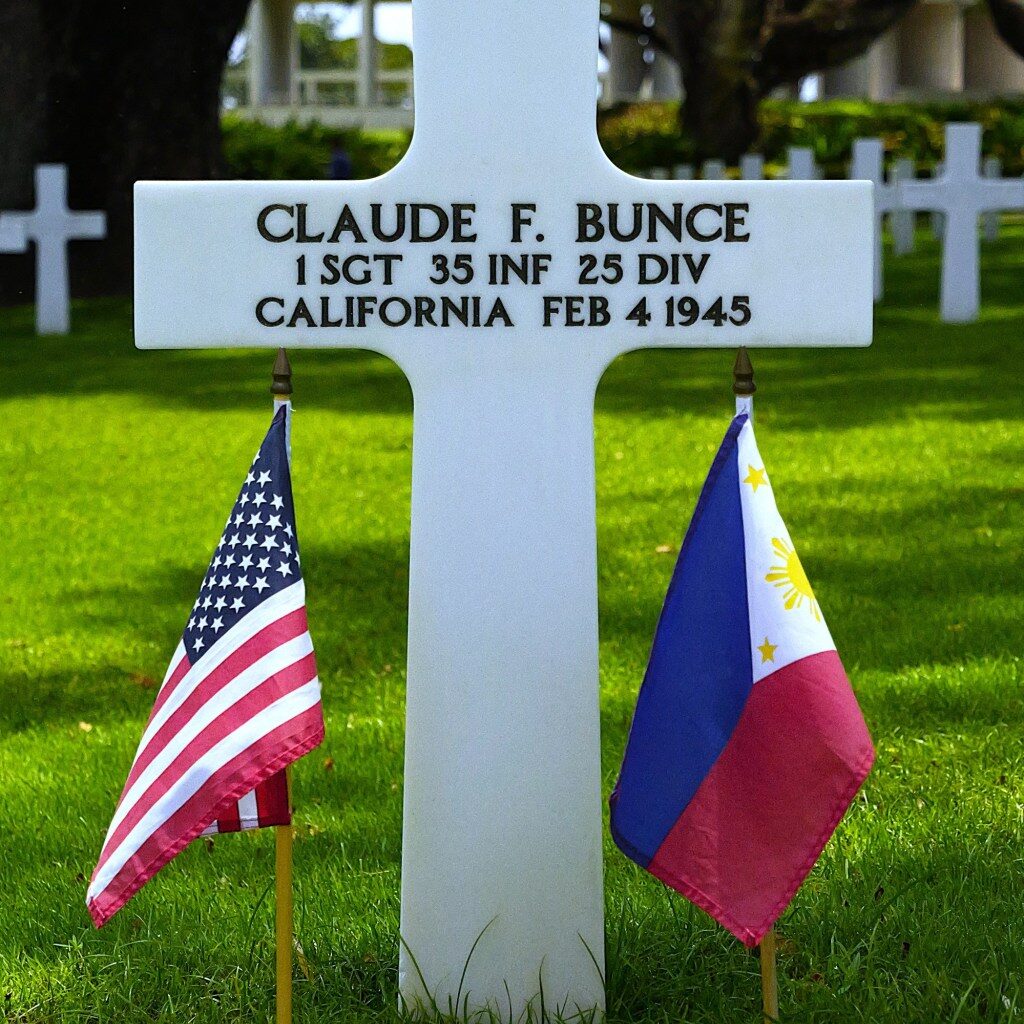
By February 1945, U.S. Army 1st Sgt. Claude Floyd Bunce had already survived more than one major campaign in the Pacific. He had been at Schofield Barracks in Hawaii on Dec. 7, 1941. American servicemen died that day as a result of the Japanese attack on Pearl Harbor and other installations. Claude’s mother, Alice, mistakenly received word that he had been one of them. So in February 1945, when the military informed Alice of Claude’s death, she must have hoped that such news was, again, a mistake. But it was not. Claude was killed in action in the Philippines, trying to help soldiers under enemy fire. The sergeant had already earned a Bronze Star. For his heroism that February day, he was posthumously awarded the Silver Star.
Like most Americans who lost their lives in the war, Claude was far from home when he died. He was born on Feb. 28, 1920, in Blue Earth, Minnesota. Claude’s immediate family was small, just his parents and an older brother. In 1927, the Bunces moved to Escondido, California, where relatives lived. With his father in poor health, Alice worked in a laundry. In April 1937, his father died. By then, Claude was already working. He had left school after the seventh grade.
Claude enlisted in the Army in December 1939. His first duty station was on Oahu. After the Japanese attack at Pearl Harbor, Claude’s mother thought he had died in the assault. On Jan. 2, 1942, the Escondido newspaper reported that Claude had been killed, while “asleep in his bunk at the barracks.” Alice probably had received a telegram from the War Department. But the report was in error. Eleven months passed before the paper could correct the news.
Claude remained on Oahu until November 1942, when his division shipped out for Guadalcanal, where it joined the fight against the Japanese. In November 1943, the War Department released names of soldiers who recently were awarded combat medals. 1st Sgt. Claude F. Bunce was among those who received the Bronze Star. According to a statement in his hometown newspaper, during combat Claude had exhibited “heroic and meritorious action.”
Claude’s next campaign was the Philippines. On Jan. 9, 1945, the Army landed on the northern island of Luzon. By the first days of February, Claude’s division reached the central plain. His regiment fought to take the town of Lupao. The assault continued for days. On Feb. 4, Claude’s battalion received orders to enter the town. His company was to lead the attack. Claude’s platoon got as close to Lupao as 100 yards. But fire from Japanese tanks pinned them down. The Army described what happened next.
“At the height of the four-day battle, Sgt. Bunce’s infantry company was attacking three enemy tanks and an undetermined number of enemy infantrymen. One of the assault platoons, having lost its platoon leader, became badly disorganized and scattered when one of the enemy tanks suddenly broke from cover and escaped through their lines. The leaderless platoon was so badly shaken that an orderly withdrawal could not be made.
With total disregard for his personal safety, and in spite of warnings from the executive officer, Sgt. Bunce took charge of the platoon and repeatedly exposed himself to withering 47mm and machine gun fire and succeeded in rallying all of the platoon except one squad. In his attempt to withdraw the isolated squad, he was mortally wounded by a direct hit from an enemy shell, dying before aid could reach him.”
The above description is taken from an article published in the Escondido newspaper on June 1, 1945. The headline announced the posthumous awarding of the Silver Star to 1st Sgt. Claude Bunce. The newspaper account likely came from the award citation sent to his mother, along with the medal itself.
There are probably no direct descendants of Claude’s immediate family alive today. His parents and only sibling, who apparently had no children, have died. Does anyone remember 1st Sgt. Claude F. Bunce’s story of military service and sacrifice? If not, it falls upon us, especially on Memorial Day, to honor this soldier. We also remember all who wore the uniform throughout our history and died in its service.
Dudik is president of the nonprofit World War II Experience. She lives in San Marcos.