
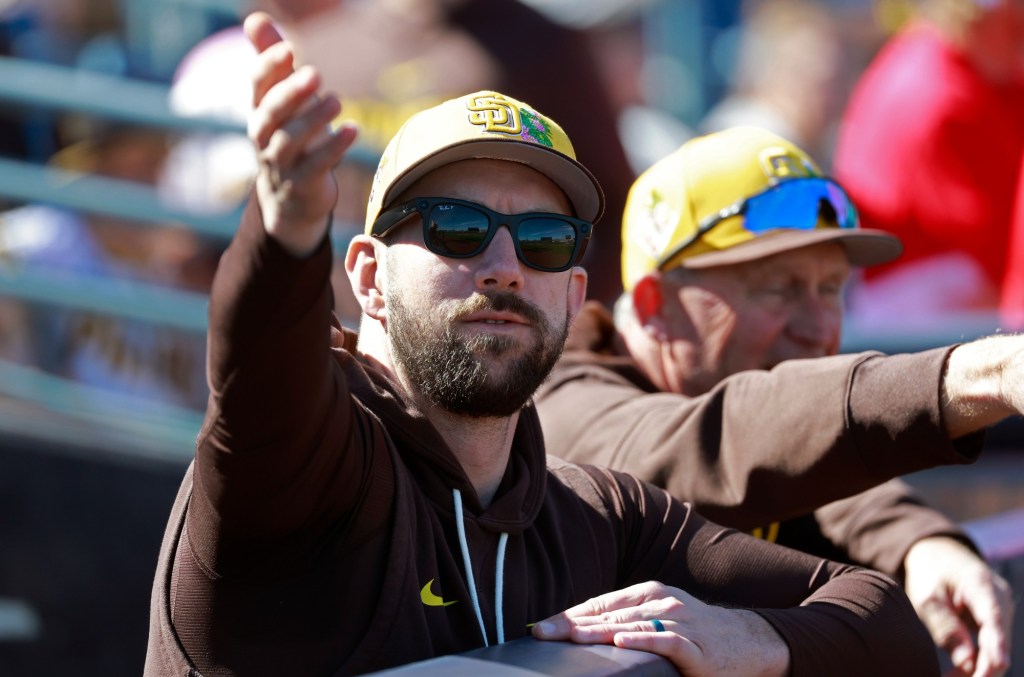
Steven Souza Jr. was hired by the Padres this offseason as the team’s hitting coach.
While it’s Souza’s first coaching job after spending last season as a special advisor for pro scouting and hitting research for the Tampa Bay Rays in 2025, he’s no stranger to the clubhouse.
Souza was picked by the Washington Nationals in the third round of the 2007 draft and made his major league debut in 2014, the same year he was teammates with Padres manager Craig Stammen. After retiring in 2022, Souza, now 37, launched a baseball instructional program in the Pacific Northwest.
His minor league career was marred by a 50-game PED suspension and a lifestyle that almost derailed him from the game permanently, an experience he now uses to help educate younger players.
This interview has been lightly edited for length and clarity.
How would you describe who you were as a player and your career as a whole?
A: I was a very high-effort player. I wanted to make sure I left everything on the table every night. Probably throttled it too hard at times. But I had to earn everything that was given to me. I felt like if I couldn’t lay down my head at night and knew I gave everything I had, I didn’t have any peace at the end of the night. And I wanted to, at the end of my career, know that I did everything I could. So that’s how I played. Tried to make sure that when fans came to the game, that I knew they were spending their money, they were bringing families, and I wanted to make sure that my effort was reciprocated for their effort in their daily life. And so my career, I got off to some really good starts. I was riddled by a bunch of really tough injuries, which is frustrating when you look back at what could have been. But I enjoyed my big-league career. All those things I went through, they’re helping me today as a hitting coach to be able to relate and share in experiences. I’m very grateful for going through all those things.
You last played in 2022. Did you play with or against anyone on this team?
A: I played against a lot of them. Gavin Sheets was at the field for my biggest injury with my knee. I played with Ty (France), played against Nick (Castellanos) forever, played against Manny (Machado) and (Xander Bogaerts) forever. The shared experiences and playing against each other with a lot of these guys was an interesting thing to get over at the beginning, but it’s been really good. I think it’s been more helpful than hindering throughout this process.
Players have hitting coaches they work with in the offseason or people they’ve listened to since they were young. What exactly is your job, and how do you tangibly do it?
A: It’s a bunch of different things. I think being a hitting coach in 2026 is probably harder than it’s ever been because of the things that you said — the hitting coaches in the offseason that think they have all the answers. The game planning is very difficult. The big-league lifestyle is very difficult. Balancing all these different things as a player, it’s all very challenging, and there’s not a whole lot of people to gravitate to and relate to, to go in all these different directions. In my experience, I was one of those guys that went outside and sought help from coaches and used my big-league hitting coaches that I played with and (also) coaches that helped me balance the mental part of the game. It’s all those things. You’re a psychiatrist, you’re a hitting coach, you’re a mechanics coach, you’re a game-planning coach, and it never stops. Every day kind of has its own unique set of problems.
How you talk to one player might be very different than how you talk to another player. How much is this about building trust?
A: You nailed it. Trust is huge in this part of the job. I think being able to get to know guys and what makes them tick (is important). What’s their background? What have they gone through? What’s their family life like? Knowing who they are, the whole as a person, a lot of the times reveals who they are as a player. And so being able to understand how you can get through to them. What do they need? Do they need less? Do they need more? Do they think they need more, but they really need less? That’s the juggling act that every hitting coach has to go through to figure out how to get through to a player. And a lot of times, it’s backing off and then realizing when the right time to help is, but when you go to help, you better have some good answers.
It’s an ongoing process. It doesn’t just take two months into the year … And these guys have been doing it for a long time, so they’re good at it. It’s about being able to meet them halfway or introduce something in a manner where they find that it’ll help them be successful. And understand them as people as well. That’s probably the most important thing.
You used strobe glasses at one point in your career, which speaks to trying to find any little edge. Do you see guys today trying to find any little thing that might help them see pitches better or have better reflexes?
A: Yeah. I think again, in 2026, with social media the way it is, you see all these, like, litany of drills that are out there. Everybody’s trying all these different things. I think as a professional, you don’t know which ones really help. I think where I’ve lent a hand is, ‘Hey, I’ve tried these things. They don’t really work.’ And, ‘I’ve tried these things, you can really see some benefit,’ and then explaining why. That’s what players want to know. Why am I doing this? What am I getting out of it and how is it going to help me? Because that’s all they want to do. As players, we just want to be successful on the field. So as a coach, I want to make sure whatever I’m giving even if it’s creative — that it’s impactful. That’s why I did the strobe glasses, because I needed to be able to see the ball better. I created this chaotic environment with a little ball and some strobe glasses so that when I was in the game, that was my main focus. Getting these guys to get in some challenging environments, to try and see that there are some different ways to get some benefits back.
What’s your perspective on all the information that’s accessible these days?
A: I think it’s putting (players) in a position to where they feel like they’re the most dangerous in the box. If that’s a lot of numbers, present the truth to them and not overwhelm them. Information is great when it’s targeted. If you’re just blanketing a bunch of information out and not knowing, ‘What am I looking for?’ I think it can get really dangerous. But if you have the targeted information, you’re just showing the objective truth of a situation and then being able to counter that with, ‘OK, here’s the truth. Now what’s our process to get the end result?’ So it’s just a part of the process. That’s all information is. If you look at it like, ‘I have to do literally what this thing is saying,’ you can get a little bit lost. Some guys, it works for. A lot of guys, it doesn’t. You’re just looking at it as a roadmap to help get the answers.
I’m sure you’ve heard the word ‘adjustment’ only about a million times. How do you know when to tweak and when not to tweak?
A: Listening to the player. That’s why it’s important to just be in the cage. I want to make sure I’ve got my eyes on guys going through their routine every day. Is it just (how) you’re going through your process? The game is very challenging. Is it a bad process? We got to maybe tweak that a little bit. I think that’s the part of knowing the timing, reading the body language, having regular conversations and hearing the way they’re speaking and the way they’re talking about things. These guys are really smart. They’ll just come up and ask questions. ‘Hey, what do you see on this?’ And getting our group together to have those answers. They know when something’s off and they know when they’re good. So being able to just lend a hand when they need it. They’ll tell you when they need the adjustments most (often).
What’s your take on the Padres’ offense through the first eight weeks?
A: I think it’s like any offense throughout the year. You have your ups and your downs. I think for the first three weeks of the year, we were really good, and then there was a middle stretch in there where I think we kind of lost our identity. And obviously, on this (last) road trip, we did a good job of finding it. My faith has not wavered in this offense by any means. These guys are super talented and the back of their baseball card shows that. I think we’re gonna be just fine.
Everyone locally and nationally is weighing in on Fernando Tatis Jr. and his homerless streak. What have you seen from working with him to this point?
A: He’s just kind of getting out of whack mechanically at times, and trying to find it. Anybody that sees all the pressure behind him, it’s human nature to want to add and make things happen. He’s an electric player that loves to do those things and help the team win. I think at the end of the year we’ll look at it and it’ll be just fine.
Is there one specific philosophy that you want the offense to adhere to?
A: Line drives. Not trying to do too much. I think this group has a ton of power and when they try and do too much, swings get a little bit bigger, decisions get a little bit worse. And that’s any baseball player — that’s not just specific to this group. But staying disciplined and when we get the mistake, we don’t try and hit it nine miles. We just try and barrel it up. When we do barrel it up, it gets hit hard.
Fans, especially on social media, break down players’ swings and say, ‘Well, he should just do this,’ or he should be on his back foot, or turn his head a little more. Would you say it’s that easy?
A: It’s definitely not that easy. I can tell you that from experience. It’s one of the hardest things to do. I think your ability to manage what’s actually happening in your mind that’s affecting your body is probably the most important thing. So what I’m trying to do at the plate — and this is what people don’t realize until they’ve actually stepped in the box, or have a little bit of empathy, or asked enough questions to big leaguers to really get the answers — is that what you’re trying to do in your mind, with the pitches, with a fastball, if you get jammed, those things impact your mechanics and you’re lying if you don’t say that they are. I’m a firm believer of that. We’re all trying to be successful in the box as players. So these guys, you have to figure out if it’s the mental that’s affecting the mechanics, if it’s the timing — it’s this circular dance and roadmap, where you have to try and pigeonhole, ‘Where’s the start?’ and then work its way back. I think a lot of people just say, ‘This is what’s happening. Fix that,’ and they don’t really know why or they don’t have the right answers, I guess, to get back to the proper position that they need to be in so that they’re free to make good decisions. That’s all we’re looking for. Being free to be direct and make good decisions. That’s the best chance we got.
I want to talk to you about your personal story. When you first entered the minor leagues, you were a very different person than you are now. You lived more of a hard-partying lifestyle, even to the point where a suspension didn’t interrupt that. You left the game for a period. How have you changed since then and what ultimately led to your growth?
A: I was an 18-year-old kid living a college lifestyle and trying to be a professional at the same time, which doesn’t really work out too often. I think going through those experiences of getting caught up in what everybody was doing around me, because you’re trying to fit in, really helped me to own my own craft. And I think stepping away from the game in 2011 and really figuring out who I was as a person, my faith grew immensely during that time. My identity moved away from the game, and I started to own who I was as a man, and what I wanted to be as a man was a follower of Jesus but also, I wanted to come to the park and work every day. That’s when it started to become, ‘When I’m done with this game, I want to have some peace.’ So I tried to study, I tried to work as hard as I could, and then I put all that (lifestyle) stuff away because I said, ‘You only get one chance at this and you just want to look back on it (with peace).’ And not everybody makes it. I didn’t know if I was going to make it in the minor leagues, but you want to look back and say, ‘I gave it the best I could.’ If everybody does that in the game and says, ‘I gave it the best I could. I put away these things and gave it my best shot,’ then you can go away from this game with a lot of peace. That’s all we’re really looking for. Every player, every Hall of Famer, I don’t care who you are, you’re just looking for peace at the end of the road.
Teaching these guys is sharing in the faults and the mistakes that I made. A lot of them have, you know, beat me to the punch, and they know that. But also, the young kids coming up and (me) sharing, ‘Hey, you have an opportunity here and here’s maybe some things that are going to distract you.’ So all those things, in the moment, were very hard. It was hard on my family. The suspension was tough to swallow. It was a mistake I made. But I am grateful for those experiences now, because hopefully I can share that with kids and young players that don’t have to make the same mistakes I did.
You added “Jr.” to your name as a player. Your dad didn’t play baseball. What was behind that?
A: It was the identity change. I was kind of putting away the old and building the new. Even though my name has always been Jr., for me, when I came to the park, I wanted to hear and remind myself that I’m doing something different now. And at the same time, honor my father with that. People started to ask questions and my dad loved it. Like, ‘Did your dad play?’ I said my dad played high school football, and that was about it. But that identity change for me, where it was like, ‘This is who I am now and I want to remind myself of that every day,’ was super important.