
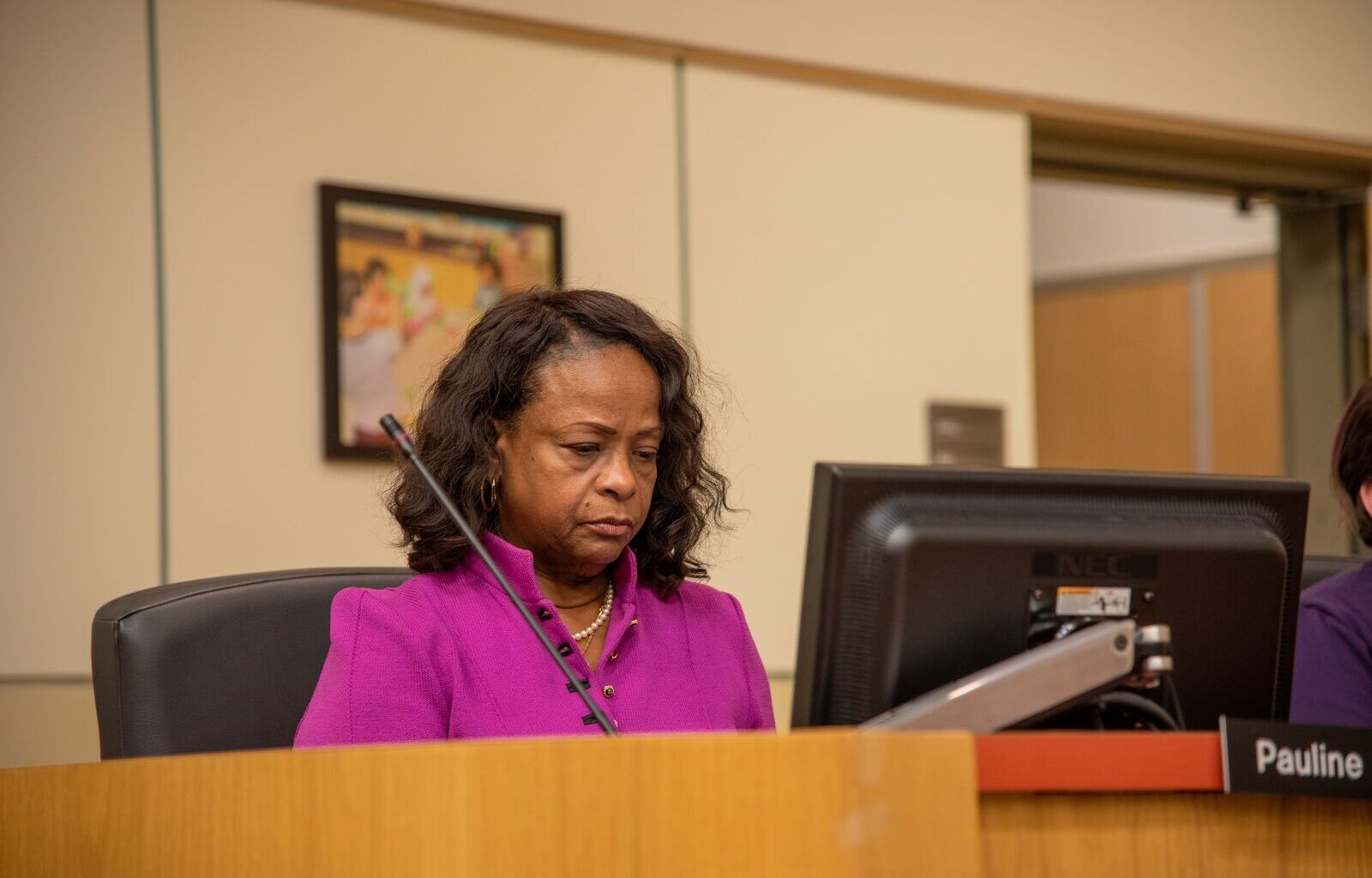
 BUSD Assistant Superintendent of Business Services Pauline Follansbee during a school board meeting in June 2023. The school board spelled out an early version of a budget-balancing plan that would leave a roughly $843,000 cushion for next year. Credit: Ximena Natera, Berkeleyside/CatchLight
A few weeks ago, Berkeley school district leaders were facing a $10.4 million budget deficit, with some pain coming from an early state budget plan from Gov. Gavin Newsom that could have meant the loss of up to $7.8 million in Proposition 98 funds for the district.
But after Newsom revised his budget on May 14 following pushback from educators, the Berkeley Unified School District (BUSD) is expecting a more palatable financial picture for the 2026-27 school year. District leaders are now confident they’ll get at least $2.7 million more in state revenue, including Prop 98 funds, than they had previously planned on.
The school board spelled out an early version of a budget-balancing plan Wednesday that would leave BUSD with a roughly $843,000 cushion for next school year — achieved via staff reductions, new transportation fees and central‑office cuts.
Under the plan, BUSD would avoid the most severe reductions, maintaining all of its college preparation programs.
But 21 non-teaching positions would still be cut, including all nine after-school coordinators, an ethnic studies teacher and administrative positions at Berkeley High and Berkeley Tech. District leaders are considering shifting additional costs into longer-term sources of funding, like the Berkeley Schools Excellence Program (BSEP), a local special tax that supports public education, among other steps.
BUSD officials are still reviewing the details of the budget‑balancing plan, which aims to close a multi‑year deficit without destabilizing classrooms, and an update will be presented at the board meeting next Wednesday, May 27.
After the governor’s revised budget, “it’s like, ‘Oh, maybe there are options,’” school board director Jennifer Shanoski said Wednesday. “I look forward to next week’s discussion, where we have a better understanding of what those numbers look like, and we can make more strategic decisions.”
State law requires the school board to adopt a balanced budget by June 30 each year.
But the district still faces some financial uncertainty in the long term. Even after the governor’s revised budget, Berkeley Unified projected about a $600,000 deficit in its Local Control and Accountability Plan (LCAP) supplemental budget, which pays for services aimed at high‑need students. BUSD officials said some of that gap could temporarily be covered by one‑time funds, but staff warned that those dollars will run out within a few years.
What’s driving budget deficits and revenue at BUSD?
BUSD’s deficit, like that of other school districts, is being driven in large part by enrollment declines that began during COVID-19. While BUSD enrollment has inched upward in recent years, it remains below pre‑pandemic levels, reducing the funding it receives through students’ average daily attendance.
Compounding the problem, special education costs are growing faster than state funding, and one‑time grants, like COVID-19 relief money, are expiring.
Labor costs have also increased, with the Berkeley Federation of Teachers securing 6% wage increases over two years and higher health benefits in a new contract. The district negotiated with all four of its unions this year, with projected costs reaching $8.7 million in 2026‑27 and $7.6 million each in the next two years. BUSD leaders note that about 80% of the budget is tied to personnel expenses, and they anticipate a mid-year budget increase next year to cover negotiated benefits.
During Wednesday’s meeting, BUSD board members pulled five top administrators’ employment contracts, including Superintendent Enikia Ford Morthel’s, from the consent agenda for further review. The contracts contained proposed salary increases, with Morthel’s containing a 2.5% retroactive raise for 2025-26 and a 3% increase the following year. The superintendent’s salary was $310,200, as of July 2025.
The increasing expenses are putting pressure on the district’s finances, pushing BUSD to move forward with additional cost‑cutting. BUSD is consolidating administrative positions and making about $75,000 in cuts to the Home and Hospital program — which serves students with disabilities who cannot attend school for long periods — to stabilize the budget. BUSD removed job vacancies last year and the year before; leaders said there are no savings from closing positions in the 2026-27 school year.
Additional savings would come from eliminating duplicate roles, reducing printing costs ($867,000), and requiring non‑union employees earning over $125,000 to take five furlough days.
To increase revenue, the district is planning to collect a $1 bus transportation fee for non-BUSD after‑school programs, totaling $242,680 for the year and impacting about 700 students. BUSD is also expanding Medi‑Cal billing for eligible health services and shifting eligible expenses to fall under longer-term funding.
Even slight increases in enrollment are a bright spot in a difficult budget year. BUSD projects 15 additional students next school year, which would generate $13,860 per pupil, or about $194,000 more in revenue.
Additional funding includes a Pacific Gas & Electric reimbursement ($200,000 in one‑time support and $100,000 in ongoing funds), along with a $250,000 grant from the California Youth Behavioral Health Initiative. The district also expects $4.57 million from the state’s Student Support and Professional Development Discretionary Block Grant to fund academic, mental health and staff needs.
Community members on Wednesday praised the district for avoiding large cuts, but urged BUSD leaders to fully fund ethnic studies, maintain after-school coordinators and safeguard equity‑focused programs like the Bridge college preparation program for years to come.
BUSD’s planned budget reductions also include:
Transferring expenses to other funding sources to shift central office clerical costs away from the general fund.
Moving parent reports to a digital format to eliminate printing and distribution expenses.
Shifting BUSD’s LanguageLine contract to BSEP to reduce general fund spending on translation services.
Upgrading the district website and changing vendors to reduce long‑term maintenance and costs.
Reducing specialized printing and copying by limiting high‑cost print jobs across departments.
Making school‑site staffing adjustments by reducing Berkeley Tech Academy clerical support and eliminating duplicate Berkeley High School and BTA positions.
Scaling back Berkeley High wellness support tied to expiring grants.
“*” indicates required fields