
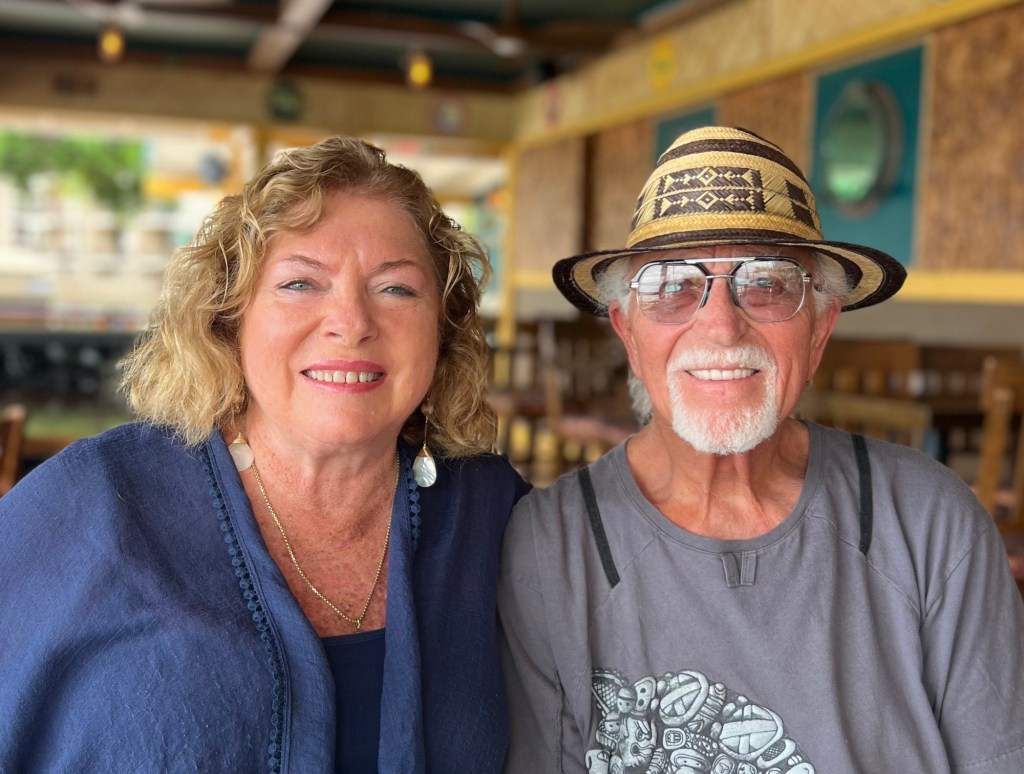
Ron Eisenberg called himself “forever young” — not just as a motto but as a way of life. At 85, he worked out with a personal trainer three times a week. He’d owned a beloved cookware store and cooking school for decades. He met his second wife, Devora, in traffic school. He played poker, traveled and made friends wherever he went. When he was diagnosed with pancreatic cancer in April 2024, the couple asked themselves: “How can we do this best?”
You may remember Eisenberg and his wife, Devora Safran, from my November column when I wrote about their decision to retire to Ajijic, Mexico — a life they described as one long adventure. What I didn’t know then was that he had recently been diagnosed with pancreatic cancer. He lived almost exactly one year from diagnosis — and spent that year living it his way.
He and Safran visited Cleveland (his hometown), Florida and San Diego to see old friends. His San Diego poker buddies planned games around his visits. They went to the New Year’s Eve party they always attended. And at 5:20 a.m. April 6, he slipped away at home in Ajijic with his night nurse next to him.
Shortly after Eisenberg’s death, I talked on Zoom with Safran and Loretta Downs, the death doula who guided his final days, about what a “good death” looks like. It is one of the most meaningful conversations I have had in all my years as a journalist.
Downs, 76, spent 30 years in sales management in Chicago’s home fashion industry before retiring at 50 and reinventing herself around a calling: helping people die well. Her path began in the 1980s, when the AIDS epidemic swept through her professional world, taking colleagues and friends. In 1995, she began volunteering on an AIDS ward at a major Chicago hospital where she saw that patients who accepted their dying — whose friends decorated their rooms, smuggled in small pets, threw parties — and then tended to go into hospice care and die peacefully at home. Those who fought dying often died alone in the ICU.
Downs went on to become a certified advance care planning facilitator and end-of-life care practitioner. She first visited Ajijic in 2012, gave a talk at the Lake Chapala Society and was surprised when 200 people showed up. Today, she mentors a network of a dozen active death doulas, holds monthly meetings and gives quarterly workshops on advance care planning.
The profession, which she notes is barely 10 years old, is rapidly integrating into the mainstream in the United States. A recent New York Times article focuses on Nicole Kidman’s interest in becoming a death doula after going through her mother’s death.
“Understanding dying teaches us how to live,” Downs told me. “When you accept it and plan ahead — rather than avoiding it out of fear — you can go on living more fully. Families that haven’t talked about the ‘what if’ end up managing a crisis. Those who have talked about it can simply be present with each other.”
Eisenberg and Safran had taken her “Death and Dying Lakeside” workshop before his diagnosis. They filled out detailed end-of-life wish forms — not just medical directives, but deeply personal ones. Eisenberg wrote that he wanted jazz music. He wanted someone to rub his feet. He wanted someone to wipe his lips with red wine. He wanted his wife to keep cooking for him until the end. He wanted to die at home in Ajijic surrounded by family and friends. “And you know what?” Safran told me. “We checked off every single one.”
After first being diagnosed in Mexico, the couple returned to San Diego, where they met with an oncologist who saw an 84-year-old man and essentially gave up on him, treating him as a “throwaway patient,” said Safran. That helped cement their decision to return to Mexico, even though Eisenberg’s treatments wouldn’t be covered by insurance.
After interviewing five doctors, Eisenberg chose a gentler chemotherapy regimen — CAPOX, an older protocol — at roughly $2,000 a cycle rather than the $10,000 per cycle they were quoted for the U.S. brand-name version. He never lost his hair. He rarely felt sick for more than a day or two. He completed seven cycles and planned travel around his infusion schedule. From the start, as Downs put it, the goal was quality of life, not quantity.
In late March, Eisenberg deteriorated sharply when the couple was in San Diego, dealing with fixing up their Point Loma house to get it ready to sell. He and Safran quickly returned to Ajijic with family members. Three days later, the palliative care doctor visited, and Eisenberg made his request.
“He was in his favorite recliner — the one we had brought from San Diego when we moved here — and he said, ‘I’m tired, and I’m ready,’” Safran recalled. “And then, to the doctor, very clearly: He wanted final sedation, and he wanted it now.” His wife was stunned. Eisenberg hadn’t warned her. “I said, do you mean you want to die now? And he said yes. I’m ready.” He was cracking jokes with the family just hours earlier.
Downs explained that Mexico does not allow physician-assisted death but does allow terminal sedation, whose purpose is to end the suffering, not to cause death. It is delivered through an IV slowly so the patient sleeps for the last days of their life, and they’re not eating or drinking. Eisenberg slept for two days and died peacefully the early morning of April 6.
“Many people who are surrounded by loved ones still slip away in a quiet moment. I told the family that’s intentional — that some people need to let go alone,” she said.
Downs coordinated care, helped the family understand Eisenberg’s limited energy for goodbyes, and guided everyone through those final days with what Safran calls “a minute of therapy.” After Eisenberg’s passing, Downs led a gentle ceremony: The family gathered flowers from the garden, arranged them around his body, placed a small glass hummingbird — his spirit animal — in his hand, and said their goodbyes. “That’s a sweet picture in my mind I will hold onto forever,” Safran said.
During our Zoom interview, a hummingbird appeared at the feeder just outside Safran’s window. We all noticed it.
Two days after Eisenberg died, family and friends gathered for a brief service at Ajijic’s small synagogue, followed by a luncheon at a lakeside restaurant. Safran had originally planned a party for Eisenberg’s 86th birthday on May 3. His birthday cake read “forever young,” and the guests sang happy birthday.
Now Safran is figuring out her next chapter. She plans to remain in Ajijic — the Point Loma house recently went into escrow — while making frequent trips back to San Diego. She wants to scatter some of Eisenberg’s ashes in Lake Chapala because he fell in love with the place in ways that still surprise her. The rest she plans to take traveling, sprinkling a little here and a little there, just as they traveled together when he was alive.
“When the diagnosis came,” she reflects, “we said, how can we do this best? And I think we gave him the best life and the best ending.”
A free resource recommended by Loretta Downs is The Conversation Project, which offers several guides, including a conversation starter, how to choose a health care proxy, and how to talk with a health care team.
Please email ideas for future columns to Barbara Bry at bbry@blackbirdv.com.