
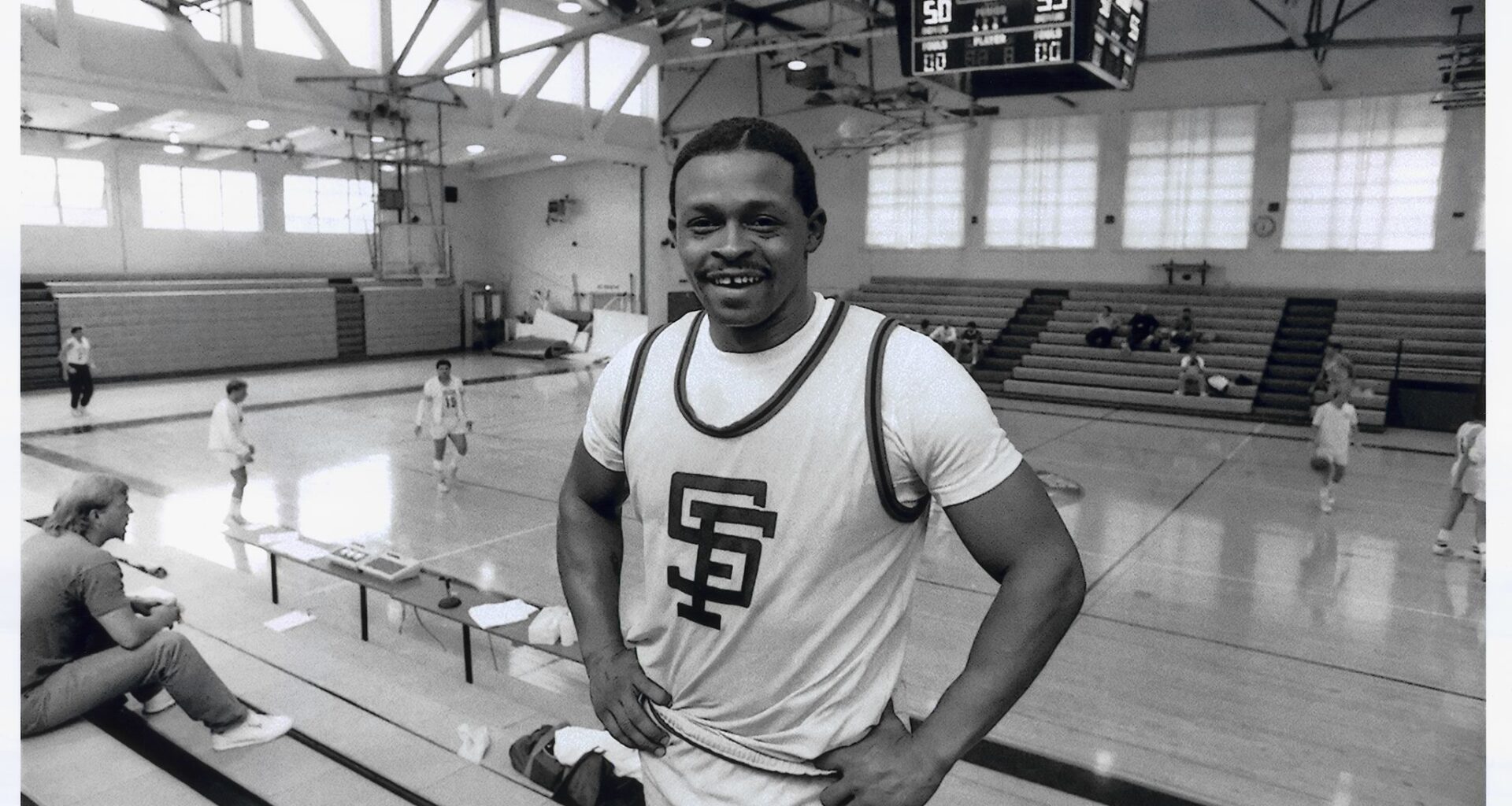
Glenn Burke prepares to play basketball at a San Francisco State gymnasium during the 1986 Gay Games.
Michael Maloney/The Chronicle
When Glenn Burke was a Los Angeles Dodgers outfielder in the 1970s he would room alone in the big city, in dive apartments far from the other players, so no one could question his personal life. His manager was a vocal homophobe.
“It was lonesome,” he told the Chronicle a decade later. “I’d just sit in my room and listen to music.”
But after the team’s 1977 playoff run, where Burke started a game in the World Series, he appeared as his full self at the Pendulum Bar in the Castro District — where hundreds of friends surrounded him in celebration.
Article continues below this ad
“The people there have been very nice to me,” he said. “They gave me the love I was missing.”
The Dodgers on June 5 will honor Burke for Pride Night, acknowledging the first American in a major league sport to come out as gay. But as major league teams make up for lost time, Burke’s life in San Francisco remains at best a footnote in his remarkable story.
San Francisco Chronicle Logo
Make us a Preferred Source to get more of our news when you search.
Add Preferred Source
His years in the Castro District were far from a happy ending. Burke died of AIDS-related illness destitute after bouts of homelessness in the late 1980s and early 1990s. But San Francisco is where he was embraced, made friends, and where Burke told the Chronicle he had his happiest athletic moments as an adult. San Francisco was where he was fully himself. San Francisco was home.
Burke was a star baseball and basketball player at Berkeley High in the 1960s, and a phenom in the minor leagues, once stealing 63 bases for the Dodgers Triple-A team in an abbreviated season. He was a defensive force in the majors but hit just .237 in four seasons with the Dodgers and Oakland A’s. And while teammates knew and mostly accepted his truth, Burke said Dodgers and A’s managers Tommy Lasorda and Billy Martin were openly hostile about his sexuality.
Article continues below this ad
Oct. 4, 1977: Glenn Burke takes batting practice at Dodger Stadium in Los Angeles before starting at center field for the Los Angeles Dodgers when they opened the National League Championships against the Philadelphia Phillies.
Associated Press
“I just didn’t want to beat my head against the wall for nothing,” Burke told the Chronicle in 1986. “I took voluntary retirement in 1979.”
He landed in the Castro, where he bought a home, joined the Pendulum Pirates gay softball team — which competed in annual games against the San Francisco Police Department — and helped elevate the Gay Games. He came out publicly in a 1982 Inside Sports feature headlined “The Dodger who was Gay.”
When the magazine called teammate and San Francisco Giants manager Dusty Baker about the story, Baker gave Burke a call.
“He said, ‘Tell ’em everything; I’m coming out of the closet,’” Baker recalled in a 1994 Chronicle interview. “He told me he was tired of living a lie.”
Article continues below this ad
Burke was remarkably frank in the 1982 article, displaying little bitterness and focusing on the welcoming community he found in San Francisco. But response to the story brought backlash, including a suggestion by Chronicle columnist Glenn Dickey that Burke should have stayed in the closet.
“Frankly I’ve had it with homosexual whining,” Dickey wrote. “If they’d only keep quiet about it, I wouldn’t care if their sexual preferences were for men, women or even goats. As Mrs. Patrick Campbell once put it, ‘As long as they don’t do it in the streets and frighten the horses.’”
May 27, 1978: Glenn Burke of the Oakland A’s looks the other way as Chicago White Sox catcher Bill Nahorodny applies belated tag in the fourth inning at Chicago.
Larry Stoddard/AP
Burke was just 29 when the piece was published. Friends in the Castro urged him to return to baseball and file a discrimination lawsuit if his comeback was denied. But the ex-major leaguer didn’t want to be the Jackie Robinson of gays in pro sports. He just wanted to be Glenn Burke, and he found a place to make that happen.
“I stuck it out. I made it,” he told the Chronicle while rejecting the prospect of a comeback. “They can’t ever tell me I couldn’t make it.”
Article continues below this ad
Burke had a few good years in the Castro, working with developmentally disabled children, playing softball and basketball, and throwing great house parties. But in 1986 a car drove into a crosswalk and smashed his leg. Already a cocaine user, he became addicted to opioids, couldn’t work and lost his home, eventually doing time in San Quentin on a grand theft conviction related to drugs. After that he faced bouts of homelessness, and contracted AIDS.
By the early 1990s, Burke made the news again as one of the thousands of Bay Area men dying. The Examiner’s Tim Keown visited Burke in San Francisco General Hospital AIDS Ward 5B.
“The forearms are still those of an athlete, strong and sinewy, but the rest of him is impossibly thin,” Keown wrote. “… Optimism here is strictly temporary; there is no hiding from the aggressively destructive nature of the disease.”
Even as he was wasting away, Burke showed little bitterness about his fate, expressing regret for the pain his drug addiction caused his friends and family. He died in 1995.
Former Major League Baseball player Glenn Burke sits in a Castro District restaurant in San Francisco in 1993. Burke, who died in 1995 at age 42, felt he was blackballed by the sport.
Mark Hundley/Associated Press
Burke made more headlines in the years that followed. He is credited by Baker and others as inventing the “high five.” Screenwriter Ken Levine acknowledged that his groundbreaking “Cheers” episode “The Boys in the Bar,” about a former Sam Malone teammate who comes out, was inspired by Glenn Burke.
Article continues below this ad
Erik Sherman in 1995 published “Out at Home: the Glenn Burke Story,” and local sports station NBC Sports Bay Area in 2010 premiered a thorough Burke documentary. When Sports Illustrated in May 2013 published a story depicting NBA center Jason Collins as the first male athlete from an American pro team to come out as gay, Bay Area sports writers, including the Chronicle’s John Shea, called out the magazine for neglecting Burke.
A few years later, A’s reliever Sean Doolittle and his future wife Eireann got behind a Pride Night with the Oakland A’s in 2015, pushed back against fans who protested, and Burke’s family members were invited to throw out the first pitch. The Dodgers earlier this month announced a permanent display in tribute to LGBTQ+ sports trailblazers including Burke.
How would Burke feel about his growing attention as an LGBTQ+ pioneer? He’s on the record about that too. In a 1994 interview with the Associated Press, one of his last, Burke described himself as “just basic people,” showing a wisdom that arguably exceeded his athletic achievements.
“Sometimes people put you on a pedestal. I’m not better than nobody and never wanted to be,” Burke said. “I played the sport and made it and made a name for myself. But it didn’t really matter to me. I just wish the world was a better place to live in.”