
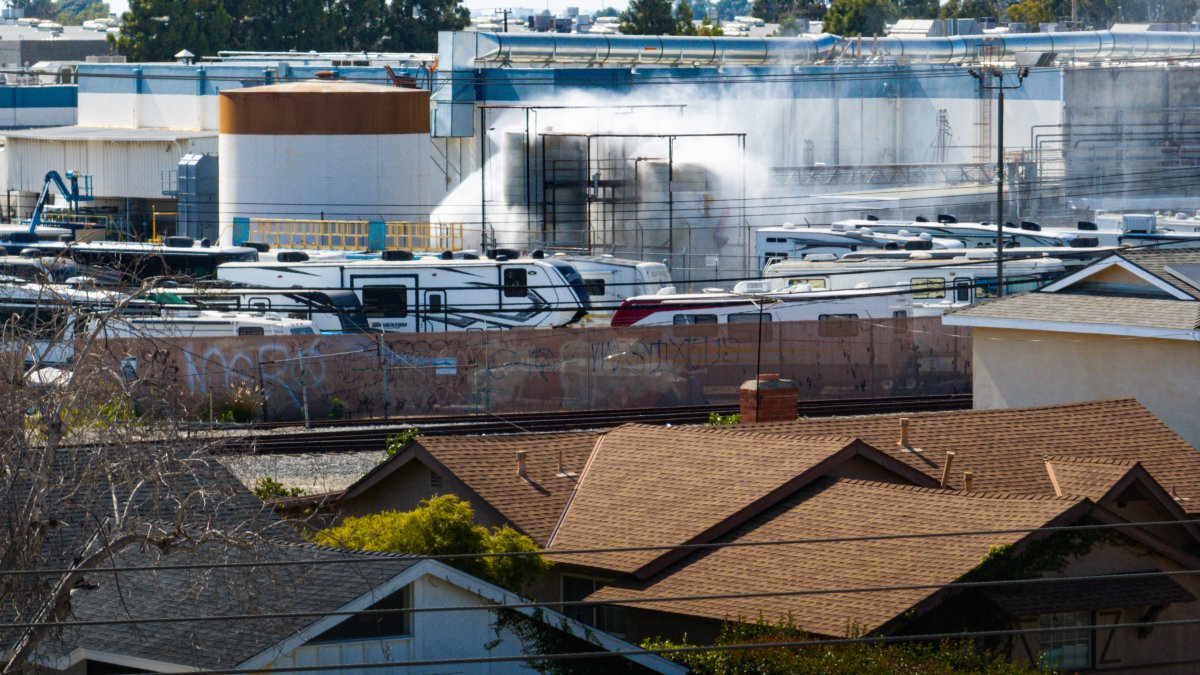
Firefighters grappling since last week with ways to reduce the threat of a toxic chemical tank explosion shared what they called “incredibly positive news” in a Monday morning update on the days-long emergency in Garden Grove.
There were grave concerns over the possibility of a storage tank explosion — referred to as a BLEVE — that could send a toxic chemical plume into the air at the aerospace facility near homes and businesses in the Orange County community. On Monday, the Orange County Fire Authority announced in a morning update that the risk of a BLEVE had been eliminated.
The announcement was considered a turning point in the crisis that began Thursday when a storage tank at GKN Aerospace began heating up with pressure building due in part to a pressure-release valve problem. Firefighters warned the tank would either spill its toxic contents or explode.
Evacuation orders were in place through the weekend and into Monday for about 50,000 people due to what authorities called an unprecedented and complex hazardous materials emergency. The tank contains methyl methacrylate, a colorless, volatile, flammable liquid chemical used in the manufacture of resins and plastics, can irritate the skin, eyes and nose in humans.
Here’s what to know about a BLEVE and what Monday’s annoucement means for the emergency in Garden Grove.
What is a BLEVE?
BLEVE stands for boiling liquid expanding vapor explosion. The term describes the process when a liquid inside a container overheats. If the liquid contained by the tank is above its atmospheric boiling point and then rapidly depressurizes, it can trigger a nearly instant transition from liquid to vapor and an explosion. The result can be a large aerosol fireball.
In their Monday morning update, fire officials said the temperature inside the tank and pressure levels were decreasing. OCFA members entered the danger zone around the tank overnight and confirmed that a crack in the tank was relieving pressure.
“The crack is there,” said Orange County Fire Authority Division Chief Craig Covey. “The tank has released its pressure. In addition to that, the temperatures has bene stabilized and actually reducing.
“That is incredibly positive news as we turn the corner on this incident.”
The Orange County Fire Authority said the temperature within the tank had dropped from 100 degrees to 93 degrees in an overnight reading.
A constant stream of water was sprayed on the tank since late last week to help reduce heat.
Spill or explosion?
Authorities said there is nothing leaking from the tank and the threat of an explosion was off the table, but there’s still the matter of the toxic chemical inside the problematic tank.
OCFA said a spill of the chemical was preferable to an explosion and possible plume of toxic material spreading over the area. In the event of a spill, emergency crews are working to execute a plan that would dam and contain the toxic chemical.
The elimination of the explosion threat means firefighters can enter the tank area at reduced risk and during daytime hours. Check on the overheated tank had been conducted at night, when the air temperatures cools, to reduce the risk to firefighters.
There are two other tanks near the tank with a faulty pressure-release valve. Authorities said they were able to neutralize the chemical in at least one of those tanks.
When will Garden Grove evacuations be lifted?
Evacuations remained in effect early Monday for about 50,000 people. The evacuations were ordered late last week due to the threat of a BLEVE sending the toxic contents of the tank into the air.
For residents in the evacuation zone, the hazardous materials situation triggered an unsettling chain of events that continued to play out over the weekend. Evacuation shelters were at or near capacity and there was no immediate word on when resident will be allowed to return home.
Several schools in the area are closed until further notice.
An update was expected in the coming hours on evacuation orders.