
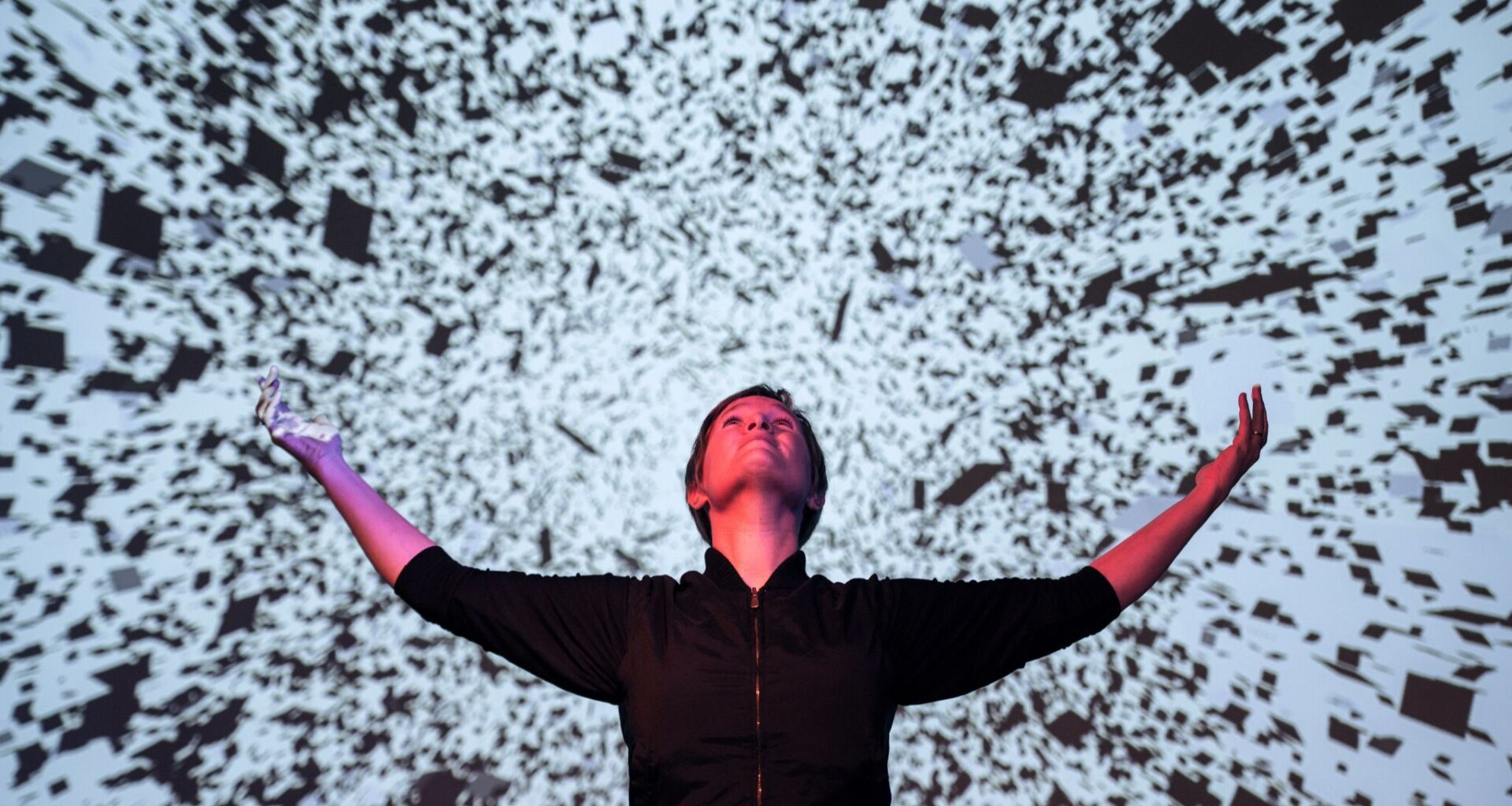
Courtesy Anne Hege
Michelle Kennedy as Eurydice, lef,t with Anne Hege in a workshop for “The Glance.”
Don Fogg/Laptopera Productions
Sidney Chen, left, and Michelle Kennedy in a workshop for “The Glance.”
Don Fogg/Laptopera Productions
The term “laptopera” may sound like Silicon Valley jargon, but it describes a distinctly modern form of musical theater built around portable computers and live electronic sound.
Composer Anne Hege uses the form to reinterpret the Greek myth of Orpheus and Eurydice in Laptopera Production’s “The Glance,” premiering at San Francisco’s ODC Theater on Friday-Sunday, May 29-31. In her retelling of how Orpheus attempts to rescue his lover from the underworld, digital instruments and motion-tracking devices tell a story of intimacy, control and transformation.
Unlike a conventional orchestra of strings, woodwinds, brass and percussion, the production uses “instruments” composed of laptops and the software installed on them. Several speakers, game controllers, iPhones, a radio transmitter and a tape machine constructed from three cassette players and the singers themselves make up the orchestra.
Article continues below this ad
The very motion of the performers playing Eurydice (soprano Michele Kennedy) and Hades (bass Sidney Chen) provides data that the software and laptops then translate into sound.
Sidney Chen as Hades in a workshop for
“The Glance.”
Don Fogg/Laptopera Productions
“Elements of the music are processed live in performance,” Hege told the Chronicle, noting that the workflow “can include pitch changes, delay, reverberation and filtering.”
“The Glance”: Laptopera Productions. 8 p.m. Friday-Saturday, May 29-30; 4 p.m. Sunday, May 31. $40-$150. ODC Theater, 3153 17th St., S.F. 415-549-8534. www.odc.dance
Kennedy, for instance, wears a skirt affixed with eight cables connected to four posts, in the corners of the stage, that also hold speakers. The skirt transmits her movements to the laptop, where it is translated to sound.
Article continues below this ad
San Francisco Chronicle Logo
Make us a Preferred Source to get more of our news when you search.
Add Preferred Source
Chen’s counterpart hardware is an iPhone strapped to one forearm. He also maneuvers a large hoop about the stage during “The Glance.”
“In my imagination,” Hege explained, “(the hoop] is the way that Hades is managing sound movement in the underworld. It filters the sound of the underworld, and we can hear that through his movement.”
Kennedy’s tethered costume visually reinforces the ways in which Eurydice is bound by external forces, a constraint echoed in her music.
During the first act, Eurydice can only sing within an octave range, from the note D immediately above middle C to the D one octave above. She is limited in her relationship with Orphea (yes, a woman, sung by queer experimental vocalist Carmina Escobar) who treats her abusively. They’re not the blissful couple of the original Greek myth, and it’s Orphea, not a snake, who kills Eurydice.
Article continues below this ad
Michelle Kennedy as Eurydice in a workshop for “The Glance.”
Don Fogg/Laptopera Productions
Thus, “The Glance” reinterprets the Orpheus and Eurydice story as one of intimate violence.
Hege noted that her late father, a physician, believed the myth was about surveillance and mistrust. In that story, Orpheus, unable to fully trust that Eurydice is following him out of the underworld, looks back and loses her. Here, in the second act of “The Glance,” the story focuses on growth and transformation, as Eurydice is freed of the tethered skirt and begins to assert herself.
Lest this sound dry or mechanical, the music of “The Glance” is anything but. There is a vocal score for the singers and little processing of the voices. Meanwhile, there is a deep electronic musical track reminiscent of chant or a passacaglia’s repeating bass line, and some of the laptopera’s music is improvised by the singers.
The interconnectedness of the elements in “The Glance” is a natural outgrowth of Hege’s interests and studies. She wrote her doctoral dissertation at Princeton University on embodied cognitive theory and how performances speak to the body.
Article continues below this ad
Her path to these subjects ran through composer Meredith Monk, whose works Hege had encountered as an undergraduate.
“Her talk about starting with the body, starting with these kinds of embodied rehearsals, creating things for specific singers and their bodies, made complete sense to me,” she said.
Hege’s process, like Monk’s, is highly collaborative. Chen, who has performed with Monk, commented that he, Kennedy and Escobar come from different musical backgrounds and that working on “The Glance” has been “a really fun, collaborative environment. Let’s figure out what we each are bringing into the space, and how can that inform what we’re doing.”
Carmina Escobar as Orphea in Laptopera Productions’ “The Glance.”
Don Fogg/Laptopera Productions
Where Kennedy draws on her Baroque background to add ornamentation to Eurydice’s music, Escobar approaches the role through improvisation and extended vocal techniques.
Article continues below this ad
“I was always attracted to weird sounds,” Escobar said, acknowledging that audiences may find it “a little bit more chaotic” because of the nature of the tape machine.
The result is an experimental work where technology provides the framework, but the singers’ performances give “The Glance” its historical resonance and emotional force.
Lisa Hirsch is a freelance writer.