
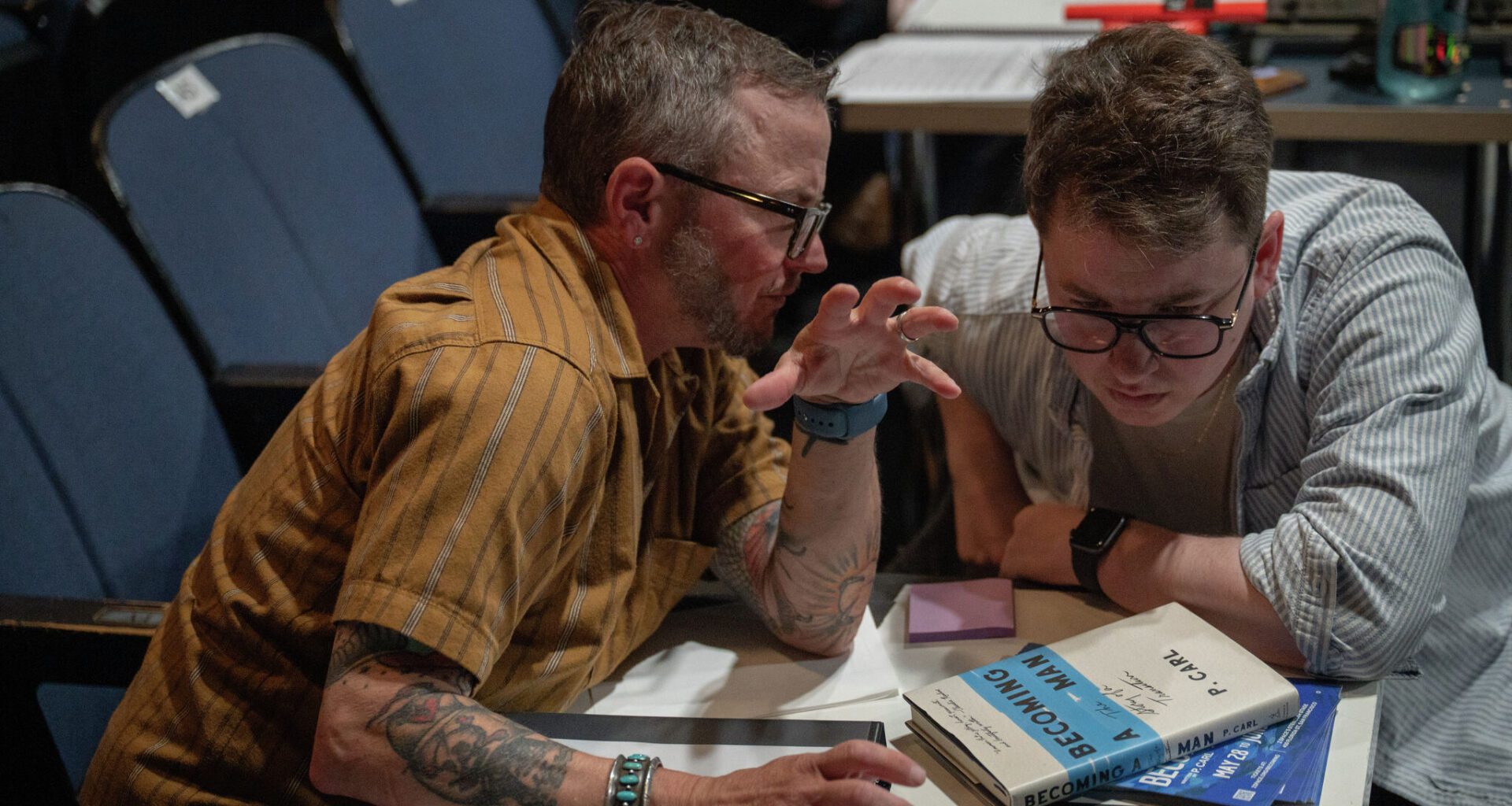
Writer P. Carl (left) talks with Lyam B. Gabel, director, during rehearsal of “Becoming a Man” at Z Space on Wednesday, May 6, 2026 in San Francisco, CA. “Becoming a Man” adapted from P. Carl’s memoir of the same name is about what it was like to take on male privilege after his gender transition.
Amy Osborne/For the S.F. Chronicle
Director Lyam B. Gabel (left to right) runs through a scene with Casimir Kotarski, Petey Gibson during rehearsal for “Becoming a Man” at Z Space on Wednesday, May 6, 2026 in San Francisco, CA. “Becoming a Man”, adapted from P. Carl’s memoir of the same name, is about what it was like to take on male privilege after his gender transition.
Amy Osborne/For the S.F. Chronicle
Writer P. Carl sits for a portrait Z Space on Wednesday, May 6, 2026 in San Francisco, CA. “Becoming a Man”, adapted from P. Carl’s memoir of the same name, is about what it was like to take on male privilege after his gender transition.
Amy Osborne/For the S.F. Chronicle
“Becoming a Man”, P. Carl’s play, adapted from his memoir of the same name, about what it was like to take on male privilege after his gender transition at Z Space on Wednesday, May 6, 2026 in San Francisco, CA.
Amy Osborne/For the S.F. Chronicle
When the character of Carl tries to speak up for a woman in a fight, it hits differently now.
Before he transitioned, it would have read as sisterhood. Now — coming from the same impulse, with the same consciousness and life history — he’s “a guy yelling at another guy.” He’s cutting a woman off, as if she can’t speak for herself.
“Becoming a Man”: Written by P. Carl. Directed by Lyam B. Gabel. Performances begin Thursday, May 28. Through June 14. $35-$75. Z Space, 450 Florida St., S.F. 415-626-0453. www.zspace.org
In P. Carl’s autobiographical play “Becoming a Man,” which begins performances Thursday, May 28, at Z Space, Carl’s gender transition has mostly already happened.
Article continues below this ad
Now new questions loom: Are Carl and his wife still queer? What about her attraction to women? And how does he negotiate his new male privilege — whether at the pub back home in Boston or visiting his ailing parents, with whom he has a strained relationship, in Elkhart, Ind.?
Carl, who adapted the play from his memoir of the same name, confirmed that the world really does treat him differently now that he’s a man.
Casimir Kotarski (left to right), Petey Gibson, and Lyam B. Gabel, run through a scene during rehearsal for “Becoming a Man” at Z Space on Wednesday, May 6, 2026 in San Francisco, CA. “Becoming a Man”, adapted from P. Carl’s memoir of the same name, is about what it was like to take on male privilege after his gender transition.
Amy Osborne/For the S.F. Chronicle
“It’s everything,” he told the Chronicle before a recent rehearsal. “My wife will be on the phone with somebody and get one thing, and then I call back and get treated a totally different way, and it just makes her enraged.”
San Francisco Chronicle Logo
Make us a Preferred Source to get more of our news when you search.
Add Preferred Source
In most places Carl goes, “Men talk to men in a certain way, and they talk to women in another way.”
Article continues below this ad
His work and personal lives have their own bifurcation, he went on. On campus at Emerson College, where he’s an artist-in-residence, he’s “the trans queer icon,” as the first trans faculty member there.
“Then in my other life, I’m just rolling around on my motorcycle, taking bird photos — like a guy,” he explained. (Full disclosure: Carl was also briefly an editor of mine at the theater site HowlRound.)
Z Space Executive Director Shafer Mazow, who’s also a trans man, said he and Carl have led “parallel lives.”
P. Carl, writer, (left) and Shafer Mazow, executive director, sit for a portrait Z Space on Wednesday, May 6, 2026 in San Francisco, CA. “Becoming a Man”, adapted from P. Carl’s memoir of the same name, is about what it was like to take on male privilege after his gender transition.
Amy Osborne/For the S.F. Chronicle
“We’re of a similar generation, where transitioning was not an option and assuming a butch-dyke identity was, so you took that as far as you could,” he explained. “ Then the world offered up other opportunities.”
Article continues below this ad
Mazow, like Carl, noticed he was treated differently as a man. “I could speak more in meetings,” he said, “and people listen to me more than they ever did before.”
But sometimes, people “assume” he has privilege that he doesn’t.
“I have a whole lived experience and an internal life that was formed by being born and raised a girl, by not being recognized as someone who fit in society at all,” he pointed out. He’s not just a man; he specifically identifies as a trans man.
A related conflict figures into the play, which is directed by Lyam B. Gabel. In one scene, Carl (Petey Gibson) and fellow trans man Nathan (Casimir Kotarski) debate what it means for Carl and his wife Lynette (Laura Domingo) to pass as a straight couple. They also argue about whether it’s OK that Carl “kind of” likes doing so.
Rehearsal of “Becoming a Man” at Z Space on Wednesday, May 6, 2026 in San Francisco, CA. “Becoming a Man”, adapted from P. Carl’s memoir of the same name, is about what it was like to take on male privilege after his gender transition.
Amy Osborne/For the S.F. Chronicle
Rehearsing that confession, Gibson smiled through a wince, as if he were getting pleasure through pain.
Article continues below this ad
That moment — two trans male characters sharing different experiences of being trans — on its own makes “Becoming a Man” a trailblazer.
Another rare quality is how it lets Carl be flawed — which is to say, more fully human.
In the play, as Carl argues with Lynette, he can be self-centered, not seeing Lynette’s pain when she asks, “What’s my part in this new life of yours?” Some of his remarks even sound sexist. All the while, he accuses Lynette, “You don’t like how I look,” demanding that she say his new name.
For trans audiences, such unvarnished honesty can be a lifeline. Carl recalled that when the show premiered at American Repertory Theatre in Boston two years ago, a young trans audience member told him, “I feel like I can make some mistakes now.”
“Becoming a Man”, P. Carl’s play, adapted from his memoir of the same name, about what it was like to take on male privilege after his gender transition at Z Space on Wednesday, May 6, 2026 in San Francisco, CA.
Amy Osborne/For the S.F. Chronicle
But the play, part of Z Space’s new Trans Artists Initiative, is not just for trans audiences.
Article continues below this ad
“The world needs to see us as real people,” Mazow said, citing an online anti-trans legislation tracker that currently tallies more than 650 active such bills across the country. “The world needs to see this human being trying to be his best self. He happens to be doing it through transition.”
The play deepens that portrait by making the bold choice of including Carl’s pre-transition identity as a character, Polly (Shoana T. Hunt). Carl said he’s very aware of provoking accusations of deadnaming, or referring to a trans person by a name used pre-transition.
“I transitioned at 49, 50, and I’d been in a relationship for 20 years,” he said. “I was not going to kill off the person who’d been in that relationship for 20 years unless I wanted to kill off the relationship, which I did not.”
A copy of P. Carl’s memoir is seen during rehearsal for “Becoming a Man” at Z Space on Wednesday, May 6, 2026 in San Francisco, CA. “Becoming a Man” is about what it was like to take on male privilege after his gender transition.
Amy Osborne/For the S.F. Chronicle
For Carl, having Polly onstage literalized one facet of transitioning, which was like having an angel and a devil on each shoulder. Each time the character of Carl says something brutish, he explained, “Polly rolls in, like, ‘My friend, we know quite a bit about feminist history and theory.’”
For Mazow, the choice made total sense.
“In a trans life, your past self comes with you whether you want it to or not,” he said.
Carl pointed out that from Polly’s point of view, “He’s living what she wanted.”
“So she wants him not to f— it up because she worked really hard to get him there,” he continued. “Now he needs to remember why he’s there and how he got there.”