
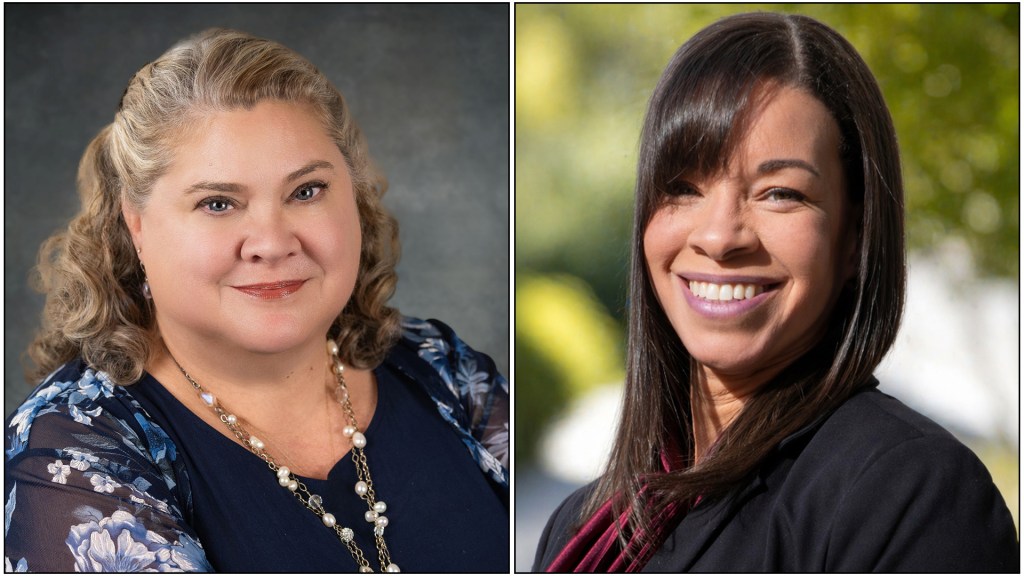
There are two contested local Superior Court judge elections on the June 2 ballot. For Office No. 31, both Jodi Cleesattle, a supervising deputy attorney general for the state of California, and Adam Noakes, an administrative law judge with the state Health and Human Services Agency, have won the blessing of the San Diego County Bar Association. It rated Cleesattle as “exceptionally qualified” and Noakes as “well qualified.”
The U-T Editorial Board has no reason to doubt that both would be competent judges. But we give the edge to Cleesattle. Her thoughtful, analytical responses to questions from a U-T editorial writer stood out among the judicial candidates who were interviewed.
For one example, Cleesattle, a trial lawyer for 32 years, was asked about a disturbing 2009 National Academy of Sciences report on forensic science in law enforcement. It warned that many commonly used tools — starting with analysis of bullet markings, bloodstain patterns and bite marks — lacked rigorous empirical foundations despite decades of courtroom acceptance. Contrary to the certitude about the validity of these techniques offered by TV shows like “CSI,” their reliability is very much in doubt. This is why the Maryland Supreme Court in 2023 ruled that it would no longer accept ballistics evidence — purported “gun DNA” — as credible.
She acknowledged the legitimacy of concerns that “junk science” was accepted uncritically in some courtrooms by juries after alleged “expert” testimony. But she also cited evidence that eyewitness testimony was not as reliable as assumed. People “are overconfident in our abilities to recall who we saw and the facts that we observed.”
For judicial Office No. 31, the U-T Editorial Board endorses Jodi Cleesattle.
In the second contested judicial election, for Office No. 32, the choice was more complicated. Nicole D’Ambrogi — a law professor and practicing lawyer with a varied background in estate planning, conservatorships, guardianships, family law hearings and civil disputes — was found to be “not qualified” by the county Bar Association. In an interview with an editorial writer, D’Ambrogi made a strong case that the process by which the association reached this conclusion reflected an entrenched bias toward judicial candidates who were “government attorneys” and was not clear, objective or consistent. She also offered thoughtful observations in response to questions about legal issues and philosophy, in particular about the tension between the traditional view that judges should be umpires calling “balls and strikes” and the view of some that they should be problem-solvers.
Her main opponent is Tia Ramirez, a chief deputy city attorney for the city of San Diego who leads the City Attorney’s Office’s pioneering, highly regarded Gun Violence Reduction Unit. The county Bar Association rated Ramirez as “qualified,” its third-highest evaluation rating for judicial candidates. In an interview with an editorial writer, she offered a forthright and well-reasoned “no” response to a general question as to whether judges should have larger agendas than upholding the law. Yet she otherwise came across as unusually cautious and unrevealing. Two questions about the wisdom of mandatory minimum sentences — a very contentious topic in legal circles — yielded only brief responses.
But Ramirez’s impressive résumé and her lengthy, bipartisan list of endorsements from judges and former judges ultimately matter more.
For judicial Office No. 32, the U-T Editorial Board endorses Tia Ramirez.