
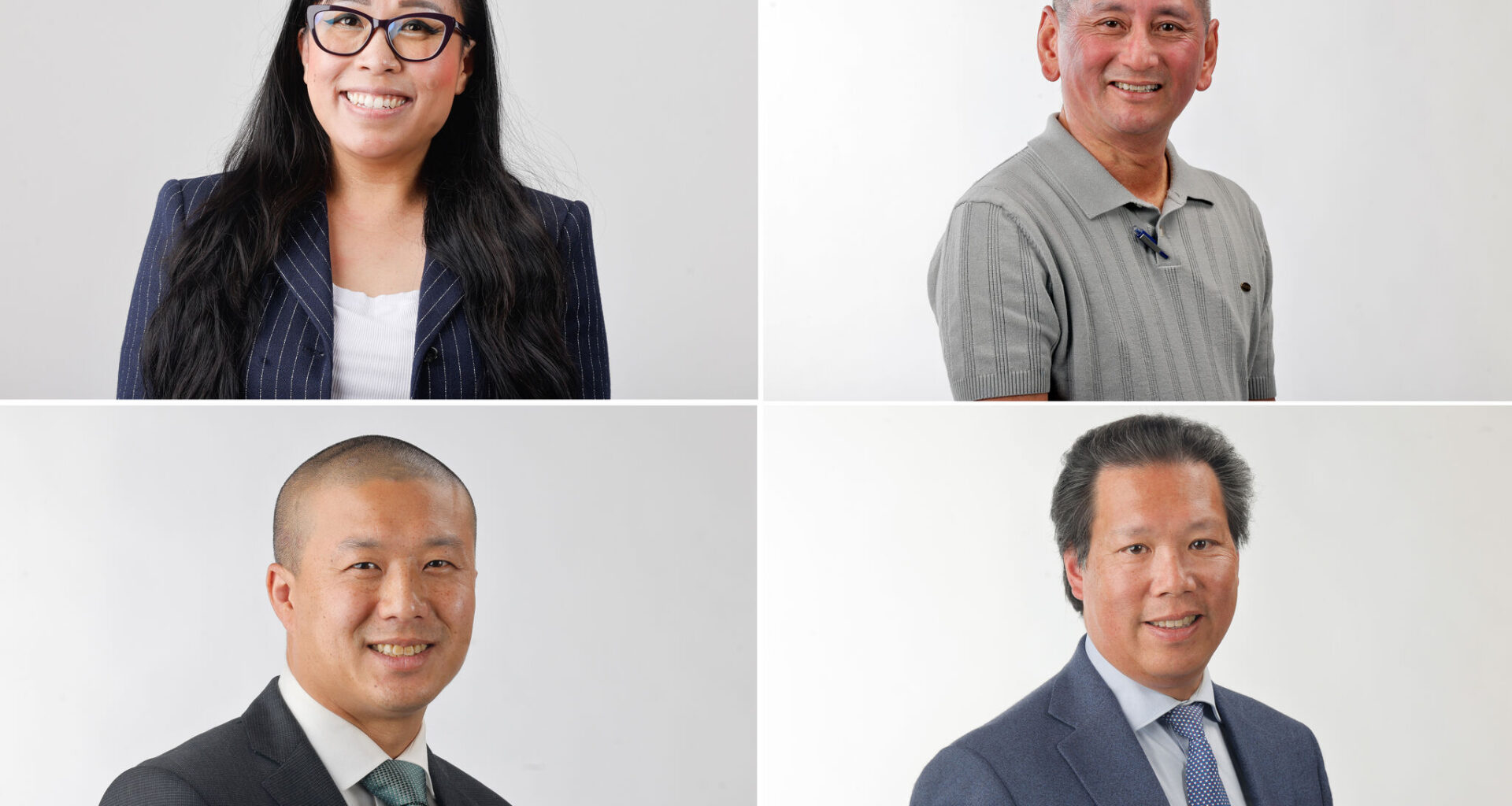
Clockwise from top left: Natalie Gee, Albert Chow, David Lee or Alan Wong are the leading candidates for District 4 supervisor in San Francisco.
Lea Suzuki/S.F. Chronicle
When Joel Engardio was elected to the San Francisco Board of Supervisors in 2022, he broke a two-decade streak of Chinese Americans representing District 4.
On Tuesday, unless there’s a major upset, a Chinese American once again will be elected as District 4 supervisor.
Engardio was recalled by voters last year, and the four presumptive favorites in the special election to finish his term are Chinese American — Alan Wong, who was appointed by Mayor Daniel Lurie to fill the seat; Albert Chow, hardware store owner and a leader of the recall campaign; Natalie Gee, an aide to District 10 Supervisor Shamann Walton; and David Lee, an educator and former Recreation and Parks Commission member. Political newcomer Jeremy Greco is the lone non-Chinese American candidate.
Article continues below this ad
About half the population in District 4, mostly the Outer Sunset neighborhood, is Asian American, and most of them are Chinese.
Does the District 4 supervisor need to be Chinese American? No, but when one group represents a large proportion of the population, it helps. Gordon Mar, who narrowly lost to Engardio in 2022, told me it matters that a Chinese American is in the District 4 seat.
San Francisco Chronicle Logo
Make us a Preferred Source to get more of our news when you search.
Add Preferred Source
“Representation does build trust, cultural understanding and a stronger connection to City Hall, especially with respect to the District 4 seat,” Mar said. “But representation alone isn’t enough, and the role of a supervisor is really about how that perspective translates into governance.”
Representation can lead to policy that matters.
Article continues below this ad
Former Assembly Member Phil Ting said if he and other Asian American lawmakers didn’t raise their voices, there might not have been a robust state response to anti-Asian hate that spiked with the pandemic. The Asian Pacific Islander Legislative Caucus pushed for funding that led to the allocation of $156 million in 2021 for anti-hate initiatives, including public safety and mental health services.
“You see what happens when there are Asian American voices or people representing their own communities in legislative bodies or in elected bodies, they bring those perspectives in,” Ting, who represented San Francisco’s west side from 2012 to 2024, told me. (Full disclosure: My wife went to graduate school with Ting and has volunteered for his election campaigns.)
But it’s not right to vote based on a candidate’s race, right? Yet, San Francisco State political science Professor Jason McDaniel told me that that’s what often happens.
Race is an “information shortcut” for voters that tells them what a candidate is about when lacking identifiers such as party affiliation or knowledge of policy positions.
“A shared sense of interest and identity. Community. Connections,” McDaniel said. “Racial identity is, I think, one of the most powerful things.”
Article continues below this ad
That’s not to say Chinese Americans vote only for Chinese Americans, or that elected leaders can’t represent the interests of a different ethnic or racial group. But the lived experience helps.
Engardio certainly misjudged the blowback he would get for championing Proposition K in 2024 to close the Great Highway for what became Sunset Dunes park — the issue that got him recalled. Perhaps if Engardio had a deeper connection to the Chinese American families in the Sunset who rely on their cars and opposed the closure, he might not have been so quick to sign on for putting the initiative on the ballot.
“I think having a supervisor who can bring those deeper perspectives through their lived experience that are common with a large proportion of the community helps navigate complex and contentious issues like addressing the housing affordability,” Mar said.
That’s not to say all Chinese Americans, or District 4 voters, agree on the Great Highway or other issues.
“The Sunset is far from monolithic, despite the simplistic narrative that we are all conservative homeowners,” said Mar, who is leading a new progressive political group on the city’s west side.
Article continues below this ad
Mar said there’s a generational shift in many Chinese American households.
“What we’re seeing is that younger folks who grew up in the Sunset often hold much more progressive perspectives than their parents or grandparents on contentious issues, whether that’s the Great Highway, affordable housing or even public safety.”
Some of what Mar says might be coming to fruition with this crop of candidates in District 4. Gee is probably to the left of everyone else in the race, with Chow toward the center and Lee and Wong in between.
There was a time when there might be just one Chinese or Asian American candidate in an election — the fight was to get any representation. Now the challenge will be who has the best ideas. That’s a great outcome, no matter who wins.
Thursday in Opinion: Oakland Measure E endorsement
Oakland voters are being asked again if they want another tax to fund vital city services.
Article continues below this ad
The city has gone to the ballot box repeatedly for funding — Oakland residents now pay some of the highest local taxes in California, but as our editorial board endorsement points out, they still have deteriorating public services, chronic budget instability and widespread frustration over basic city governance.
Guest opinions in Open Forum and Insight are produced by writers with expertise, personal experience or original insights on a subject of interest to our readers. Their views do not necessarily reflect the opinion of The Chronicle editorial board, which is committed to providing a diversity of ideas to our readership.
Read more about our transparency and ethics policies
However, Measure E’s parcel tax, like many before it, will pay for worthy goals — mainly for improving 911 times, violence prevention, fire and emergency medical services, homelessness encampment mitigation and illegal dumping cleanup.
Is Measure E’s tax worth it for Oakland residents? Find out what the editorial board recommends in its endorsement.
You’re reading the Opinion Central newsletter.