
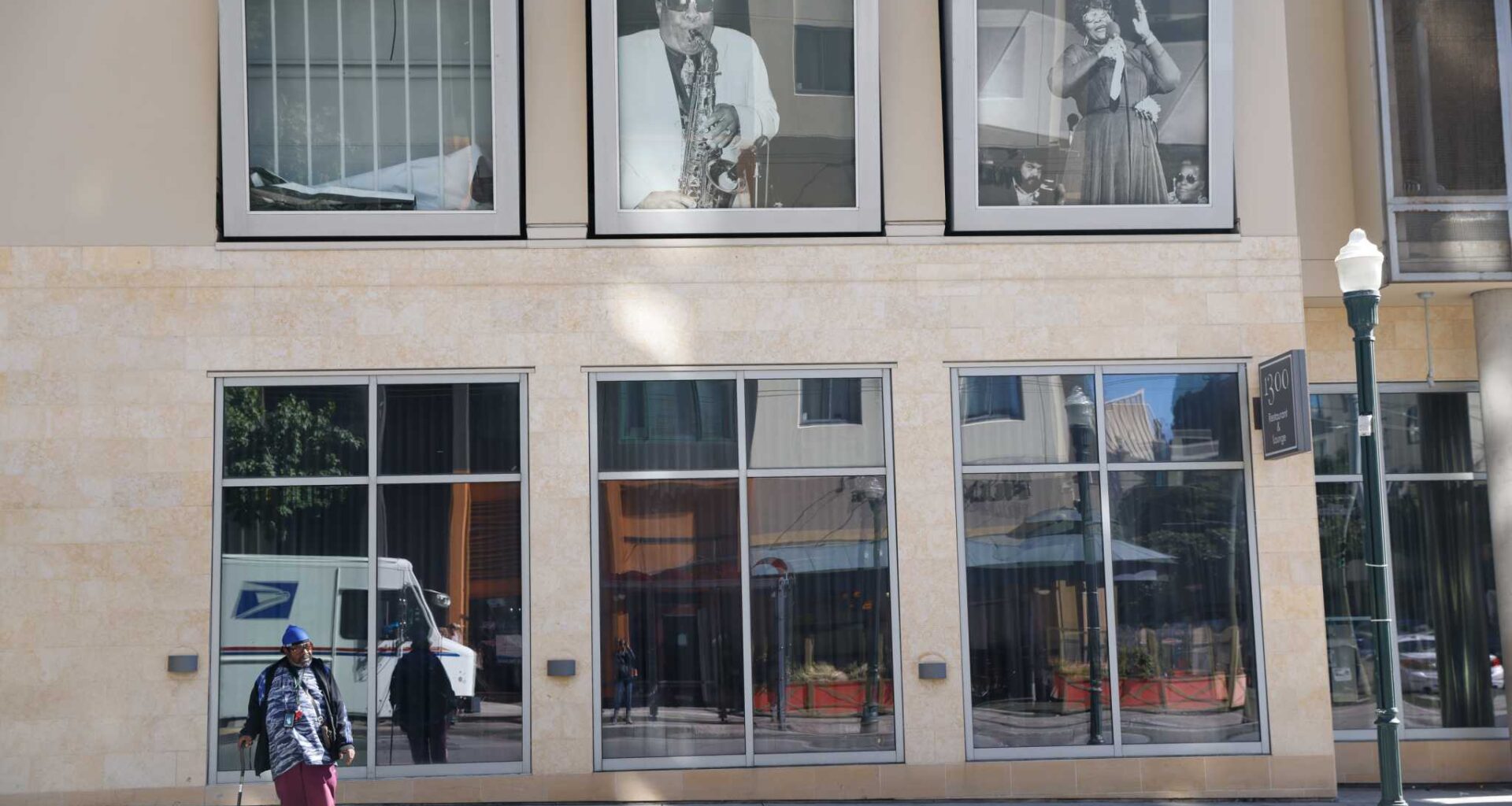
A pedestrian waits for a bus next to the Fillmore Heritage Center in 2024. The long-dormant building will be reopened, temporarily.
Lea Suzuki/The Chronicle
Just days after a contentious debate over governance at the Ella Hill Hutch Community Center, San Francisco’s City Hall is now taking another step toward reviving one of the Fillmore neighborhood’s most visible dormant landmarks: the long-shuttered Fillmore Heritage Center.
City officials announced Thursday that the Heritage Center, which years ago served as the home to Yoshi’s nightclub at Fillmore and Eddy streets, will reopen temporarily through December for short-term activations and events led by local community groups, artists and small businesses. The effort is aimed at bringing life back to a building that many residents have long viewed as both a cultural touchstone and a reminder of the city’s unfulfilled promises to the historic Black neighborhood.
For years, the Fillmore has been shaped by an ongoing struggle to reclaim what decades of redevelopment and disinvestment took away — from the unrealized promises of economic revival to the shuttered community spaces that came to symbolize a historically Black neighborhood still waiting to see those promises fulfilled. Mayor Daniel Lurie said in a statement Thursday that the city’s latest plan for the Heritage Center “honors the legacy of the Fillmore while creating new opportunities for the people and small businesses that make this neighborhood special.”
Article continues below this ad
Starting next month, the Office of Economic and Workforce Development, or OEWD, plans to begin rolling out temporary programming inside the space while opening the doors to outside organizers looking to host public events, performances, pop-up businesses and community gatherings there. Applications for groups and creators interested in programming the Heritage Center are expected to open at the end of June, part of what city officials describe as an effort to test new uses for the building and reestablish it as an active neighborhood destination after years of vacancy.
The Fillmore Heritage Center is seen reflected in the window of a commercial space for lease on Fillmore Street in 2024.
Lea Suzuki/The Chronicle
“OWED is committed to working collaboratively with the community and making the investments to ensure that Fillmore is a vibrant commercial corridor,” said Diana Ponce De Leon, OEWD’s acting director, who confirmed that private events will not be permitted for the time being.
San Francisco Chronicle Logo
Make us a Preferred Source to get more of our news when you search.
Add Preferred Source
The city’s initiative will not provide funding for community groups to host events, though use of the heritage center will be free.
Article continues below this ad
At the same time, the city plans to begin evaluating what it would take to permanently reactivate the 50,000-square-foot complex, including infrastructure upgrades. Officials said the effort will include both a facilities assessment and a broader market study aimed at determining the Heritage Center’s “highest and best use” moving forward.
The city expects to complete a full assessment and cost estimate for reopening the existing spaces while simultaneously studying whether an entertainment and dining concept remains financially feasible in today’s market. The findings, expected in the coming months, will help shape a community-driven process around the center’s permanent future.
All possibilities, including potentially selling the property, remain under consideration.
The move places two major Fillmore community hubs under city management at a pivotal moment for the neighborhood. Last week, city officials announced that the Recreation and Parks Department would temporarily take over operations at the Ella Hill Hutch Community Center after abruptly scrapping a proposed no-bid lease agreement that would have handed control of the long-vacant facility to the Booker T. Washington Community Service Center. The reversal, which came amid broader scrutiny over city contracting and concerns from some residents about transparency and favoritism, reignited longstanding tensions in the Fillmore over who gets to shape the future of neighborhood institutions and who benefits from public investment.
“The Fillmore Heritage Center represents more than a building, it represents opportunity, culture, creativity and community restoration. These temporary activations are about bringing life back into this space through arts, music, entrepreneurship and public engagement while creating pathways for the next generation of Black artists and leaders,” said Majeid Crawford, executive director of New Community Leadership Foundation, a local nonprofit organization that has long sought to reopen the Heritage Center and briefly operated it prior to the pandemic.
Article continues below this ad
Supporters see the Heritage Center reopening as a chance to finally reactivate a cultural anchor. Skeptics view it as another test of whether City Hall can rebuild confidence in a community shaped by long-stalled revitalization efforts, while some community members told the Chronicle they viewed the recent decision to turn the Ella Hutch Community Center’s management over to a city department as underscoring a false notion that the Black community cannot govern itself.
Supervisor Bilal Mahmood, whose district includes the Fillmore, described the city-led activation at the Heritage Center as a “key first step in reversing the long history of disinvestment on Fillmore Street.”
“This is a moment the community has been asking for, for so long, and we’re excited for it to mark the beginning of a process to establish the site’s long-term future for generations to come,” he said.