
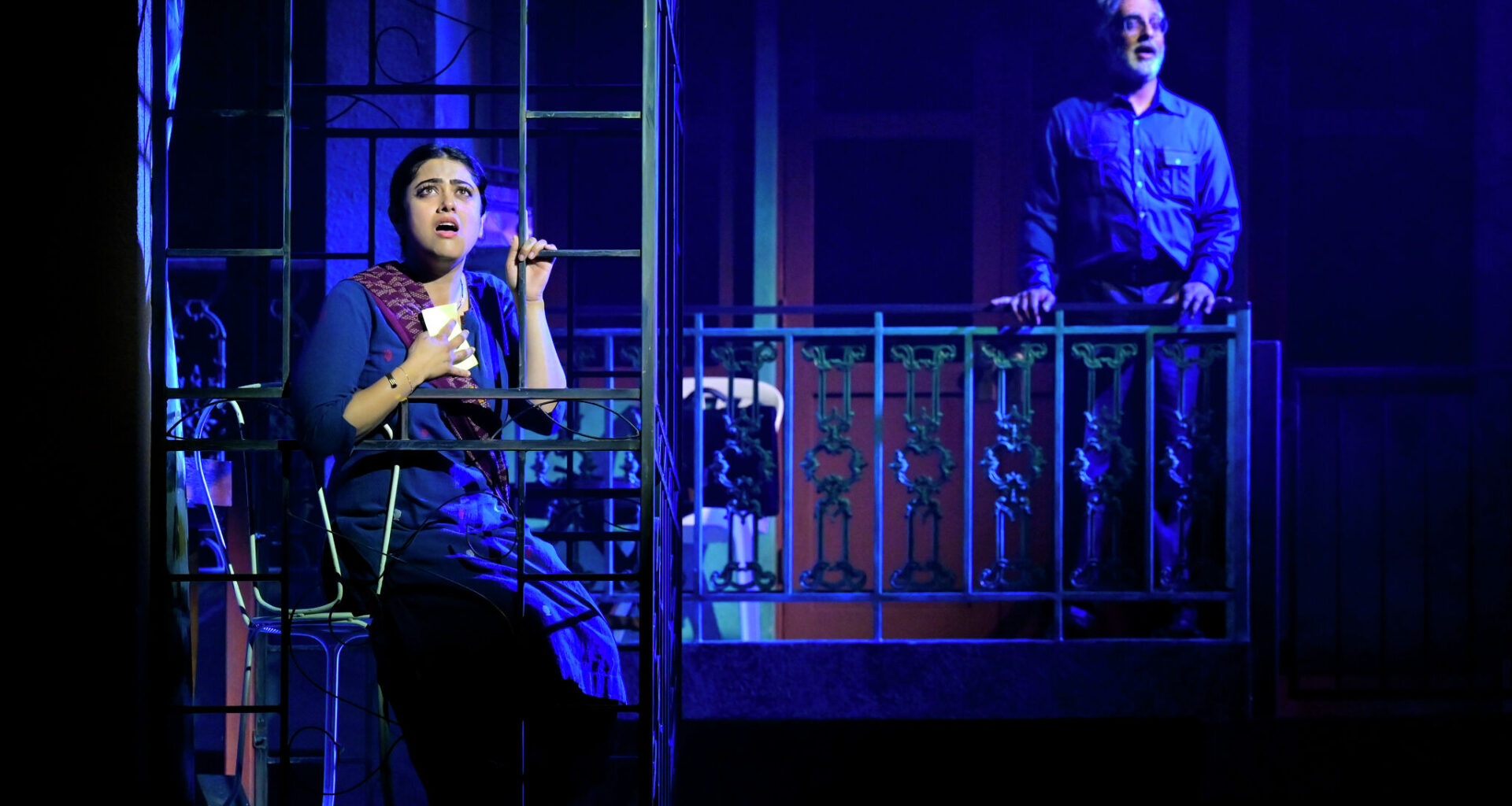
Kuhoo Verma, left, and Manu Narayan in Berkeley Repertory Theatre’s “The Lunchbox.”
Kevin Berne/Berkeley Repertory Theatre
Musicals can depict a lot of things, but restraint isn’t often one of them. It’s difficult to be mysterious and withholding as you’re bursting into song.
Ritesh Batra’s 2013 film “The Lunchbox,” by contrast, is all about the unspoken, which suits a tale that stems from an oversight. In the quiet, unconventional love story, the seed of a mistaken lunch delivery magically blooms into desire, all without its couple — a lovelorn housewife and a lonely widower — ever meeting. When they start to exchange notes via the lunchbox, their epistles are wry, almost epigrammatic. Each tosses off banalities and life-shattering events alike with an exquisite little “c’est la vie” shrug.
Kuhoo Verma in “The Lunchbox.”
Kevin Berne/Berkeley Repertory Theatre
Shrugs don’t typically motivate “I wish” numbers, though, making the story an unusual choice for a musical adaptation.
Article continues below this ad

“The Lunchbox”: Book by Ritesh Batra. Music by the Lazours. Lyrics by Batra and the Lazours. Directed by Rachel Chavkin. Through June 28. Two hours. $25-$135. Berkeley Rep’s Roda Theatre, 2025 Addison St., Berkeley. 510-647-2949. www.berkeleyrep.org
That tension runs through Berkeley Repertory Theatre’s world premiere, which opened Wednesday, May 27. But if the show sometimes seems stuck in a war between its form and content, it still offers plenty of moments of transcendence, starting with Kuhoo Verma’s performance as housewife Ila.
Her singing voice is so thrillingly tuneful, each note a lovingly cared for golden egg, that the melody could go off-the-walls atonal and it wouldn’t matter. In one ecstatic moment in the piano and string-driven score, by songwriting brothers the Lazours, she has her own melodic line wafting sinuously above the chorus, and it’s the musical equivalent of a starburst.
Kuhoo Verma, left, and Shiv Nadkarni in “The Lunchbox.”
Kevin Berne/Berkeley Repertory Theatre
Verma’s acting is just as strong. If much of the film’s success derives from its leads’ behind-the-eyes acting, she is just as communicative, but in a way that would register all the way to the back rows of Berkeley Rep’s Roda Theatre.
Article continues below this ad
San Francisco Chronicle Logo
Make us a Preferred Source to get more of our news when you search.
Add Preferred Source
Watch the scene where Ila’s husband Rajeev (Shiv Nadkarni) comes home from work and barely looks at her, seeming to wish he could shoo her away like a pest. She’s been trying to rekindle his affections by putting extra care and special spices into his lunches, with the knowing aid of Mrs. Deshpande (Anisha Nagarajan) upstairs, but nothing’s working — and not just because her efforts are going to that lucky widower, Fernandes (Manu Narayan) instead. As she clutches him and whirls away, her eyes look like two caged wild animals. Each new glance is as thoughtfully calibrated as each note on a score.
But “The Lunchbox” isn’t just “The Kuhoo Verma Show.” Director Rachel Chavkin devises stage versions for much of the film’s magic. A dabbawala, or lunch deliveryman, might saunter down the city street singing an incantatory air, accompanied by a violinist, right as Ila and Fernandes are getting to know each other through their letters. This humble worker, the staging implies, might actually be something larger — a protective, guiding deity or a trickster figure, or even a little bit of both.
Benjamin Mathew, from left, Savidu Geevaratne and Vishal Vaidya in “The Lunchbox.”
Kevin Berne/Berkeley Repertory Theatre
Scenic designer Mimi Lien makes the characters’ Mumbai apartments resemble the cylindrical stacked tins, called tiffins, that serve as lunchboxes — crowded together but atomized at the same time.
Article continues below this ad
Choreographer Reshma Gajjar dapples the whole show with touches of wit. The dabbawalas jauntily slink their shoulders as they shuffle along, cocky in their famed competence. As Ila and Mrs. Deshpande blast a meal with extra chiles to avenge a note from Fernandes in which he dares to nitpick about his free home-cooked meal, female dancers surround him squatting in warrior poses and making off-with-his-head gestures.
Whereas jukebox musicals have a connective-tissue problem, reverse-engineering a story from one preexisting song to another, musicals that adapt movies have a parallel but opposite issue. The narrative’s already there. It didn’t need songs before. Adding them after-the-fact risks simply padding the action, distending one line into a minutes-long dilation, turning poetry into exposition, implication into cliche.
But then there’s that moment toward the finale when Verma’s Ila takes off her jewelry. She’s preparing to pawn it, but it’s as momentous as unlatching shackles. The chorus crescendoes into a great throng of yearning, and the band, under the music direction of Sheela Ramesh, courses and swirls. It’s like a racing pulse, an oncoming train. Sometimes in life, forces larger than you — fates, gods, dabbawalas — lead you to the just the right place.