
San Diego FC entered its second Major League Soccer season trying to prove last year was not merely a one-year surge of expansion energy, smart scouting and tactical surprise.
Fifteen league matches into 2026, the answer remains complicated.
The ball still belongs to San Diego often enough. The attack still has ideas.
Marcus Ingvartsen has become one of the league’s most efficient finishers, Anders Dreyer remains the club’s creative pulse and Mikey Varas’ team still plays with the possession-heavy ambition that caught everyone by surprise in its inaugural season.
The table tells a harsher story.
After 15 matches last season, SDFC was 8-4-3, sitting on 27 points with a plus-10 goal differential and already looking less like an expansion team than a Western Conference problem.
Through 15 matches this season, San Diego is 4-6-5, with 17 points, a plus-3 goal differential and a place on the wrong side of the playoff line entering the World Cup break.
“Yeah, the first half of the season has seen us go through ups and downs,” Varas said, pointing to a short preseason, a Concacaf Champions Cup run, travel, red cards and dips in form. “We hit a lot of adversity, and we’re not playing at our best.”
The first-half diagnosis
The strangest part of San Diego’s sophomore season is that the attack has not collapsed. In fact, the raw scoring is up.
SDFC scored 27 goals through its first 15 matches in 2025. This year, it has scored 30.
Ingvartsen has 11 goals from just 8.81 expected goals, an elite finishing clip that has helped mask deeper issues.
Dreyer has six goals, nine assists and an MLS-leading 44 key passes, proof that the top end of San Diego’s front line still plays at a Supporters’ Shield-contender level.
The concern is sustainability. San Diego’s expected goals through 15 games sits at 20.7, toward the bottom of MLS. The production is real, but it has leaned heavily on Ingvartsen’s finishing and Dreyer’s chance creation rather than consistent volume and variety.
The bigger problem is at the other end.
Last season, San Diego allowed 17 goals through 15 matches. This season, it has allowed 27. That 10-goal swing explains most of the standings drop.
SDFC’s points per match have fallen from 1.80 to 1.13, and its home-field edge has softened: 15 goals conceded at Snapdragon Stadium this year after allowing seven at home through 15 matches last season.
The underlying numbers are just as troubling. SDFC has conceded 22.95 expected goals against, ranking near the bottom of MLS, and has allowed 207 shots, sixth-most in the league. Opponents are not just scoring more. They are finding more ways into dangerous areas.
What has changed?
Varas has not abandoned his principles. San Diego still wants to build through pressure, circulate the ball, involve the goalkeeper and create superiority through the midfield. Its league-leading 61.6% possession rate confirms the identity remains intact.
But Year 2 has brought a different problem: opponents have more film, more confidence and clearer pressure triggers.
“I think we’ve already made adjustments,” Varas said. “If you’ve seen in recent weeks, we play much more in the wide areas. Teams are completely shutting down the middle of the field. I think teams are playing a lot more direct on us.”
Teams have been less willing to let San Diego play through central zones, less surprised by its buildup structure and more eager to test the space behind its fullbacks and center backs. When SDFC’s timing is right, the system still looks expansive and modern. When it slips, that same ambition can become an invitation.
“So we need to address a few things,” Varas said. “One, if we can become more dynamic in the wide areas, which I think we’ve made steps in, I think it’s going to really, really help us. Two, we need to defend the spacing behind us better. We made some steps forward, but really, we’ve got to challenge ourselves to be much better than that.”
The most obvious difference from last season is that San Diego’s mistakes have become more costly.
The back line has leaned heavily on young defenders such as Luca Bombino, Osvald Søe, Manu Duah and Oscar Verhoeven — and has needed Christopher McVey to be the adult in the room.
That is what made McVey so valuable last season. He was one of San Diego’s steadier pieces: experienced, positionally flexible, comfortable defending space and useful in a system that asks its defenders to make brave decisions under pressure.
This year, that steadiness has been harder to find.
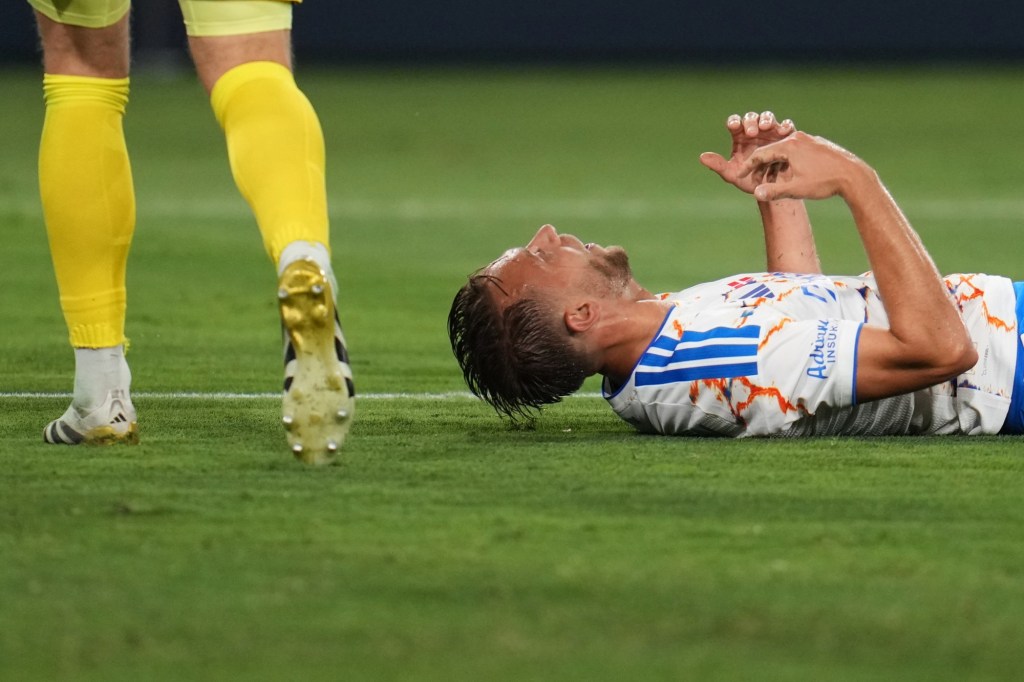
SDFC’s first half has included late concessions, red cards and stretches in which good possession has turned cosmetic. The club has not merely been unlucky. It has repeatedly lost control of game states.
“You have a lot of the ball, and then you give it up in situations that turn into huge chances, it feels very frustrating,” Varas said.
Midfielder Onni Valakari framed the mistakes less as individual breakdowns than collective failures.
“In the game of football, mistakes are never on one player,” Valakari said. “It’s part of the whole collective. If we put somebody in a bad situation that’s impossible to get out of … mistakes happen in football. It’s just how we recover from them.”
That has been the season in one sentence. San Diego has created too many of its own emergencies — then struggled to recover.
What needs to be done?
The roadmap is not mysterious, and Varas did not pretend otherwise.
“We’ll be active,” Varas said of the summer transfer window. “The club is ambitious. You can see that some reinforcements would really help us, especially in these really tough games. We will probably target an elite attacker on the highest line. Ideally, a midfielder with a dynamic movement profile, slash dribbler or ball-winner. Then we need to make sure that we bring some depth and some competition on the back line in terms of center backs and fullback.”
That is the shopping list.
SDFC needs another defensive midfielder — ideally a ball-winning No. 6 who can cover ground, win second balls and allow Aníbal Godoy to manage rather than chase. It needs either an experienced center back addition or a steadier second half from McVey, whose 2025 form showed he can stabilize this system. It also needs a vertical attacker who can beat a defender without requiring a 14-pass sequence to create danger.
The goalkeeper picture needs clarity, too. While Duran Ferree and CJ dos Santos both have arguments for minutes, the back line would benefit from rhythm and certainty.
Dreyer didn’t reject the need for reinforcements. He pushed back only on the idea that the current group is incapable of more.
“I think we still have good players,” Dreyer said. “So we will see. It’s a club decision, not us players.”
Finally, the club must author a conclusion to the Hirving “Chucky” Lozano saga. SDFC has been linked to several high-profile international players, most notably Egyptian superstar Mohamed Salah, but with Lozano still on the roster collecting a check, an addition of that caliber remains fantasy.
Allowing that uncertainty to bleed into the second half would be roster malpractice.