
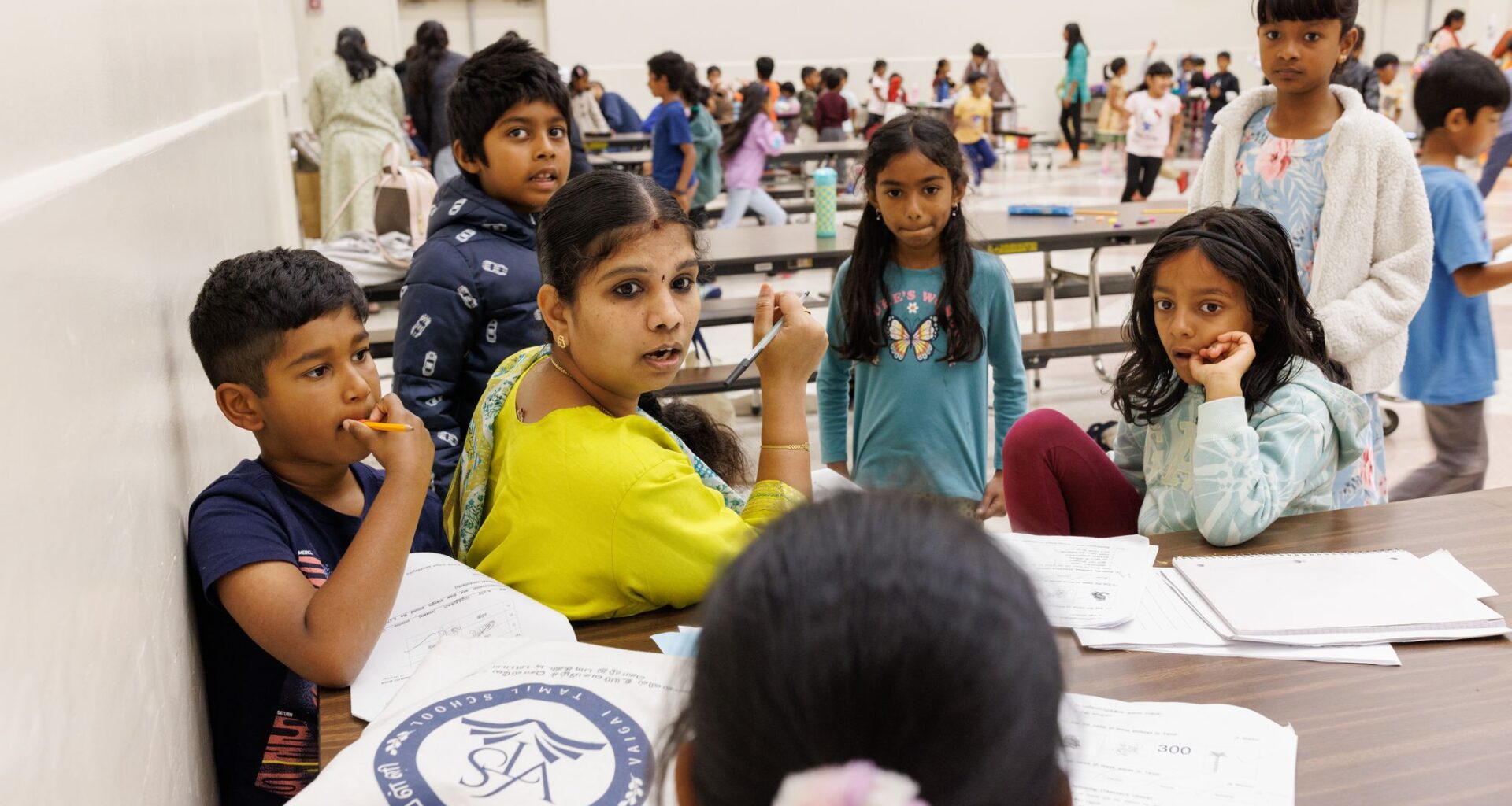
When Sharmila Mohanraj immigrated from India to the East Bay city of Concord at the age of 24, she often felt isolated. She struggled to find a strong Indian community that she could spend time with while her husband was at work — let alone people who spoke her native language of Tamil.
“You didn’t see a lot of Indian people there, or Tamil being spoken,” she said. “It was super lonely.”
Nearly two decades later, that is no longer the case. The Tri-Valley, where Mohanraj now lives, is home to some of the fastest-growing cities in the state — growth fueled by high-earning professionals who can afford these new suburban subdivisions. Disproportionately, those professionals are Asian American, and in particular Indian American, many re-creating Silicon Valley life in the green fields and wide open spaces of the East Bay.
Article continues below this ad
The result is that this cluster of East Bay cities — San Ramon, Dublin, Danville, Pleasanton and Livermore — has become one of the most significant hubs of Indian American life in California much faster than earlier-forming meccas like Fremont or the west side of the Santa Clara Valley. Two decades ago, these cities were disproportionately white and Hispanic. Now, about 18% of the region’s population identifies as Indian. Dublin, Pleasanton and San Ramon rank among the state’s 10 largest cities whose population is at least 30% Asian.
Mohanraj was determined to pass on Tamil, and the culture and traditions she associated with it, to her children. When she and her husband had a daughter, she relied on movies and music to introduce her to the language.
San Francisco Chronicle Logo
Make us a Preferred Source to get more of our news when you search.
Add Preferred Source
Then after the family moved to Pleasanton in 2010, Mohanraj learned about the Vaigai Tamil School. She enrolled her daughter, now 22, and son, now 16, in classes there when each turned 3.
Article continues below this ad
At the time, the school was relatively small, with just under 100 students enrolled at the lone campus in Pleasanton. Today, the school serves 820 students at three sites, with additional campuses in San Ramon and Livermore — an expansion made possible because the Indian American community it caters to in the Tri-Valley has exploded in size, and because many of these parents value exposing their children to the language and culture of their family in India.
It isn’t just Tamil. Indian Tri-Valley families are part of a diverse diaspora that sends children to learn Punjabi, Hindi, Telugu and other languages through temples, after-school programs and language academies.
Left: A final exam at Vaigai Tamil School in Pleasanton.
Right: Guhan Prasanna, left, and Ramya Yegammai Ramanathan taking their final exams.
Photos by Santiago Mejia/S.F. Chronicle
Top: A final exam at Vaigai Tamil School in Pleasanton.
Above: Guhan Prasanna, left, and Ramya Yegammai Ramanathan taking their final exams.
Photos by Santiago Mejia/S.F. Chronicle
After moving to Pleasanton and starting her kids at the language academy, Mohanraj found herself surrounded by a robust Indian community that has continued to expand.
“I see a lot of growth every year, it’s exciting,” Mohanraj said. “Now we see a lot of food and tradition and more Indian people.”
Article continues below this ad
In addition to the cultural infrastructure of the Indian language academies, the allure of these quiet suburbs isn’t complicated. Good schools. Low crime. Bigger and newer homes at reasonable prices relative to the overall Bay Area. A workable commute by train to San Francisco or Silicon Valley.
Mari Muthu, who teaches Tamil at the Pleasanton school, chose to live in Dublin because of its affordable homes and easy access to BART to get to his engineering job in San Francisco. Now as an employee at Tesla in Fremont, his driving commute is even easier.
Many families said that finding a growing Indian community was not a prerequisite but a bonus beyond the region’s other assets.
Prasad Ramakrishnan, a retired software engineer, left Fremont for San Ramon because of the excellent schools and to find a bigger home after his wife became pregnant with their second child.
Article continues below this ad
His kids eventually attended Dougherty Valley High School, which is now 79% Asian and features Hindu and Indian student associations. Ramakrishnan helped start the school’s Navratri celebration, an annual Hindu festival observed in honor of the goddess Durga. Today, the event, which features live music, food stalls and dance, sells out within 30 minutes, draws close to a thousand people and raises nearly $30,000 for the district annually.
From left: Prabha Prasad and Prasad Ramakrishnan prepare for dinner at their home in San Ramon.
Santiago Mejia/S.F. Chronicle
Students during an art class at Emerald High School in Dublin. Dublin’s school district hosts its own Diwali celebration as well as Holi events — not surprising considering students of Indian ancestry made up just over 41% of its enrollment as of 2024.
Santiago Mejia/S.F. Chronicle
Dublin’s school district hosts its own Diwali celebration as well as Holi events — not surprising considering students of Indian ancestry made up just over 41% of its enrollment as of 2024. Dublin began accepting Tamil taken outside of school toward its language requirement in 2017, three years before San Ramon and Pleasanton followed suit. Students organize Indian dance and culture clubs on their own throughout the districts.
The academic quality of the region’s schools, which send nearly all students to college, continues to draw families. Dublin High’s engineering and biomedical academies have built reputations as launching pads for students pursuing those fields in college, an asset for many Indian parents who work in STEM fields and want those opportunities for their kids.
Article continues below this ad
The schools were only one factor for Kashef Qaadri. He was also attracted to the bigger homes at a more affordable price than in Silicon Valley. Qaadri moved his family from Fremont to Dublin in 2017 when he needed more space to accommodate his mother-in-law, who had lost her vision, and his wife’s grandfather. They found a house with an attached ADU in Dublin.
What he didn’t expect was how much the surrounding community would shape his son’s upbringing. Three of his closest friends are Indian. Some of his non-Indian friends have picked up Hindi words. The family tried Bollywood dance classes and Hindi language classes.
“It was an added bonus to know there was a pretty decent Indian community already existing,” said Qaadri, who is now a Dublin City Council member. “Restaurants and grocery stores and things like that are important. I didn’t want to drive super long distances to pick up standard Indian groceries.”
Some families are specifically drawn to the area for language learning opportunities. While there are clusters of Indian language schools throughout the country — in places like Dallas, Chicago and the D.C. metro area — the Tri-Valley’s offerings now rival even South Bay cities like Sunnyvale and Cupertino.
“There used to be more students and language schools in San Jose, but in the last 15 to 20 years, a lot more people migrated from the South Bay to the East Bay, so there’s more here,” said Venkatesh Annadurai, the president of the Vaigai Tamil School.
While Hindi is the most commonly spoken language for India’s 1.4 billion people, the country’s constitution recognizes 22 languages, and there are more than 100 major languages spoken in all. In the Tri-Valley, census data shows that almost half of Indian Americans speak a South Indian language, primarily Telugu, one of the fastest-growing languages in America.
North Indian cultural communities are thriving, too. The Tri-Valley Sikh Temple in Livermore holds Punjabi language classes every Sunday, drawing dozens of Sikh children to recite scripture and practice speaking. Similar to the Tamil academy, the program at the Sikh temple has rapidly expanded — from 30 students in 2014 to 270 now.
“It’s giving the students their own identity,” said Meenu Kaur, the principal of the temple’s school. “And it’s OK to be a little bit different.”
About 8 miles away, hundreds of kids darted through the halls of Harvest Park Middle School, where Vaigi holds weekly classes, in red and purple saris and white and gold veshtis, traditional Indian attire. Their laughter on that recent Sunday echoed off the walls as they grabbed plastic cups of Tang from a stand outside their classroom.
Kashef Qaadri, left, and son Ilyas leave their home to go to their martial arts class in Dublin.
Santiago Mejia/S.F. Chronicle
Kashef Qaadri, left, and son Ilyas practice martial arts in Dublin. Kashef was drawn to the area for its schools and has been delighted to find the strong Indian community in the area, which has shaped his son’s upbringing.
Santiago Mejia/S.F. Chronicle
Older students ran Tamil Heritage Day presentations. In one, several children dressed up as historical figures and read poetry or talked about books on the origins of the Tamil language. One presentation highlighted traditional dances and instruments, including anklet bells to accentuate footwork and rhythm.
Four taught a group of younger kids how to play kabaddi, a contact sport in which one player has 30 seconds to tag as many opponents as possible without getting tagged.
“Who wants to play?” asked 12-year-old Eshwar Harirajan.
Ten hands immediately shot up.
“OK come on, kids,” said 13-year-old Dev Aadhan Vignesh.
Both sides immediately started laughing.
Left: Music teacher Vineet Rewari instructs Aavnoor Virk, 8, on the harmonium alongside Amandeep Kaur, left, during the last day of classes at the Khalsa School at the Tri-Valley Sikh Center in Livermore. Right: Rewari administers tests to her students.
Juliana Yamada/For The S.F. Chronicle
Top: Music teacher Vineet Rewari instructs Aavnoor Virk, 8, on the harmonium alongside Amandeep Kaur, left, during the last day of classes at the Khalsa School at the Tri-Valley Sikh Center in Livermore. Above: Rewari administers tests to her students.
Juliana Yamada/For The S.F. Chronicle
Congregants get in line for food at the Tri-Valley Sikh Center in Livermore. Around 2,000 Sikhs attend the center for worship, education and meals.
Juliana Yamada/For the S.F. Chronicle
Inside one of the classrooms, teachers smiled and, in Tamil, coaxed 3-year-old students to sit down. For the academy’s youngest children, the point isn’t grammar. It’s exposure — hearing the language used somewhere other than home, by other kids and adults in a new environment.
In another room, several children in the eighth-grade class cheered for one of their classmates, who had published an essay written entirely in Tamil in an Indian magazine.
“I love writing,” the boy said, smiling shyly.
Mani Vaiyapuri has volunteered with the school for six years. His daughter attended for eight years and came back as a teacher’s assistant after graduating from the academy. Every year he travels with a team of teachers to public schools across the Tri-Valley, to give presentations to students who might not yet know the academy exists.
“The language,” he said, “is a bridge for our culture to other generations.”
Uma Maheswari Suresh, second from left, supervising Athvika Palani Sankar, left, Venba Ganesh and Avanthika Sankarkumar at the Vaigai Tamil School.
Santiago Mejia/S.F. Chronicle
Mohanraj’s daughter, who works as a legislative aide in Washington, and her son who is in high school and graduated from the program at Vaigai, now speak Tamil proficiently.
Her son, Srirangan, who attends Foothill High School, said when he first started the language school at age 3, he didn’t understand why he had to wake up so early on the weekends.
But eventually, he looked forward to spending the day there with his friends. He enjoyed the projects that required students to answer prompts such as “what would you do with a billion dollars” or “describe your favorite vacation” in Tamil.
Mohammed Azlaan Zavid Hussain, left, thanks teacher assistant Srirangan Mohanraj after the final exams at the Vaigai Tamil School.
Santiago Mejia/S.F. Chronicle
Now Srirangan works as a teacher’s assistant at the school, and he understands why his mom made him attend class from such a young age.
“It’s definitely a lot easier to communicate with family members and cousins in India now than in the past,” Srirangan said. “Being able to hang out with friends and learn about my heritage, it was good.”
Ko Lyn Cheang contributed to this report.