
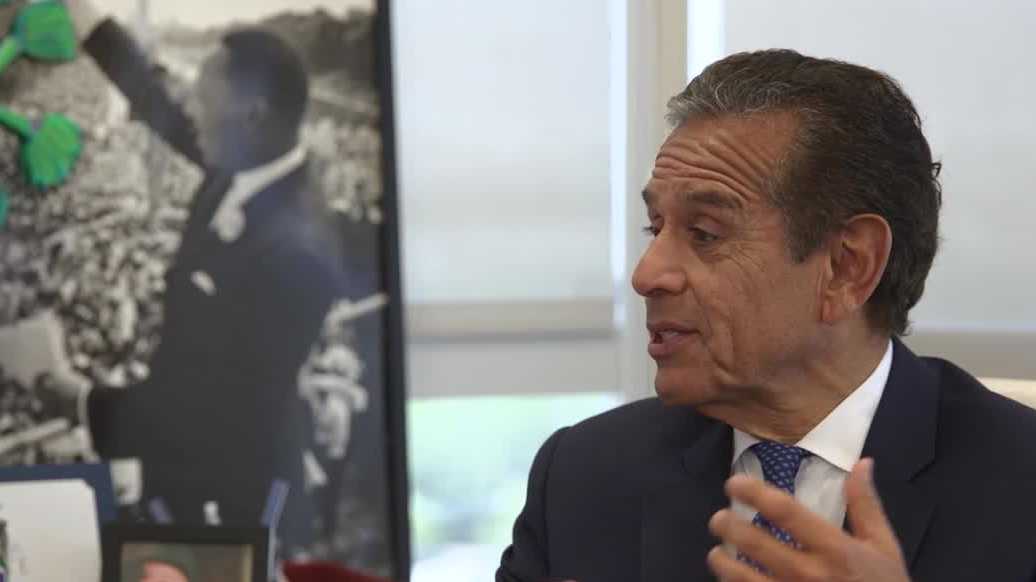
Antonio Villaraigosa explains why he should be California’s next governor | CA Politics 360
Antonio Villarregosa, thank you so much for making time for us. You pronounce my name so well. I try, um, this is *** hard time and *** really hard job. Why do you wanna be California governor now? You know, I’ve been speaker of the California State Assembly, as you may know, where I balanced two budgets with *** surplus novel, uh, with *** Democratic and *** Republican governor. I’ve been mayor of the biggest city, *** city bigger than San Francisco, San Jose, Oakland, and San Diego. I believe that we need *** proven problem solver and more importantly, I need, I believe. That we need to acknowledge that Donald Trump isn’t the only reason why things are as bad as they are right now here in California. Yes, he’s made them worse, these ICE raids, the tariffs, the failure to provide the emergency relief that. Both Altadena and the Palisades deserve. But there are problems that we created. And I’ve said, whether it’s gas prices, utility costs, uh, home prices, rent, homelessness, we’ve got to acknowledge those are sacramental policies. It’s not Donald Trump. And all you hear from Sacramento is that everything’s on Donald Trump. Yeah, I mean right now one of the big state problems, *** Sacramento issue, is this multi-state money problem that likely the next governor is going to have to deal with, putting the next state leader in *** position where you might have to cut spending on some programs or raise taxes or *** combination of both. What do you see *** governor at Villara Rossa doing? Well, one of the things I’ve said, I’m *** fan of Jerry Brown. Jerry Brown left us with *** $300 billion surplus. The fact is, with the kind of economy we’ve had over the last years, the notion that we would have this many deficits, that we’re looking at *** deficit going into the next year, maybe we’ll be saved by AI. I understand. But the LAO still says that we’re, you know, we’re looking at big deficits, maybe *** $14 billion deficit instead of an $18 to $35 billion. What it says to me is that we’re living beyond our means. You know, Voters can’t do that. California residents can’t do that. Businesses can’t do that. And it seems to me uh we need some grown-ups who are gonna say to both Democrats and Republicans, we’ve got to cut our spending. We gotta live within our means. We don’t have *** revenue, just *** revenue problem. And what I’ve said is we have *** revenue problem because we’ve had *** spending one. What do you, are there any programs like off the top of your mind that you could think of that you, well, look, we can’t keep our head in the sand and say there’s no waste and fraud when you saw what happened to unemployment, when you saw what happened to hospice care just here in LA, one entity, $250 billion plus. We got to look at waste and fraud. We gotta stop throwing money at the problem. Some things work. Homelessness as an example. I think you talked about this. $24 billion we spent. Homelessness went up during that period. The LAO said there were two programs that worked. Rental assistance. And temporary housing. We need to invest in what works and stop throwing money at what doesn’t. So those are some of the things we’re going to be looking at. There’s others. There have been some expenses that have just ended up costing the state way more than they thought it would. Including, uh, the expansion of medical for lower income undocumented immigrants right now that program is sort of stalling out. Um, there’s more than *** million, um, undocumented immigrants that are relying on that service right now. Governor Newsom is considering increasing their premium that they pay per month to get it. Others are, you know, talking about potentially allowing more to join. Uh just what would you do with this program if elected governor? Well, one of the things I’ve been on record saying from the very beginning, I believe that healthcare is *** right. It ought to be universal, high quality, and affordable. We’ve expanded healthcare, and I, that’s an area where I give. Governor Newsom, high marks. What I’ve said is we already pay for the undocumented. It’s called emergency care, and over time you spend more on emergency care than you were if you were providing that care to the undocumented. We know that I did healthy families. Millions of kids got healthcare. They had to pay some. I think we need to look at that. I don’t believe that we should deny the undocumented care. I do believe that we may have to charge people for that care. Another big expense obviously the amount of money that goes toward public schools and right now with teacher strikes and um some of the issues that the unions have raised about teacher pay but also coupled with some of the classroom performance issues we’re seeing with students being unable to do basic science, math and reading I mean how would you manage this as governor? The way I managed it when I was mayor. One out of 3 schools were failing, uh, when I became mayor. We had *** 44% graduation rate. By the time I left, we increased that graduation rate by 60%. We went from 1 out of 3 failing schools to 1 out of 10. We focused on literacy. We focused on reading and math. We’re number one in teacher pay. We’re 21st in per pupil spending. We’re in the mid-30s in reading and math in the 4th grade behind Mississippi, by the way, and we’re dead last in graduation rates. I have *** record. When I was Speaker, uh, and majority leader, I led the effort for class size reduction. I’m the author of the biggest school bond in history up till that time, *** $9.2 billion dollar bond to modernize and build new schools. We can’t just throw money at the problem. We know that we need to invest more in the kids that are behind. I’ve said many times, not someone like my son as an example when he was in school, but someone like me 50 years ago when I was. So we need to focus on what works and stop throwing money at what doesn’t. Teachers, I know I’ve been struggling obviously with the cost of living in *** lot of these in *** lot of parts of California. How would you broadly for everyone lower costs for people in the state? Well, let’s take on gas prices as an example. You’ve actually had some, uh, shows focused on those things. We’ve lost about *** dozen. Refineries over the years and in the last few years, 3 of them. If we close 1 more refinery, according to USC, gas prices are going to 875 cents *** gallon. So the first thing we’re going to do *** moratorium on regulations that raise the cost of gas and jeopardize the existence of any more refineries. By the way, they produce the cleanest fuel in the United States of America, among the cleanest fuels anywhere in the world. We need an all of the above strategy. We’re seeing with, with the Iran war that refineries are actually *** national security issue. It’s why we had so many refineries on the West Coast during World War II. So, uh we need common sense. We need And *** chief executive that understands it’s not just about ideology and great ideas, they actually have to work. And I think that’s why my candidacy is important right now. Would that moratorium, would that delay California’s climate goal? Like, would you essentially put *** moratorium on California’s 2045 carbon neutrality goal at this point? Well, here’s an example. Let’s start with all green vehicles by all electric vehicles by 2035. We built 167,000 charging stations in the last 10 years. We need 2 million more. In the next 10 years to get to that goal. We don’t have, if we built it, built them, we don’t have the grid and we don’t have the generation capacity, so we need to focus on building generation, distribution, and the grid to get to that goal. We won’t get it. The way we’re going right now, 2045. Net zero by 2045. Again, *** great goal. The next governor is going to have to work hard to get to that goal, and I’ll tell you why. You’re not going to do it without small nuclear. You’re just not. It’s impossible to get there, and you’re not going to do that without building the infrastructure that I just said applies to electric vehicles across the board. So we need an all of the above approach that understands we’re going to need transition. Oil and gas for *** time until we go. All electric and and or what what other clean technology like small nuclear. OK, how would you just switching gears here, um, make meaningful change on homelessness? I mean for people to be able to walk on their streets and sidewalks and feel like this is not *** place where they’ve been living. First of all, it’s *** housing problem, so we’ve got to build more housing we’ve got streamline permitting. We’ve got to address the fact that you can sue from Richmond, Virginia for *** project in Richmond, California. Yes, and you don’t need to sue on environmental reasons. You could sue for any reason. So we need to fix that, uh, one-stop permitting at the state level and make sure that cities and counties are doing the same thing. Those are some of the things we need housing with drug rehab and mental health. We need to make sure the Care courts was *** great idea that never really got implemented. You know, I tell people, One Flew Over the Cuckoo’s Nest, that movie where it was so easy to put people in *** mental institution back then in the 50s, now it’s impossible. Both are extremes. There’s *** middle. We need locked mental institutions, and we need to say the following. We won’t criminalize homelessness. Well, we, we will be compassionate, but chaos on the streets of California cities is unacceptable. Selling drugs in front of cities, uh, in front of cops is chaos. Encampments in front of schools and parks is chaos when you know what neighborhoods you’re gonna be in. They’re not gonna be in the affluent neighborhoods of Land Park as an example, or the fabulous 40s. They’re, they’re gonna be in the poor neighborhoods, and that’s what we gotta challenge. It’s unacceptable. What, what is humane about people living in their feces? The answer is nothing. So would CareCourt end if you were to be elected governor or we’re going to actually implement CareCourts and, and set *** standard that if you’re *** threat to yourself. And others and you refuse treatment again and again. Yes, you’re *** candidate for, for locked institutions for those who are or who are in locked institutions on crime. Uh, California is in this tug of war essentially with the need to reduce prison populations under *** court order in the early 2000s, but also people right now, some don’t feel like criminals are being held accountable in the state. How would you manage that? You know, look, I, I took on three strikes out in the 1990s. I was the spear carrier on that issue. I supported 1947, but I tell people this, if something’s not working. And some parts of 47 weren’t working, then we need *** course correction. Sacramento said no to Prop 36. I’m the only candidate that actually did commercials uh supporting it, not because I believe that we should put everybody in jail, but I do believe in accountability, and most people do, which is why about 70% of the electorate voted for it. Sacramento still hasn’t funded it. When I’m governor, we will. OK, how would you fund it exactly? Well, Budgets are *** reflection of values. I think public safety is the number one responsibility of government, of *** chief executive, the governor, president, or *** mayor. And so, People have voted for prop uh 36. The criticism, the criticism against 36 was there’s not enough uh drug rehabilitation counseling and therapy, so we’re going to fund that. We ought to provide more of that. That’s *** fair criticism. I intend to do that. You’re definitely one of the more middle of the road candidates in this race, and sorry, go ahead. Yeah, I’d say I’m practical. I’m not an ideologue. Once you’ve been *** mayor. You, you, you realize you come in with your ideas and your biases, and then you realize, well, if that’s not working, maybe we ought to try something else. I don’t think that’s moderate. I don’t think it’s conservative. I don’t think it’s progressive. I think it’s what you do when you’re in these jobs. Is it hard? Do you feel like right now like being *** moderate is, it’s hard to break through when we just when we look at the polling numbers and everything. Legitimate question. Look, I, I think, uh, both, uh, me and Mayhan have discussed, uh, maybe people aren’t looking for common sense and, uh, uh, you know, ***, *** middle between Trump, mega politics, and what we got in, you know, California. What I’ve said nationally, We’re the pinata for the rest of the country when it comes to Democrats. They point to California and they say, Look at this. Look at, you know, business leaving. Look at the, the hundreds of thousands of people in the last year that have left this state. They, they’re not all the just the billionaires. They’re actually middle class people that can’t afford rent, utilities, or gas, and they’re moving on. And what I tell Democrats. When you lose the middle, and the middle are the people that work with their hands, the people that are working families and, you know, middle class families, when you lose the middle, the way we have to the right, you better look in the mirror because there’s something you’re doing that’s not working and doesn’t make sense. In *** primary, uh, it may not be the right formula, you know, just we’ll see, we’ll see. What keeps you motivated to stay in. That um. I relish being someone who’s *** truth teller, uh, you know, I’m, uh, who better to take on Donald Trump than somebody who came out of the civil rights movement, the labor movement? Who better to challenge, uh, right-wing, uh, MAGA policies than someone like me. At the same time, who better to challenge his own party than someone who’s been Speaker. And *** mayor. And there are *** lot of things I realized that I voted for uh when I was speaker that I realized I wasn’t for once I was mayor. OK, and you, you said you, uh, you were willing to be *** one term governor. Yeah, you know what I said look, the reason why we’re not taking *** lot of these challenges on is one, we have powerful interests in Sacramento the way you do it in Washington DC they’re diametrically different interests but powerful interests in Sacramento and what I’ve said is too many people uh are looking to the next job so I’ve said every day I serve. Uh, every decision I make will be based on doing the job, not keeping the job or looking for the next one. I want to be governor. I want to fix what’s broken, and then I’ll ride into the sunset. OK. All right. Uh, on that note, what, what grade would you give Governor Gavin Newsom for his two terms as governor? Well, you know, I think it depends on what. So as an example, I’d give him *** minus on affordability. I’d give him an *** on universal healthcare and the way he expanded healthcare. I’d give him *** D. Uh, on gas prices, but I’d give him, uh, an minus on, you know, what he’s done for, uh, early kindergarten, pre-kindergarten. I think he’s done some good things, but I’ve also been willing to say. That he’s wrong on issues, uh, you know, where we disagree, different than some candidates who all of them give him an *** or refuse to answer, uh, you know, I, I think he’s done some things right and some things wrong. OK, how would you describe California under *** Governor Villaraigosa? I describe *** California that’ll be stronger and better than when I found it. Uh, California, where our kids can buy *** home again. And we can afford rent, uh, gas, and utilities. I should have said 3 words, 3 words, 3 words to describe California. Stronger Better, brighter. All right, Mr. Villa Rogosa, thank you so much for your time. Thank you thank you appreciate it.
Antonio Villaraigosa explains why he should be California’s next governor | CA Politics 360

Updated: 4:15 PM PDT May 29, 2026
Antonio Villaraigosa sat down for an interview with California Politics 360 for a wide-ranging conversation on his run to be the state’s next governor.The former Los Angeles Mayor is running as a Democrat in the race to replace Gov. Gavin Newsom, who terms out at the end of 2026.Villaraigosa is pitching himself as a one-term leader focused on addressing California’s most pressing issues. “Too many people are looking to the next job,” Villaraigosa said. “Every decision I make will be based on doing the job, not keeping the job, or looking for the next one. I want to be governor. I want to fix what’s broken, and then I’ll ride into the sunset.”Villaraigosa criticized policies passed out of Sacramento, saying they have contributed to the state’s problems. “We need to realize Donald Trump isn’t the only reason why things are as bad as they are here in California. Yes, he’s made it worse, failure to provide emergency relief, but there are problems we created,” he said. “Whether it’s gas prices, home prices, we’ve got to acknowledge, those were Sacramento policies. It’s not Donald Trump.”If elected, Villaraigosa said he would rein in state spending and tackle waste and fraud. On education, he emphasized investing in students who are falling behind in basic subjects. “When I was speaker, majority leader, I led the effort for class size reduction. I am the author of the school bond in history, build new schools. We can’t just throw money at the problem,” he said. On healthcare, Villaraigosa expressed support for continuing to provide health insurance to undocumented immigrants but suggested implementing a fee. Addressing gas prices, Villaraigosa proposed a moratorium on regulations that raise costs and jeopardize refineries. “By the way, they produce the cleanest fuel in the United States of America, among the cleanest fuel anywhere in the world,” he said. “We need an all-of-the-above strategy. We’re seeing with the Iran war that refineries are actually a national security issue. It’s why we had so many refineries on the West Coast during World War II. So we need common sense. We need a chief executive that understands it’s not just about ideology and great ideas. They actually have to work.”To tackle the housing crisis, Villaraigosa said he would fast-track permitting for new homes. On homelessness, he advocated for a balanced approach. “I tell people One Flew Over the Cuckoo’s Nest, that movie where it was so easy to put people in a mental institution back then, in the 50s. Now it’s impossible. Both are extremes. There’s a middle, he said. “We need locked mental institutions, and we need to say the following: We won’t criminalize homelessness. We will be compassionate. But chaos on the streets of California’s cities is unacceptable. Selling drugs in front of cities, in front of cops is chaos. Encampments in front of schools and parks is chaos.”Villaraigosa is a more middle-of-the-road candidate. His poll numbers have been lower compared to other top contenders. “Once you’ve been mayor, you come in with your ideas and your biases and you realize, well, that’s not working, we ought to try something else,” he said. “I don’t think it’s moderate, I don’t think it’s progressive, I think it’s what you do when you’re in these jobs.”He acknowledged the challenges of breaking through politically. “I think both me and Mahan have discussed maybe people aren’t looking for common sense and middle between Trump and MAGA politics and what we’ve got in California,” he said. “Nationally, we’re the pinata for the rest of the country when it comes to Democrats.”Villaraigosa urged Democrats to reflect on their approach. “What I tell Democrats, when you lose the middle, and the middle are people who work with their hands, when you lose the middle to the right, better look in the mirror,” he said. When asked to describe California under his leadership in three words, Villaraigosa said, “Stronger, better, brighter.”See more interviews with California governor candidates here.KCRA 3 Political Director Ashley Zavala reports in-depth coverage of top California politics and policy issues. She is also the host of “California Politics 360.” Get informed each Sunday at 8:30 a.m. on KCRA 3.
Antonio Villaraigosa sat down for an interview with California Politics 360 for a wide-ranging conversation on his run to be the state’s next governor.
The former Los Angeles Mayor is running as a Democrat in the race to replace Gov. Gavin Newsom, who terms out at the end of 2026.
Villaraigosa is pitching himself as a one-term leader focused on addressing California’s most pressing issues.
“Too many people are looking to the next job,” Villaraigosa said. “Every decision I make will be based on doing the job, not keeping the job, or looking for the next one. I want to be governor. I want to fix what’s broken, and then I’ll ride into the sunset.”
Villaraigosa criticized policies passed out of Sacramento, saying they have contributed to the state’s problems.
“We need to realize Donald Trump isn’t the only reason why things are as bad as they are here in California. Yes, he’s made it worse, failure to provide emergency relief, but there are problems we created,” he said. “Whether it’s gas prices, home prices, we’ve got to acknowledge, those were Sacramento policies. It’s not Donald Trump.”
If elected, Villaraigosa said he would rein in state spending and tackle waste and fraud. On education, he emphasized investing in students who are falling behind in basic subjects. “When I was speaker, majority leader, I led the effort for class size reduction. I am the author of the school bond in history, build new schools. We can’t just throw money at the problem,” he said.
On healthcare, Villaraigosa expressed support for continuing to provide health insurance to undocumented immigrants but suggested implementing a fee.
Addressing gas prices, Villaraigosa proposed a moratorium on regulations that raise costs and jeopardize refineries.
“By the way, they produce the cleanest fuel in the United States of America, among the cleanest fuel anywhere in the world,” he said. “We need an all-of-the-above strategy. We’re seeing with the Iran war that refineries are actually a national security issue. It’s why we had so many refineries on the West Coast during World War II. So we need common sense. We need a chief executive that understands it’s not just about ideology and great ideas. They actually have to work.”
To tackle the housing crisis, Villaraigosa said he would fast-track permitting for new homes. On homelessness, he advocated for a balanced approach.
“I tell people One Flew Over the Cuckoo’s Nest, that movie where it was so easy to put people in a mental institution back then, in the 50s. Now it’s impossible. Both are extremes. There’s a middle, he said. “We need locked mental institutions, and we need to say the following: We won’t criminalize homelessness. We will be compassionate. But chaos on the streets of California’s cities is unacceptable. Selling drugs in front of cities, in front of cops is chaos. Encampments in front of schools and parks is chaos.”
Villaraigosa is a more middle-of-the-road candidate. His poll numbers have been lower compared to other top contenders.
“Once you’ve been mayor, you come in with your ideas and your biases and you realize, well, that’s not working, we ought to try something else,” he said. “I don’t think it’s moderate, I don’t think it’s progressive, I think it’s what you do when you’re in these jobs.”
He acknowledged the challenges of breaking through politically. “I think both me and Mahan have discussed maybe people aren’t looking for common sense and middle between Trump and MAGA politics and what we’ve got in California,” he said. “Nationally, we’re the pinata for the rest of the country when it comes to Democrats.”
Villaraigosa urged Democrats to reflect on their approach.
“What I tell Democrats, when you lose the middle, and the middle are people who work with their hands, when you lose the middle to the right, better look in the mirror,” he said.
When asked to describe California under his leadership in three words, Villaraigosa said, “Stronger, better, brighter.”
KCRA 3 Political Director Ashley Zavala reports in-depth coverage of top California politics and policy issues. She is also the host of “California Politics 360.” Get informed each Sunday at 8:30 a.m. on KCRA 3.