
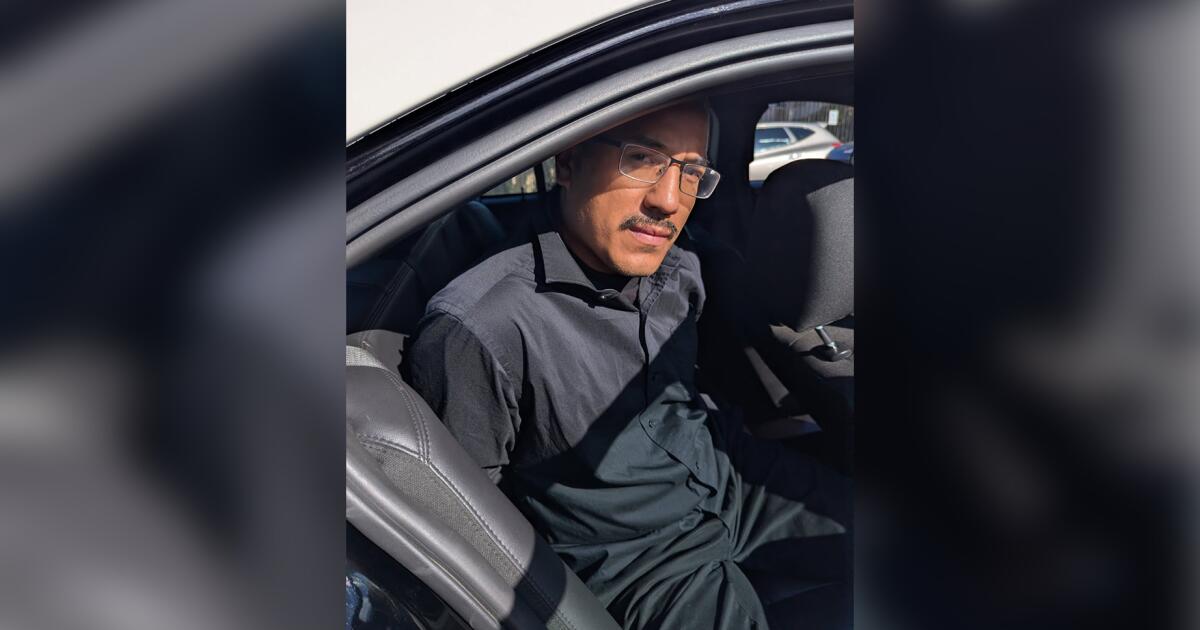
Federal authorities in Los Angeles announced Thursday that an employee of a gang intervention nonprofit was arrested for possessing body armor as a convicted felon, accusing the man of continuing to be an active member of the 18th Street gang while working as a “peace ambassador” for his city-funded organization.
First Assistant U.S. Atty. Bill Essayli touted the arrest of Michael Angel Alvarez on social media, noting that he had previously been convicted of committing a murder as a member of the gang.
“There is no indication Alvarez has ever stopped associating with the 18th Street gang,” Essayli said in a post on X. “The hardworking tax payers of Los Angeles deserve better than to see their money shelled out to a convicted gang murderer.”
Alvarez, 41, was in MacArthur Park on May 18 when he was approached by two police officers, who initially mistook him as the suspect in a vehicle theft, according to a Justice Department news release and a criminal complaint filed Wednesday in the Central District of California.
Alvarez has not yet entered a plea in response to the charges and court records did not list an attorney for him.
During the interaction, according to the complaint, Alvarez identified himself as “CRT,” a reference to Mayor Karen Bass’ Crisis Response Team. The city’s website describes the Crisis Response Team as “volunteers from all walks of life who provide immediate, on-scene, practical, and emotional support to survivors impacted by personal tragedies,” including homicides.
Police searched Alvarez and discovered two plates of military-grade body armor in the trunk of his car, according to the criminal complaint. While body armor is legal for most Americans to own, felons with a history of violence are barred from possessing it.
When asked why he had body armor, according to the complaint, Alvarez said he was going to “draw on it” because he liked “doing graffiti and stuff like that.” The charging documents say Alvarez told police he planned to display the art for neighborhood youth.
Alvarez — nicknamed “Diablo,” according to charging documents — was convicted of first-degree murder in 2002 and sentenced to 50 years to life in prison before being released in 2024, court records show.
“In jailhouse telephone call recordings of Alvarez since his release from state prison, he discussed assaulting individuals for breaking gang rules,” Essayli said.
The local nonprofit Healing Urban Barrios agreed to train and employ Alvarez in its gang intervention program following his release from prison, according to the Justice Department. The Lincoln Heights-based nonprofit has a contract with the city to provide ambassador services in Council District 1, home to MacArthur Park, where Alvarez was arrested.
Prosecutors said Alvarez was paid a salary of $58,000 through the organization.
Healing Urban Barrios did not immediately respond to requests for comment.
District 1 Councilmember Eunisses Hernandez said in a statement to The Times that Alvarez was removed from the Peace Ambassador program earlier this month.
“We take any allegations of misconduct seriously,” the statement from Hernandez’s office said. “We will not allow allegations involving one former employee of a nonprofit organization to discredit an entire field of work and dedicated intervention workers who show up every day to prevent harm.”
Spearheaded by Hernandez, the Peace Ambassador program kicked off in 2025 as a public safety strategy meant to augment direct police interventions, Under the program, the city pays non-profits to deploy trained street ambassadors to “prevent violence before it starts and to support Angelenos in moments of crisis.”
Ambassadors typically have “lived experience in the justice or gang systems,” and are trained in trauma-informed care, according to city materials. Gang intervention workers have been credited by city officials as one of the factors behind significant reductions in violent crime in recent years, with homicides and shootings both falling to near-historic lows.
Alvarez’s arrest comes as federal authorities have dramatically expanded enforcement operations in the MacArthur Park area, carrying out gang sweeps, immigration operations and narcotics investigations that have frequently put Essayli at odds with city officials and advocacy groups.
The Trump-appointed federal prosecutor has become one of the most visible faces of the administration’s immigration and anti-gang crackdown in Los Angeles.
Days after becoming the top federal prosecutor in Los Angeles, Essayli established a task force aimed at investigating local homelessness and community safety spending.
“If state and local officials cannot provide proper oversight and accountability, we will do it for them,” he said at the time.
Last week, Essayli announced federal drug charges against an ex-employee of a harm reduction organization that previously served MacArthur Park after the man was caught with fentanyl, methamphetamine and a scale in his car.