
San Jose’s new women’s hockey team is going to build its entire roster over a whirlwind month of June.
Coach and general manager Troy Ryan has the task of building a team from scratch in a league with four other expansion teams and an extremely condensed free agent and expansion process throughout June.
“Any player you sign, or get in the draft, it changes the dynamics, because players leave one market and come into your market, it starts to kind of tilt the scales a little bit,” he said in a call with Bay Area News Group. “You’re just going to be communicating with as many people as you can, and just having a pretty good feel for what’s happening around the league.”
Last year, when Seattle and Vancouver joined the league, there was an expansion draft in which the existing six teams each protected four players.
This time, the Professional Women’s Hockey League will not hold a traditional expansion draft. Instead, the league has introduced a more complex process that gives players greater control over where they land. As San Jose’s only front-office employee so far after joining the organization last week, Ryan will be handling it all.
Beginning Monday at 9 a.m. PT, each existing team can negotiate with up to 10 players on its “Master Negotiation List.” During a brief negotiation window on Tuesday and Wednesday, teams may protect only three of their existing players by signing them.
The list can include both their own pending free agents and outside free agents a team hopes to pursue. Expansion clubs — including San Jose — can negotiate with those players and potentially influence the market before protections are finalized, though unprotected players under existing contracts cannot officially sign until after Wednesday.
By the end of this phase, each of the four expansion franchises will have 10 players on its roster.
Once expansion teams finish their free-agent signings in Phase 2, the league moves into the draft-style portion of expansion, where signed players are selected by the new franchises.
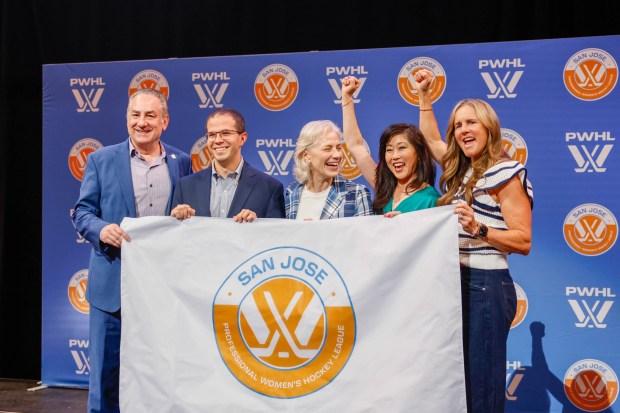 (From left to right) Jonathan Becher, president of Sharks Sports & Entertainment, Royce Cohen, PWHL Advisory Board Member and Senior Vice President, Amy Scheer, Senior Vice President of Business Operations for the Professional Women’s Hockey League, Kristi Yamaguchi, Olympic gold medalist, and Brandi Chastain, two-time Olympic gold medalist, celebrate during a press conference announcing a San Jose Professional Women’s Hockey League team at SAP Center in San Jose, Calif., on Tuesday, May 19, 2026. (Shae Hammond/Bay Area News Group)
That stage, known as the “Foundational Roster Completion,” is scheduled for June 8. Selection order and procedural details for the 10-round draft will be finalized just two hours before the event begins at 3 p.m., leaving little time for maneuvering or outside analysis.
The league’s open signing period for all remaining free agents begins June 19. By the end of the process, each of the PWHL’s 12 teams will be allowed up to 23 active players and three reserve players.
Ryan believes the expansion teams will be building for the future more than instant results. Over the league’s first three seasons, planning for the future has been difficult, he said, because of roster movement due to planned expansion.Now, he expects things to be a bit more settled, so teams can build long-term toward a championship roster.
“You want to win the Walter Cup, and in an expansion process, I think the smartest thing you could do is try to create as good of a foundation and a base as you can,” Ryan said. “Even if that doesn’t mean you’re not winning a championship in the first couple years, you’re at least building a really solid foundation and a solid business that you can build on to have a little bit more longevity.”
There has never been a pro women’s hockey league with 12 or more teams in North America, meaning the league has more talent and more roster movement than any in history.
Ryan said teams may have been more “short-sighted” when the future was tougher to predict before the stability of the PWHL.
“You’re trying to win that year, and if it costs you the next few, that’s OK,” he said.
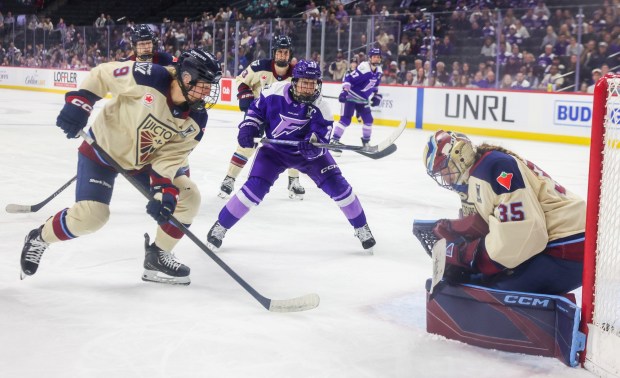 Minnesota Frost forward Kendall Coyne Schofield (26) and Montréal Victoire defenseman Kati Tabin (9) watch as Victoire goaltender Ann-Renée Desbiens (35) stops a shot during game 4 of the PWHL semifinals at the Grand Casino Arena on May 8, 2026, in St. Paul, MN. The Frost beat the Victoire 3-1. (Stacey Wescott/Chicago Tribune)
“Now, where you might get a little bit of time with your athletes, it may change who you select, because you may see an athlete that is in the draft, maybe not there ready to help you win a championship in Year 1, but with a little bit of time and a little bit of development, that athlete could be a great player for you for years to come.”
Among the players under contract who could draw interest from San Jose are Seattle goalie Hannah Murphy, forwards Jesse Compher (Toronto), Gabbie Hughes (Ottawa) and Teresa Vanisova (Vancouver) and defenders Daniela Pejsova (Boston) and Ella Shelton (Toronto).
High-profile free agents such as Emily Clark, Alina Müller, Kelly Pannek and Kendall Coyne Schofield – a former Sharks color commentator – could also become available amid the expected roster movement.
With Ryan in charge over the last three seasons, the Toronto Sceptres were defensive-minded and focused on puck possession. The Canadian national team, which he coached for a decade until leaving after the Olympics in February, has traditionally played a physical game.
This time around, it will be much more of what the market gives him.
“The existing teams kind of dictate what will happen,” Ryan said. “It’s not necessarily at my discretion. A lot of it is you’re waiting for that list to be released by doing your homework, trying to predict the losses, what the existing teams, who they may protect, who they may kind of expose.”
Ryan believes the best approach is to try to sign the best player available and then build around her. So that means if San Jose brings in a lockdown defender, it might focus more on a goal-scorer in the amateur draft later in June, for example.
“That decision will impact future decisions,” Ryan said. “It’s very complicated, but it’s exciting as well.”
By the end of June, the Bay Area’s first women’s pro hockey team will have the bones of a roster. It’s just going to be a whirlwind to get there.
“I think it’s going to be a stressful time,” Ryan said.