
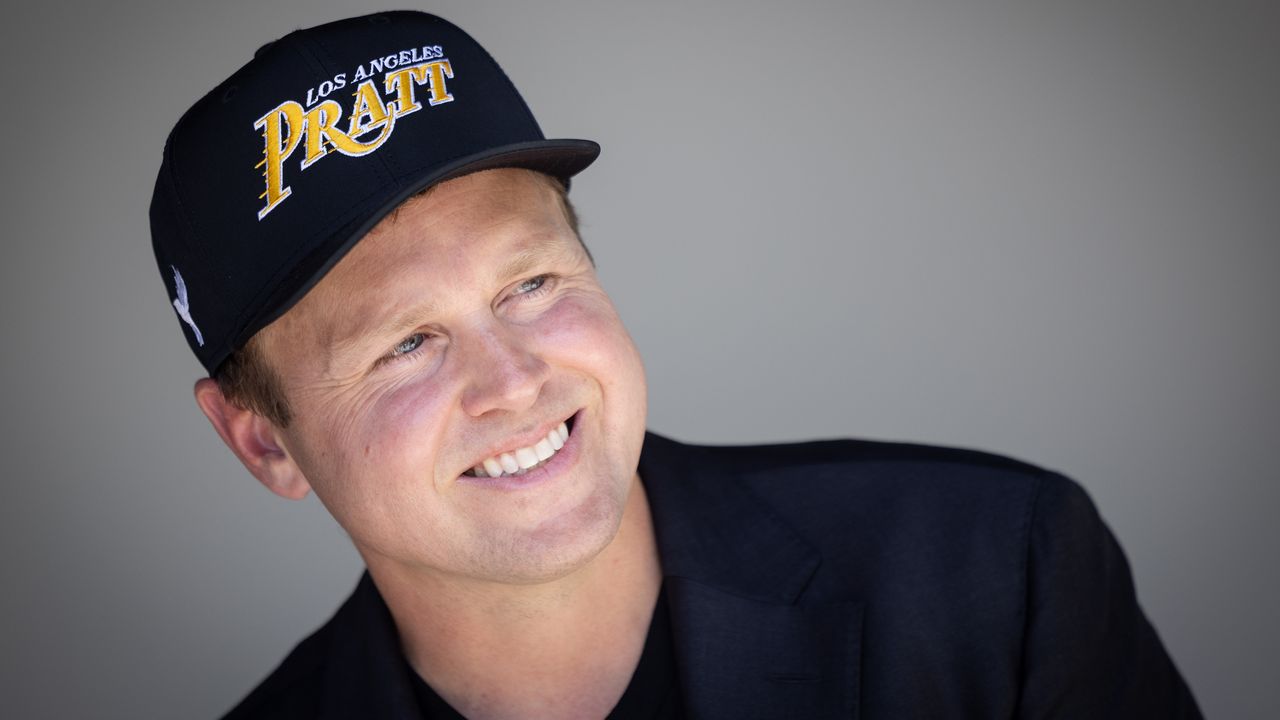
Historically, Cabrera Arús notes, political fashion was used mostly in two ways: to project authority, status, and unity (think all those men in their homogenous suits) and as branding (à la Trump’s blazing red MAGA hats). “What makes the Pratt case interesting,” she says, “is that his choices seem to be doing something hybrid. On the one hand, the suits and formalwear read as an attempt to close the distance between himself and the political establishment he seeks to win over. Coming from reality television, dressing up conveys belonging.” She mentions how New York City mayor Zohran Mamdani, a democratic socialist outsider, dressed his revolutionary messaging in innocuous tailoring to create a visual connection with familiar City Hall leaders.
“On the other hand,” she continued, “the Lakers and Dodgers logos, the Vans, the caps come closer to Trump’s playbook. These are lifestyle tokens that denote Los Angeles, street culture, the people’s teams. They convey belonging, not to the establishment but to the people. The result is a combination of Mamdani’s legitimacy-seeking formalism and Trump’s populist symbolism—a candidate trying to look like an insider, a local, and a people’s advocate at the same time.”
Andrew Weitz, a Los Angeles–based image consultant and men’s stylist, says that “from an executive style strategist’s perspective, Spencer Pratt’s style feels very intentional. The suits with Vans are meant to balance authority with relatability. The tailoring says, ‘I’m serious,’ while the Vans keep him connected to LA skate and street culture and make him feel less polished and political.”
“The hats do the same thing,” he added. “They feel more like lifestyle branding than campaign merchandise, which is smart in today’s attention economy.”
There’s precedent in the political sphere, from Jimmy Carter’s avuncular cardigans to Ronald Reagan’s cowboy cosplay. More recent examples include John Fetterman’s schlubcore and Maine senatorial candidate Graham Platner’s rugged workwear, both of which speak to their blue-collar personas. (Cabrera Arús added Fidel Castro, son of a wealthy landowner who cemented his revolutionary persona with his military fatigues, to the bunch.) Though less folksy than those models, Pratt’s look, too, sets him apart from the political machine that he disdains. Any Angeleno will recognize the laid-back, skate/surf-inflected affectations that Pratt embodies as a common uniform of the area. It’s part off-duty dad, part beach bum. As Weitz says: “He’s not dressing like a traditional politician—he’s dressing like Los Angeles.”
Pratt’s use of local sports team emblems—which, SFGate has noted, likely qualifies as trademark infringement—can be read most of all as a way for him not to identify with a particular political party but with the city and state itself. Pratt recently revealed that he’s a registered Republican, but he has kept a distance from the MAGA movement, despite Trump recently expressing his support. He is running as an independent, and his stated policies include vague notions of disaster preparedness, fiscal reform, and the housing crisis. At times, he seems more animated by revenge on Mayor Bass than anything else; he has recently shared AI-generated ads attacking her. His message is clear—that he is not part of the establishment and that his loyalty lies with the city—and his LA-affiliated merch serves as a visual reinforcement of that point.