
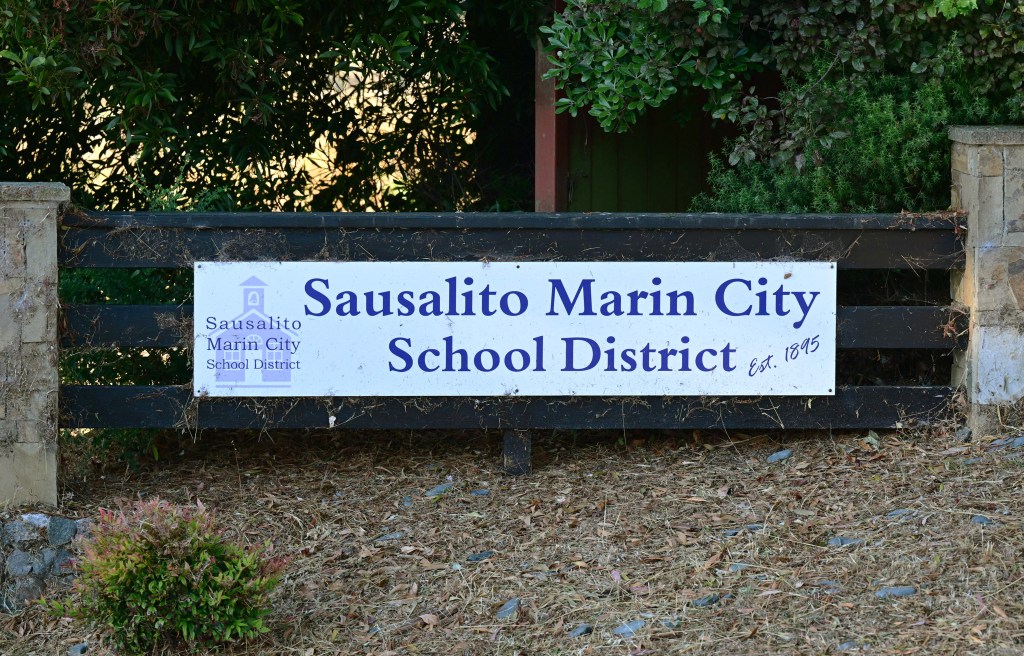
For the third year in a row, teachers and management at the Sausalito Marin City School District are at an impasse over a contract.
The two sides failed to reach an agreement at the first state mediation session this month. A second mediation session has been set for June 4, according to the Sausalito District Teachers Association.
The union represents 26 certificated teachers at Dr. Martin Luther King Jr. Academy in Sausalito.
Union president Nathan Scripps said the two sides avoided a strike in the 2023-24 school year with a last-minute settlement. That was right after fact-finding, the last step in the state mediation process, failed to produce an agreement.
For the 2024-25 school year, the two parties had mediation “throughout the summer,” Scripps said.
“This year, the parties were unable to make progress after four sessions,” he said.
Superintendent LaResha Huffman said the district is one of many struggling with fiscal and staffing issues.
“Like many districts across California, the main challenge in negotiations is balancing competitive compensation with the district’s responsibility to remain fiscally solvent in the years ahead,” Huffman said in an email.
“We remain hopeful an agreement can be reached through mediation while also ensuring we protect the district’s reserves and avoid the financial challenges many districts across the state are currently facing, including layoffs and program cuts,” she said.
The union says the district, which received a financial boost from the Measure G parcel tax approved in 2024, initially offered 1% increases in wages for 2026-27.
“We are frankly surprised that we are at an impasse after the passage of Measure G,” said Scripps, a science teacher. “Thanks to community support, Measure G has increased the district coffers by $1.3 million dollars a year which, in theory, provides a larger ongoing operating budget, a stable staff and a robust education experience for students in the Sausalito Marin City School District.”
“The district, however, had other plans for taxpayer money,” Scripps said. “Stable staffing was not one of them.”
According to Andrea Burns, bargaining chair for the union, a 1% increase would amount to about $127 per month, per member, before taxes.
“The union offered to restructure the salary schedule, explore commuter benefits and discuss full family insurance to ensure competitiveness across Marin County,” Burns said. “The district was not interested in exploring any concepts that would create stability and the best learning experience for our students in our school.”
Burns said the union “had no choice but to go through the impasse procedures again.”
According to union research, the district received a total increase of $1,663,585, or 13.53%, in revenue over last year. Total revenue is now at $13,955,419, or $53,675 per student, the union said. That is among the highest per pupil funding in Marin.
The California state average in per pupil funding is $22,194 per student, the union said.
“With $53,675 per student, Sausalito Marin City School District can and should be providing comprehensive programs for our students and attracting top talent with competitive salary and benefits,” Burns said. “It is time for the board of trustees and district management to put students first — Sausalito Marin City students deserve the best.”
According to the 2025-26 salary schedule for district teachers, a starting teacher makes $63,418. A teacher at the other end of the scale, with 21 years’ experience and either a bachelor’s degree and 75 education credits, or a master’s degree and 30 credits, makes $133,569.
The 2025-26 salary schedule represents a 3.5% increase in compensation, according to the district website.
Amy Hale, principal of Dr. Martin Luther King Jr. Academy, said teachers have improved student reading skills.
“Our teachers and staff have worked hard to strengthen foundational reading instruction, align interventions more closely to student needs and use assessment data more intentionally to support growth,” said Hale, who started in August. “We are seeing encouraging progress in our reading data, particularly in early literacy.”