
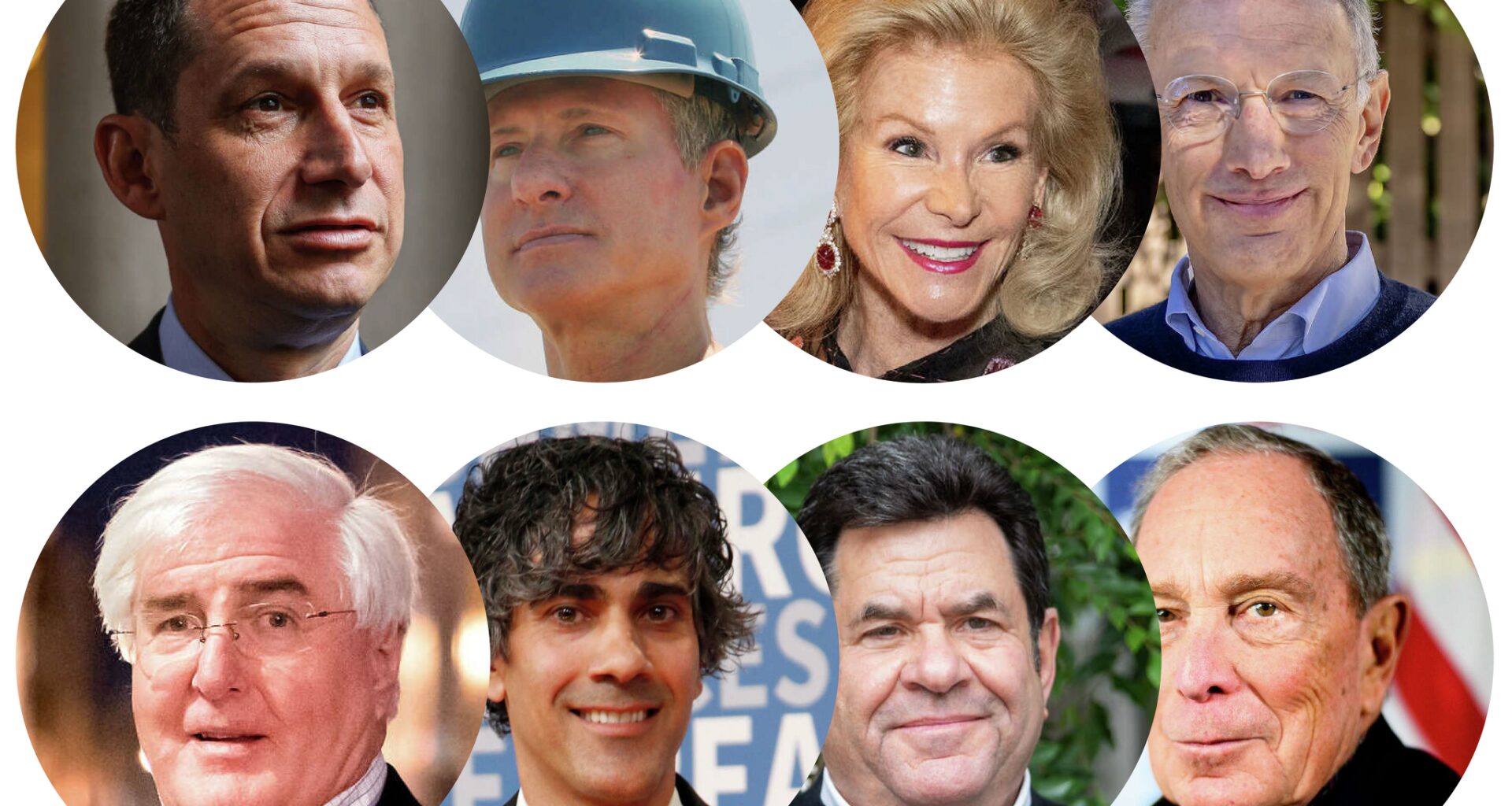
Wealthy donors have poured tens of millions of dollars into San Francisco politics over the last six years, and they’ve continued to spend big on the upcoming June election.
A Chronicle analysis of the top ten individuals or couples who gave the most to elections in the city this decade shows that most of their money has gone to boost moderate candidates. That includes Mayor Daniel Lurie, who bankrolled his own campaign and also benefited from deep-pocketed allies who funded a political action committee that backed him. Donors also invested in several high-profile ballot measures such as the successful 2024 effort to turn the Upper Great Highway into a park and Lurie’s proposals slated for the November ballot to reform the city’s governance structure.
Still, the huge amounts of money that continues to flow into San Francisco races and measures is striking. In the June 2 primary, wealthy contributors are funneling millions more into campaigns that will determine whether the city raises taxes on big businesses and whether two of the mayor’s allies on the Board of Supervisors keep their jobs.
These findings come from political donation data published by the San Francisco Ethics Commission, which collects information about contributions to committees influencing San Francisco elections. The analysis, based on donations made from the start of 2020 onward, only includes donations to committees formed specifically to support or oppose a candidate or ballot measure. Contributions to general purpose committees were excluded, since these groups sometimes spend money on non-San Francisco causes, as were donations to state and federal campaigns, including the race to succeed Speaker Emerita Nancy Pelosi in the House of Representatives.
Here’s a look at some how the decade’s leading donors are shaping local politics.
No one has spent more money on local San Francisco races in recent years than Lurie. And he spent the overwhelming majority of his contributions on himself.
Lurie is an heir to the Levi’s denim fortune by way of his mother, Mimi Haas, who married the late Peter Haas, a descendant of Levi Strauss and longtime leader of the denim company, when Lurie was a child. Before Lurie entered politics, he founded and ran a local antipoverty nonprofit, Tipping Point Community.
Lurie was little known to most San Francisco voters when he launched his mayoral bid in 2023. While Breed already had widespread name recognition and wealthy backers and prominent organizations endorsing her, Lurie was relatively unknown and relied on his fortune to get his message out. He ultimately spent about $9 million of his own money on his campaign — far more than any other individual donor has expended on local politics since 2020.
It was arguably money well spent for Lurie, who beat Breed by 10 points in the November 2024 election.
Daniel Lurie’s donation history
Crypto billionaire Chris Larsen, the co-founder of Ripple Labs, was a major backer of Breed’s when she was running for reelection in 2024. He gave more than $1 million in support of her bid for another term and a ballot measure she put before voters in March 2024 that expanded police powers.
Larsen has moved into Lurie’s corner in the years since the election. He and his philanthropist wife, Lyna Lam, have given a combined $2 million this year to support the mayor’s charter reform ballot measures slated for the November election.
A prominent supporter of San Francisco police who funded a network of surveillance cameras used by police, Larsen’s political spending has also emphasized public safety. He donated $250,000 to defeat a 2024 ballot measure branded by its opponents as a “cop tax.” This year, he gave more than $500,000 in support of a bond that would help the city pay for seismic upgrades and other infrastructure related to disaster response.
Billionaire venture capitalist Michael Moritz has become one of the biggest political spenders in recent San Francisco elections, contributing about $6.5 million to back ballot measures and candidates aligned with the city’s moderates.
Moritz made his fortune at venture firm Sequoia Capital, where he invested in tech companies such as Google and PayPal. He also has a charitable foundation, Crankstart, and he is chairman of the San Francisco Standard news website.
He gave heavily during the 2024 elections in support of Proposition D, a failed ballot measure to slash the number of city oversight commissions and make other City Hall governance changes. The measure was backed by TogetherSF, a now-defunct political group tied to Moritz.
Moritz was also one of the top financial backers of Mark Farrell, a former supervisor and interim mayor who finished fourth in the 2024 mayor’s race. But Moritz has since become an ally of Lurie’s. He has given $2 million to support one of the mayor’s top political priorities this year: a trio of ballot measures to reform the city’s governing document.
While he’s best known for his three terms leading the nation’s largest city, Bloomberg has also been a player in San Francisco politics in recent years. Before entering politics, he became a billionaire thanks to his namesake company, which provides financial software and also publishes a news outlet.
The vast majority of his recent San Francisco contributions — about $1.5 million — went to support Breed’s mayoral reelection campaign in 2024.
Breed had previously endorsed Bloomberg’s unsuccessful presidential campaign in 2020.
Bloomberg also gave $250,000 in favor of a successful 2020 ballot measure that authorized a $487.5 million bond to fund an array of projects related to parks, homelessness, addiction, mental health and infrastructure.
An heir to Hyatt Hotels Corp., John Pritzker has donated millions to philanthropic causes in San Francisco, including helping build UCSF’s psychiatry building and kicking money toward the city’s most expensive park.
But Pritzker has also used his billions to support San Francisco ballot measures, donating $250,000 to help pass a 2020 bond. In 2024, he also poured $200,000 into a ballot measure committee run by then-mayoral candidate Farrell, who was later fined for illegally using the committee’s funds for his candidacy.
Like Moritz and Larsen, Pritzker has since become a Lurie ally, giving $1 million to the mayor’s charter reform effort, making up the bulk of the $1.48 million he’s given since 2020.
Yelp CEO Jeremy Stoppelman has given more than $1.1 million toward San Francisco causes since 2020. Half went to support Proposition K, the measure that closed the Upper Great Highway to vehicles, and fight the recall of Supervisor Joel Engardio that ensued.
That wasn’t the only pedestrian-oriented proposition Stoppelman supported. In 2022, he donated $300,000 to back a measure keeping Golden Gate Park’s John F. Kennedy Drive closed to cars.
If political spending is any indication, the mayor’s mom is one of his biggest supporters.
Haas, a major philanthropist, made a record-breaking $1 million donation to a committee supporting Lurie’s bid for mayor in 2023.
Since then, her political donations in San Francisco have been much more limited, consisting of $500 donations to Alan Wong’s and Stephen Sherrill’s campaigns for supervisor. Lurie has endorsed both candidates.
A major Democratic backer in federal elections, Ron Conway has also donated hundreds of thousands of dollars to San Francisco causes over the past several years. The Silicon Valley venture capitalist gave $160,000 to help pass Prop M in 2024, which reduced city taxes for small businesses. The same year, he also gave $150,000 to a committee backing the failed Prop D, which would have vastly expanded mayoral power.
More recently, Conway donated $25,000 to oppose Engardio’s recall.
Diane “Dede” Wilsey, a San Francisco socialite, philanthropist and heir to fortunes from Dow Chemical and dairy farms, has continued to advocate for the city’s museums, even after stepping down as president of the board of the Fine Arts Museums of San Francisco in 2019. In 2022, she donated $200,000 to a failed effort to reopen JFK Drive to cars, which she and other museum supporters said would encourage visits to the De Young Museum.
Wilsey’s other San Francisco donations include $100,000 to support Prop F, a 2024 measure that required drug screenings for welfare recipients. She gave another $50,000 to back a 2024 bond measure funding healthcare facilities.
Saikat Chakrabarti has spent millions of dollars on his San Francisco congressional campaign. Now, he’s putting some of his wealth — gained from equity in tech company Stripe, where he was a software engineer — into ballot measures.
In recent weeks, Chakrabarti has donated a total of $600,000 to support San Francisco’s Prop D (not to be confused with the 2024 measure). The labor-backed proposition would raise taxes for large businesses whose CEOs make more than 100 times the median pay of their employees.
On Wednesday, Chakrabarti also donated $150,000 to support Measure A, which would authorize San Francisco to issue $535 million in bonds to fund earthquake preparedness infrastructure.
Chakrabarti’s previous donations this decade were much smaller, including contributions to the supervisorial campaigns of Bilal Mahmood, Michael Lai and Natalie Gee.
About this story
To identify the top donors to San Francisco causes, the Chronicle analyzed donation data reported to the city by campaign committees. This data covers contributions in city elections, including the San Francisco Democratic County Central Committee, but does not include state or federal races.
The Chronicle’s analysis only included individuals’ donations to what are known as “primarily formed committees,” which are formed to support or oppose specified San Francisco candidates or ballot measures. Donations to general purpose committees, also known as political action committees or PACs, were excluded since these groups’ spending does not always entirely go toward San Francisco elections.
Donor photos by Gabrielle Lurie/S.F. Chronicle, Lea Suzuki/S.F. Chronicle, Carlos Avila Gonzalez/S.F. Chronicle, Noah Berger/Special to The Chronicle, Jessica Christian/S.F. Chronicle and Laura Morton/For the S.F. Chronicle.
 Go deep into the numbers with the SFChronicle data team as your guides.
CreditsReporting and data by Christian Leonard. Reporting by J.D. Morris. Graphics, design and development by Hanna Zakharenko. Editing by Dan Kopf and Emily Fancher. Design editing by Alex Tatusian.