
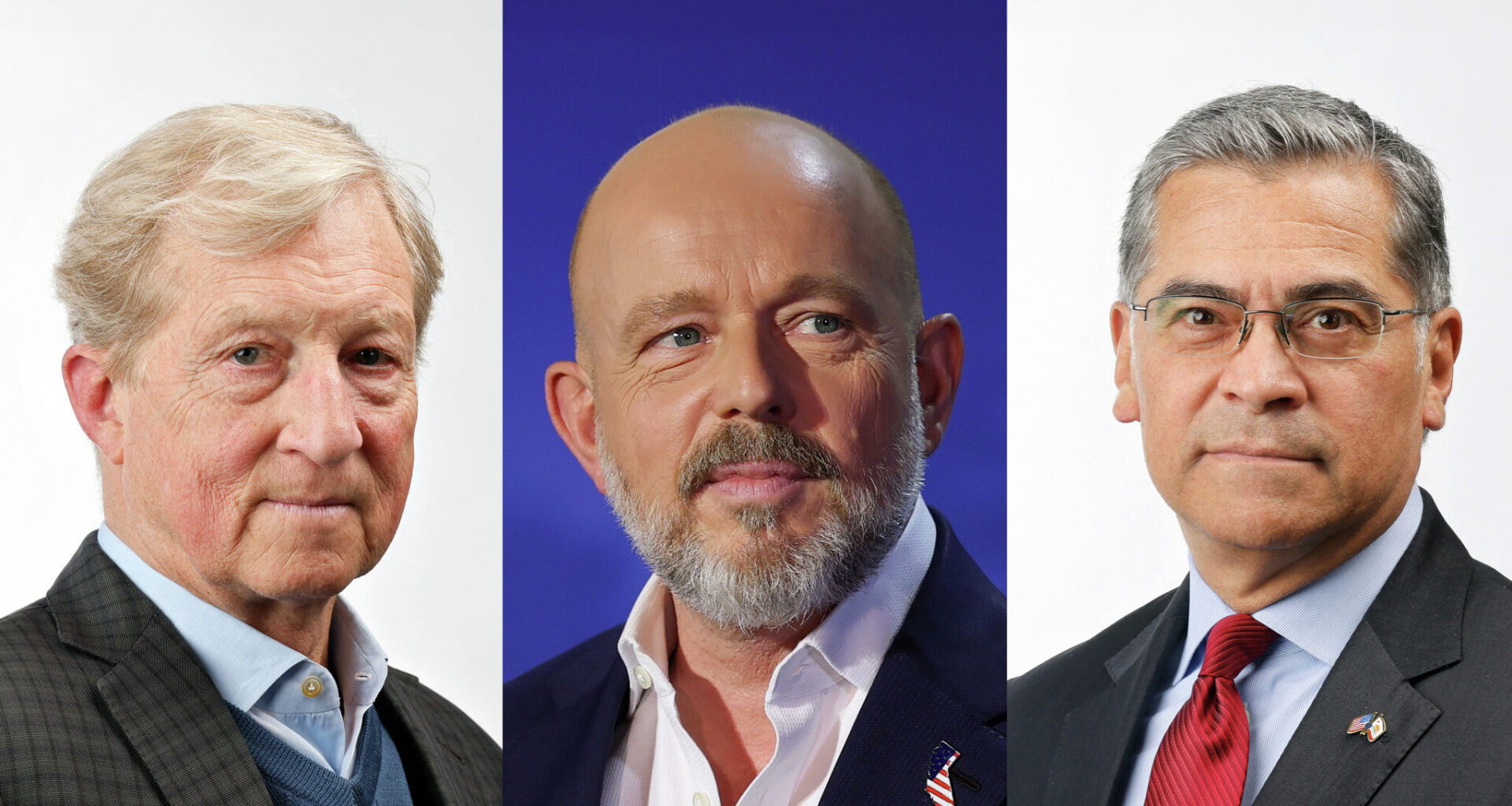
From left: Tom Steyer, Steve Hilton and Xavier Becerra are among the top-polling candidates in the race to become California’s next governor.
Lea Suzuki/S.F. Chronicle; Eric Thayer/L.A. Times via Getty Images
Xavier Becerra speaks during a campaign rally at Manny’s in San Francisco on Saturday.
Manuel Orbegozo/For the S.F. Chronicle
Steve Hilton greets a supporter after speaking at a protest against the participation of a transgender athlete in the CIF State Track & Field Championships in Clovis (Fresno County) on Friday.
Stephen Lam/S.F. Chronicle
Tom Steyer delivers remarks during the California Democratic Party convention at Moscone Center in San Francisco on Feb. 21.
Yalonda M. James/S.F. Chronicle
Olivia Calderón, mayor of Arvin (Kern County), center, speaks with volunteers canvassing for congressional candidate Randy Villegas at Smothermon Park in Arvin on May 16.
Jenna Schoenefeld/For the S.F. Chronicle
Volunteers listen to Jasmeet Bains speak at a canvassing event in Bakersfield on May 16.
Jenna Schoenefeld/For the S.F. Chronicle
Saikat Chakrabarti speaks at a campaign rally in SoMa in San Francisco on May 7.
Lizzy Montana Myers/For the S.F. Chronicle
Election Day voters cast their ballots at a polling station at San Francisco City Hall in November 2024.
Brontë Wittpenn/The Chronicle
Savannah Stokes delivers her ballot and her father’s at a drop box outside City Hall on Election Day 2024 in San Francisco.
Brontë Wittpenn/The Chronicle
Outgoing U.S. Rep. Nancy Pelosi speaks in support of San Francisco Supervisor and congressional candidate Connie Chan, right, at Friday’s “Get Out the Vote” rally in San Francisco. The former House speaker has endorsed Chan to fill her seat.
Gabrielle Lurie/S.F. Chronicle
State Sen. Scott Wiener poses for a photo with supporters as he campaigns for his congressional race in San Francisco’s Chinatown on April 23.
Lea Suzuki/S.F. Chronicle
The most tumultuous and wide-open California governor’s primary in decades will conclude (but perhaps not the vote-counting) on Election Day. If that’s news to you, you can still cast a ballot until polls close at 8 p.m. Tuesday.
• Related: Details on last-minute voting.
Meanwhile, as Californians wait (and likely wait … and wait … and wait) for the results to come in, here are some things to watch for.
Article continues below this ad
Will voting, and vote-counting, run smoothly amid election fearmongering?
The vast majority of Californians vote with a mail-in ballot — either by dropping it in their own mailbox, at the post office, an election drop box or polling place. Tallying those ballots takes time: Election workers sort envelopes, verify signatures and separate ballots in order to count them anonymously. The crowded governor’s race has prompted a lot of voters to hang on to their ballots longer than previous races, as they take their decision-making down to the wire. That, in combination with California’s voting laws that allow ballots received up to seven days after Election Day so long as they’re postmarked by June 2, and time for someone to “cure” — or fix — a rejected signature, means it can take weeks for elections officials to verify race results. The length of the process has added to President Donald Trump and Republicans’ scrutiny and suspicion of the state’s results.
Republicans nationally have been working to restrict voting and vote-counting in the name of election security. Trump has been pushing the federal SAVE Act and has attempted to seize voter rolls in California and other states. Gov. Greg Abbott redistricted Texas to appease Trump, Louisiana Gov. Jeff Landry suspended a primary election already underway, and right-wing commentator Steve Bannon has called for ICE officers to patrol polling places. Last week, Gov. Gavin Newsom signed a bill to prevent Riverside County Sheriff Chad Bianco (or any sheriff) from repeating his recent unprecedented seizure of 650,000 ballots from last year’s special election over Proposition 50, which was California’s answer to Texas’ redistricting with its own changes to favor Democrats.
San Francisco Chronicle Logo
Make us a Preferred Source to get more of our news when you search.
Add Preferred Source
That tense backdrop could add fuel to any problems voters experience in returning a ballot, or drawn-out vote-counting that keeps voters in the dark regarding which candidates will advance to November. A voter ID initiative is set to face California voters in November. Whether the election runs smoothly on Tuesday could influence people’s votes on that measure.
Article continues below this ad
Greatest comeback since Lazarus?
The nation will be watching to see who will be the top two finalists to lead the world’s fourth-largest economy.
A juicy subplot is that Tuesday’s top vote-getter in the governor’s race could be a Democrat that the chair of the California Democratic Party and other party leaders were trying to nudge out of the race a few months ago: former Health and Human Services Secretary Xavier Becerra. In March, Democratic Party Chair Rusty Hicks wrote an open letter encouraging low-polling candidates to drop out. Rival candidate Antonio Villaraigosa encouraged Becerra to end his bid, saying it would decrease the chances of two Republicans advancing to the general election. Now Becerra is leading in most polls, trailed by Republican Steve Hilton and billionaire Tom Steyer. Villaraigosa polled 1% in last week’s Berkeley IGS Poll, tied for last place.
Will there be a Dem vs. Dem governor showdown?
In March, analysts said there was an “historically high lack of awareness” in the governor’s race. Democratic Party leaders fretted that the party, which counts roughly twice as many registered voters in California than Republicans do, could be locked out of the November election in the nation’s bluest state. Now there’s a 98% chance that the general election race will be between a Republican and a Democrat and a 2% shot of it being Democrat on Democrat, according to a computer model created by Sacramento data expert Paul Mitchell.
Article continues below this ad
Who follows Pelosi?
The top race to watch in San Francisco will be the battle to succeed Speaker Emerita Nancy Pelosi, who decided not to seek reelection after first entering Congress in 1987. A Chronicle poll released earlier this month showed San Francisco state Sen. Scott Wiener with a commanding lead, but the race for the second between wealthy former tech engineer Saikat Chakrabarti and San Francisco Supervisor Connie Chan, is tight. Pelosi recently endorsed Chan.
Trump giveth, Trump taketh
Hilton started to pull away from his top Republican rival, Riverside County Sheriff Chad Bianco, after President Donald Trump endorsed him. A Berkeley IGS Poll released last week found that 37% of likely GOP voters said Trump’s nod made them more likely to back Hilton. That Trump bump will fade quickly after Tuesday. If Hilton makes the top two, Democrats will tie Trump’s endorsement around Hilton like an anvil, a potentially fatal curse in a state where two-thirds of voters loathe Trump.
Is money everything?
Steyer has already set a record for self-funding a campaign, pouring $213 million of his own money into the race. Will he make the top two or will Tuesday be a reprise of his ill-fated 2020 presidential campaign, when Steyer spent $345 million and received no pledged delegates?
Article continues below this ad
Will Swalwell and Yee siphon votes?
Former Rep. Eric Swalwell remains on the ballot despite dropping out of the race after the Chronicle reported allegations that he twice sexually assaulted a former staffer. He withdrew from the race last month. Former Controller Betty Yee, who dropped out of the race after consistently polling at the bottom, also appears on the ballot, because like Swalwell she ended her campaign after the deadline to remove names from the ballot had lapsed.
Political operatives often talk about “low-information voters” — those who barely follow the races they cast ballots in. How many voters will cast a ballot for the disgraced Swalwell or Yee?
There is precedence for such voter ignorance. In 2014, former state Sen. Leland Yee received 380,361 votes out of 4 million cast for secretary of state just two months after being indicted in a federal corruption investigation. He finished third in the primary, ahead of several candidates who had been actively campaigning.
Will younger candidates make an impact?
After Trump won reelection and Republicans took the House and Senate, there was much chatter among Democrats about needing to replace the older generation of officeholders with younger candidates. Pelosi, 86, will not be on the ballot, but Rep. Mike Thompson, 75, will be trying to stave off a challenge from Eric Jones, 35, who raised $8.2 million, more than double what Thompson did ($3.4 million). More ominous for Thompson: If Jones advances Tuesday from the nine-candidate field to a one-on-one matchup, he still has $4.2 million cash on hand for the general election. Thompson has $1.7 million.
Article continues below this ad
Will a progressive or a moderate advance in the Central Valley?
As always, Democrats are divided about the best way to beat Republicans in red and purple districts. One race to watch this dynamic play out will unfold in the Central Valley, where moderate Assembly Member Jasmeet Bains, 40, a family physician, is dueling with Randy Villegas, a 31-year-old community college professor who is running on a progressive agenda. Likely one of them will emerge to take on Republican Rep. David Valadao, who regularly manages to hold onto his seat in a district that is now 42% Democratic, 26% Republican and 24% no party preference. Valadao is the last remaining House Republican who supported Trump’s second impeachment.
How did gerrymandering work out?
Last November, 64% of California voters overwhelmingly approved Prop 50, which temporarily redrew California’s congressional maps in an effort to flip five GOP seats.
The measure was designed to help Democrats take control of the U.S. House and to counter moves by Republican-controlled states that are redrawing their own maps. California’s effort got dealt a major blow by a recent U.S. Supreme Court ruling gutting the Voting Rights Act in a way that has allowed red states to swiftly redraw their own maps, with very little stopping them from carving districts in whichever way is most beneficial to the GOP. Still, it’s worth watching what happens in California’s five redrawn districts currently held by Republicans — including Valadao’s — that could flip to Democrats in November.