
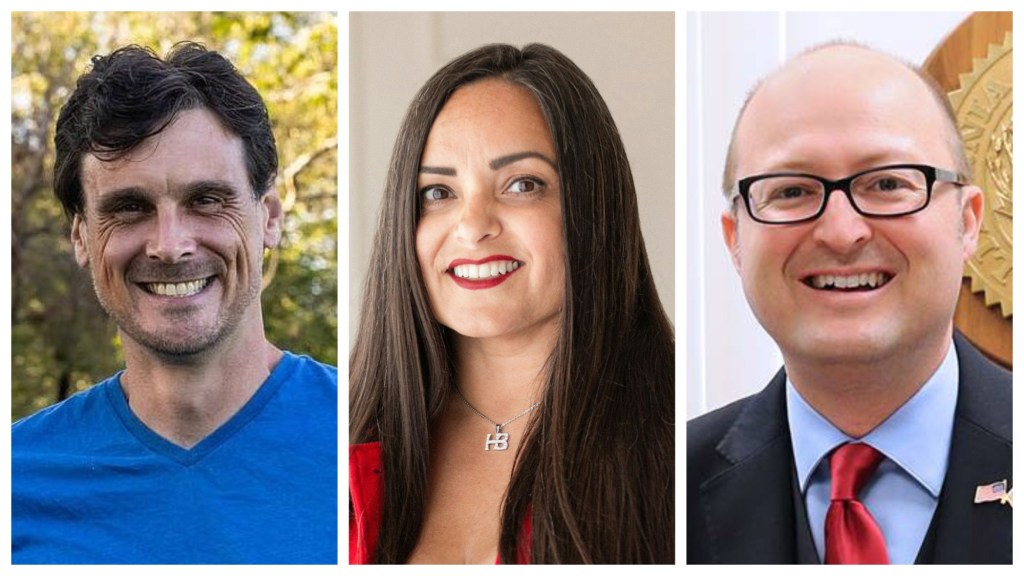
Chris Kluwe sprang to the lead on Tuesday night, with Gracey Van Der Mark in a close second and Matthew Harper and Frank Wagoner trailing behind in early primary returns for California’s 72nd Assembly District.
Geographically, the district spans the Orange County coast, from Seal Beach to Laguna Beach, and includes the inland communities of Aliso Viejo, Laguna Woods, and Lake Forest. Politically, voter registration data points to a slight right lean, with 39.4% of voters registered as Republican, 32.1% registered as Democrat and 21.5% registered as no-party preference.
Kluwe, a community activist and former NFL player, acknowledged Tuesday evening that results could change as more votes are tallied, but said he believes voters responded to the themes of his campaign.
“I think my willingness to take on corruption, regardless of party, as well as focusing on working-class families and their struggles of affordability, really resonates with a lot of voters who just want the government to do their work and to leave them alone.”
• Also see: June 2 Primary Election Results
Van Der Mark, a city councilmember; Harper, a real estate broker; and Kluwe, are from Huntington Beach. Wagoner is a community activist in Lake Forest. The district is currently represented by Diane Dixon, a Republican from Newport Beach who is not running for re-election in the Assembly but is a candidate for the Fifth District seat on the Orange County Board of Supervisors.
Kluwe has not previously held public office. The one-time NFL punter said he would use a combination of spending cuts and new revenue to fix the state’s budget deficit.
“Everyone should be able to agree we need to take more initiative to address fraud and bureaucratic waste throughout California, with those efforts driven by an independent oversight committee, not politics.”
He believes the state’s most pressing issues are affordability, the environment, and the use of artificial intelligence. When it comes to the state’s immigration policy, Kluwe said the federal government’s current enforcement operations are “unconstitutional, immoral, and directly contrast to the idea of a democratic society that upholds law and order and treats people fairly with respect.”
“I would work with the incoming governor and other legislators to ensure we work together in response to the cruel, unsafe, and ineffective actions of the Trump administration and hold them accountable,” he said in the O.C. Voter Guide.
Van Der Mark previously held the rotating role of mayor of Huntington Beach and has sat on boards connected to the Orange County Housing Finance Trust and Orange County Waste and Recycling, among other roles.
Van Der Mark has said she opposes using tax hikes to balance the state budget, and has criticized Gov. Gavin Newsom for taxing Californians to “the max.” Van Der Mark said she will not support budget cuts to public safety or corrections. And said the top three challenges facing the state are: the high cost of living, fraud in the government, and high crime rates.
When it comes to immigration enforcement, Van Der Mark said she supports law enforcement.
“Rhetoric from politicians has tried to make law enforcement the villains in this debate,” she said in her answer to this question in the OC Register Voter Guide. “That is simply unacceptable. However, today’s immigration challenges are the result of years of inaction by the state and, in many cases, policies that have prevented local law enforcement from cooperating with federal authorities. We need to allow law enforcement to do their jobs.”
Harper previously served in the Assembly from 2014-2018, and also held the rotating role of Huntington Beach mayor in 2013 and ’14. He served on the Huntington Beach council from 2010 through 2014, and previously held roles as a trustee of the Huntington Beach Union High School District (1998-2010), and as chairman of the Young Republican Federation of California from 2005-2007.
He opposes raising taxes and said the state budget should focus on improving education and fighting crime.
“Spending on illegal aliens should be cut,” he said, in an answer provided to the OC Register voter guide, and suggested that California can make broad spending cuts to state operations by eliminating vacant positions and reforming major programs, like Medi-Cal.
The three greatest challenges to California, Harper said, are improving education, fighting crime, and tax hikes.
On the question of immigration enforcement, Harper said he “voted against illegal aliens in our state more than any other member” when he was in the Assembly.
He supports repealing California’s sanctuary state laws, including SB554.
“Local and state law enforcement should be able to work together with federal law enforcement,” he said. “Removal of illegal aliens is a clear priority for the voters and the state of California should not impede this policy objective.”
Wagoner, of Lake Forest, has also never held public office.
He believes the state’s budget deficit can be reduced by not spending money on localized projects that benefit specific people or interest groups.
One of the state’s greatest challenges, in his view, is crime, which Wagoner has said can be reduced by keeping “repeat offenders off the streets while eliminating the amount of probation given for multiple crimes.”
He also believes the high cost of housing could be eliminated by “making it easier to build houses without profiteering by the cities,” and he recommends changing unused commercial buildings for residential use. He would also like to see better drug enforcement and more effective treatment of addictions.
When it comes to how the state should handle immigration, Wagoner said, “the federal government needs to work with the state government and notify them of criminals they want to arrest and the crimes committed.”