
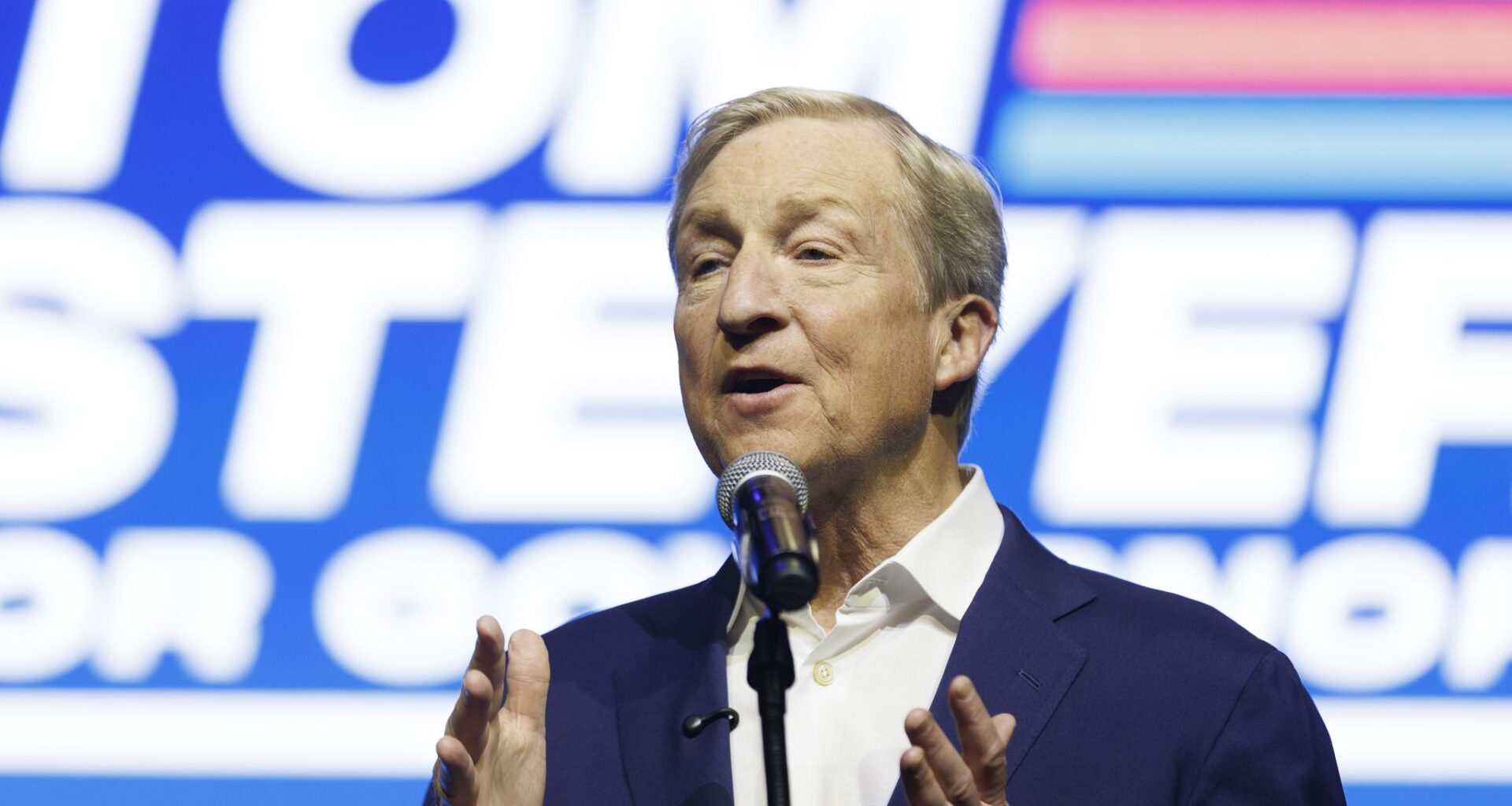
Tom Steyer speaks at his election night watch party at the Regency Ballroom in San Francisco on June 2, 2026.
Santiago Mejia/S.F. Chronicle
What can $200 million buy you? Perhaps not the California governor’s office.
Despite breaking campaign spending records in the gubernatorial primary, billionaire environmentalist Tom Steyer was third in the initial results reported Tuesday night with nearly 20%. He trails Republican Steve Hilton, a former Fox News host, who led with about 28%, and fellow Democrat Xavier Becerra, the former state attorney general and U.S. health and human services secretary, who had more than 25%.
Steyer pumped his personal fortune into wooing progressive voters. His potential failure headlines a rough showing this year, up and down the primary ballot, for rich, self-funding candidates, as well as for wealthy donors who hoped to reassert control over a state political landscape they fear is slipping away from them.
Article continues below this ad
Call it the billionaire bust. It underscores the limits of money’s influence on elections in a state as vast and diverse as California, where most voters don’t start paying attention until their ballot hits their mailbox and where the electorate has a historic populist streak.
“Politics is not deeply embedded in California’s culture,” veteran Democratic strategist Darry Sragow said. “You could have infinite amounts of money and it’s hard, it’s just hard, to pierce the conscience of a sufficient number of voters.”
San Francisco Chronicle Logo
Make us a Preferred Source to get more of our news when you search.
Add Preferred Source
Campaigns are learning that tough lesson anew this cycle.
San Jose Mayor Matt Mahan, a more moderate Democrat who was recruited into the governor’s race by Silicon Valley power players such as Y Combinator CEO Garry Tan, was trailing in sixth Tuesday night with just over 4% of the vote, despite outside groups spending more than $30 million to boost his campaign.
Article continues below this ad
Many of those same people pushed former tech entrepreneur Ethan Agarwal as a centrist Democrat alternative to progressive Rep. Ro Khanna in the East Bay’s 17th Congressional District after Khanna endorsed a controversial billionaire tax proposal. But Agarwal turned out to be a nonfactor, on track to finish a distant fourth with about 6% of the vote.
Meanwhile, Saikat Chakrabarti, who pivoted from startup engineer to become the first chief of staff for progressive icon Rep. Alexandria Ocasio-Cortez, is set to finish well behind two other Democrats in the 11th Congressional District after spending more than $8 million to introduce himself to San Francisco voters as he sought to succeed Rep. Nancy Pelosi.
Saikat Chakrabarti gestures to the crowd during an election night celebration with supporters in San Francisco on June 2, 2026.
Carlos Avila Gonzalez/S.F. Chronicle
Former venture capitalist Eric Jones gave more than $5 million to his effort to take out veteran Rep. Mike Thompson in the North Bay’s 4th Congressional District. But he was thousands of votes behind a Republican for the second place after Tuesday night.
And in the East Bay’s 14th Congressional District, political newcomer Rakhi Israni contributed more than $1 million to her bid to fill former Rep. Eric Swalwell’s seat, providing her campaign more money than all of her competitors combined. Yet she’s currently in fifth, more than 4 percentage points outside the top two.
Article continues below this ad
Nothing compares to Steyer, who poured more than the GDP of the island nation of Nauru into his quest to lead California, flooding the airwaves with ads and paying online influencers to promote him.
If the result holds and he misses the top two, Steyer would be the latest in a long line of gubernatorial hopefuls who have opened their own wallets and spent big, only to fall short of victory.
The list includes Republicans (former eBay CEO Meg Whitman set the previous record in 2010 when she dumped more than $140 million into her unsuccessful campaign against Gov. Jerry Brown, outstripping entrepreneur Steve Poizner’s $24 million investment in the primary that same year) and Democrats (venture capitalist Steve Westly went more than $35 million deep seeking a promotion from state controller in 2006, but lost his party’s nomination).
More recently, Republican real estate investor John Cox spent more than $15 million across two failed runs for governor in three years. Last fall, Stephen Cloobeck, the founder of a time share company, dropped his Democratic gubernatorial bid after $10 million made no dent in the polls.
That’s not to naively suggest money doesn’t matter in politics. Particularly in low-profile races where voters are starved for information about the candidates, it can be decisive. But it’s hardly a silver bullet.
Article continues below this ad
Consider Lt. Gov. Eleni Kounalakis, the daughter of developer Angelo Tsakopoulos. She won California’s second-highest, though largely ceremonial, office in 2018 with help from nearly $8 million of her own money and $5 million from her father. Yet that platform did little for her gubernatorial ambitions. After running for governor for more than two years, Kounalakis pivoted last summer to the race for state treasurer. She led that field Tuesday night and will advance to the November general election.
Sragow said California voters tend to greet wealthy, self-funding candidates with a large dose of skepticism, wondering why they are running for political office when they could do, well, anything else. There is also the question of relatability, and whether the electorate believes these privileged individuals can truly understand their lives and concerns.
“Fundamentally, the voters have to look at you and like you,” Sragow said. “They have to be comfortable with you as a person. And that gets down to: How do they perceive you when they see you?”
He served as the campaign manager for Al Checchi, a former airline executive who sought the Democratic nomination for California governor in 1998. Checchi put about $40 million into his campaign, ultimately finishing far behind the late-surging then-Lt. Gov. Gray Davis.
That campaign offers, in many ways, a parallel to the race between Steyer and Becerra. As the 1998 primary came to a close, Sragow said he picked up in focus groups that voters were gravitating toward Davis because he seemed like more of a safe bet — someone with a long record of public service whom they had never heard anything bad about. In the end, they went with experience over the flashy message.
Article continues below this ad
It’s a useful reminder for self-funding candidates, who are often successful businesspeople with no political experience.
In his 2006 gubernatorial run, Westly, coming off four years as controller and decades of involvement in the California Democratic Party, said he received little blowback over his massive spending. He attributed his close loss in the Democratic primary more to union support for his opponent.
Westly said having at least some prior political involvement — like the tobacco tax and clean energy funding initiatives Steyer sponsored in past elections, or the after-school education ballot measure that Arnold Schwarzenegger campaigned for before running for governor — can assuage voter concerns that a rich candidate is only in it for himself.
“You have to do something other than just show up on the scene,” Westly said. “It’s not the amount you invest. It is the amount of time you’ve committed in your life to public service.”
Even without Steyer, the battles for influence will continue into November.
The statewide ballot is set to include a union-backed initiative that would tax billionaires 5% of their wealth to fund health care programs. Silicon Valley leaders, including Google co-founder Sergey Brin, have already contributed tens of millions to defeat it.
They might take some hope from the early results for Proposition D, a San Francisco measure to tax large companies with highly-paid executives.
It was sponsored by local organized labor, which argued that new revenue is needed to offset funding cuts from the Trump administration. But city leaders expressed concerns it could harm San Francisco’s slow post-pandemic recovery, and the tech elite — including Brin, venture capitalist Michael Moritz and former Ripple CEO Chris Larsen — gave millions to the opposition.
Despite the tech industry’s increasingly close relationship with President Donald Trump, which could have played perfectly into the proponents’ campaign, voters seem to be siding with them. Prop D trailed by 11 percentage points in the initial results reported Tuesday night.