
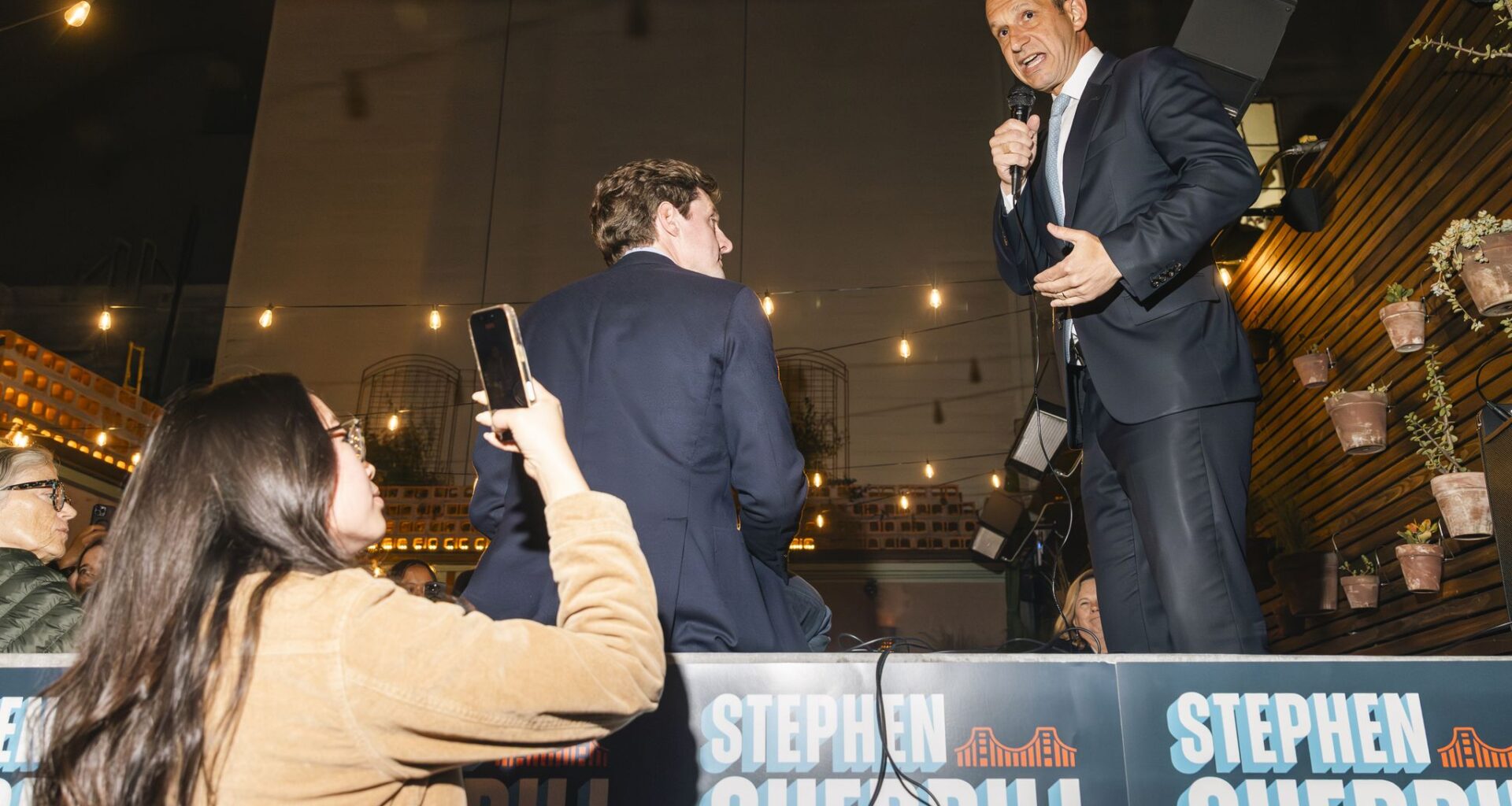
Tuesday’s election in San Francisco continued a remarkable political winning streak for Mayor Daniel Lurie. Lurie is shown speaking at Stephen Sherrill’s election watch party on election night.
Lizzy Montana Myers/For the S.F. Chronicle
Tuesday’s election in San Francisco continued a remarkable political winning streak for Mayor Daniel Lurie.
Lurie, who has enjoyed resounding popularity since becoming mayor 18 months ago, got more welcome news when voters elected all three local candidates he endorsed in the June 2 primary. Lurie was also on the winning side of at least two ballot measures; a third was breaking the mayor’s way as well but was still too close to call as of late Tuesday.
It’s unclear whether Lurie influenced the outcome of those races or merely reflected the views that a majority of the electorate already held. But the takeaway is clear: San Francisco’s well-liked mayor, who had a 74% job approval rating in the Chronicle’s latest poll, continues to be on the same page as most voters in the city he leads. Or at least those who participated in this week’s election.
Article continues below this ad
The results are likely to embolden Lurie as he advances the rest of his political agenda this year, including four ballot measures he is pushing for the November election. The Board of Supervisors is also likely to continue to embrace the mayor’s legislative priorities after both of his board allies up for election Tuesday prevailed.
Speaking to reporters outside Original Joe’s restaurant in North Beach on Tuesday night, Lurie said the initial results showed that “San Franciscans like the direction that we’re heading in” on his watch.
San Francisco Chronicle Logo
Make us a Preferred Source to get more of our news when you search.
Add Preferred Source
“We are going to continue to put our foot on the accelerator to continue this momentum,” Lurie said. “Voters are sending a message that they want to continue that.”
He said voters seemed to appreciate that “supervisors and the mayor are working well together” and promised he would “stay focused on delivering results for the people of San Francisco.”
Article continues below this ad
Until this election, Lurie had spent most of his mayorship taking a cautious approach to any political issue outside his City Hall purview. He famously does not utter President Donald Trump’s name in public. When former Supervisor Joel Engardio was recalled last year, Lurie stayed out of the race.
But he took a different approach in the June primary. For the first time as mayor, Lurie endorsed candidates, including Supervisors Stephen Sherrill and Alan Wong, both of whom are aligned with the mayor. Lurie also supported Phil Kim’s bid for reelection to the school board. He advocated for Proposition A, an earthquake safety bond, and he opposed two business tax measures, Propositions C and D.
Wading into the business tax measure debate was politically risky for Lurie, because it required him to take a stand against prominent unions that could organize against him for years to come. Lurie also drew labor’s ire when he laid off 127 city employees as he worked to close a huge budget deficit this year. And a union is fighting a contract related to the mayor’s signature initiative to overhaul the city permit system.
But the mayor largely, if not unilaterally, prevailed.
Sherrill, Wong and Kim won, as did Prop A. Prop C failed, and Prop D was trailing in early returns. It’s possible Prop D may still win despite Lurie’s objections, but even if that happens, it’s unlikely to be a blowout victory that would signal overwhelming disagreement with Lurie’s stance.
Article continues below this ad
David Harrison, the public policy director for the San Francisco Chamber of Commerce, said Lurie has been “turning the page on the politics of old in San Francisco” and has been “really focused on how can we think collaboratively and intently about the future of this city and where we want things to go.”
“It’s pretty clear … that people are bought into Daniel Lurie’s philosophy for running the city,” Harrison said. The chamber backed Prop C in an attempt to derail Prop D.
Lurie saw ample reason to wade into the two supervisor races and the business tax fight, which will all influence the rest of his term.
Sherrill and Wong are part of a board majority that has largely backed the mayor’s plans. Supervisors last year granted him more power to address homelessness and the drug crisis and approved his plan to accommodate denser housing on the north and west sides of the city. This year, they signed off on a sobering center he proposed as a jail alternative for drug users despite concerns about the legality of the facility.
Lurie and his allies feared that if challengers prevailed against Sherrill or Wong, the board would become more hostile to Lurie. But Wong, who was appointed by Lurie, bested four opponents even after failing to advance a ballot measure that would address one of his District 4 constituents’ top concerns: the transformation of an oceanside thoroughfare into a public park. Sherrill, meanwhile, prevailed in District 2 against an opponent who blasted him over his support for Lurie’s housing plan.
Donors who support Lurie spent heavily to boost both Sherrill and Wong in their respective races. Grow SF, a moderate political group aligned with the mayor, spent at least $476,000 in favor of Sherrill and Wong before Election Day. SF Believes, a pro-Lurie political action committee backed by $1.8 million in contributions, also kicked in six-figure sums in both races.
Article continues below this ad
Steven Buss Bacio, a co-founder of Grow SF, said he thought Lurie had an impact on the supervisor races.
“Voters are all independently minded — just because someone you like supports or opposes something doesn’t necessarily change how you think about it,” Bacio said. “But I do think his endorsement certainly carries a lot of weight, given his popularity and the state of the city.”
Bacio said the races that Wong and Sherrill won asked voters whether San Francisco would continue to have a legislative branch that “avoids stupid fights and wants to work with the mayor” or whether the political balance would shift and “suddenly the board stops Mayor Lurie at his every move.”
The business tax battle over Props C and D will also have implications for Lurie’s agenda, including his relationship with organized labor.
Prop D, backed by unions representing city workers, would raise and modify a San Francisco tax on large companies with highly paid CEOs. Dubbed the Overpaid CEO Act, it was intended to create a new funding stream for city services in response to federal funding cuts being implemented by the Trump Administration.
Article continues below this ad
But Lurie worried that Prop D could scuttle San Francisco’s fragile economic recovery from the pandemic by encouraging more businesses to leave the city or raise prices for consumers. He also opposed Prop C, a rival measure pushed by the chamber that would make more modest changes to the same tax targeted by Prop D. If both measures had gotten more than 50% support, only the one with the most votes would have gone into effect.
Lurie tried to prevent the two measures from reaching the ballot by urging business and labor leaders to find a compromise instead. When that failed, he publicly opposed both Prop C and Prop D, saying in a recent social media video that the dueling measures were “designed to confuse voters, and it’s San Franciscans who pay the price.”
A win for Prop D would give San Francisco’s public-sector unions more reason to stand up to Lurie. Unions representing most city workers have contracts that expire next year, and some labor leaders have already threatened a strike if negotiations break down.
Jason McDaniel, a political scientist at San Francisco State University, said that if Prop D comes up short in the final count, “you have to give the mayor a lot of credit for that.” Raising taxes on deep-pocketed companies would seem like a winning message in liberal San Francisco, and Lurie tapped into some of his political capital to oppose the measure, McDaniel said.
A defeat for Prop D, in addition to the success of Lurie’s other endorsements, would be a sign of “a mayor in all his power,” McDaniel said.
“Obviously, (Lurie is) not a flash in the pan, but someone who is really able to marshal resources and support around candidates and issues,” McDaniel said.
He added that if Prop D fails, critics might be less willing to oppose Lurie publicly, and progressives will have to regroup to think about “when to build some oppositional momentum against a mayor that seems popular and has the support of broad majorities in San Francisco.”
Lurie, for his part, is already looking to the next election.
In November, the mayor will ask voters to approve a parcel tax measure that would provide an influx of funding for the city’s public transportation system. He is also pushing a trio of ballot measures that would reform the city charter, San Francisco’s core governing document. One of those measures would make it harder for future measures to appear before voters — which Lurie has framed as an attempt to avoid ballot battles like the fight over Props C and D.
Lurie told a crowd of small business owners at a downtown bar last week that all four measures were “critically important” and represented “a generational chance to shape how this city is run for the next 40, 50 years.”