
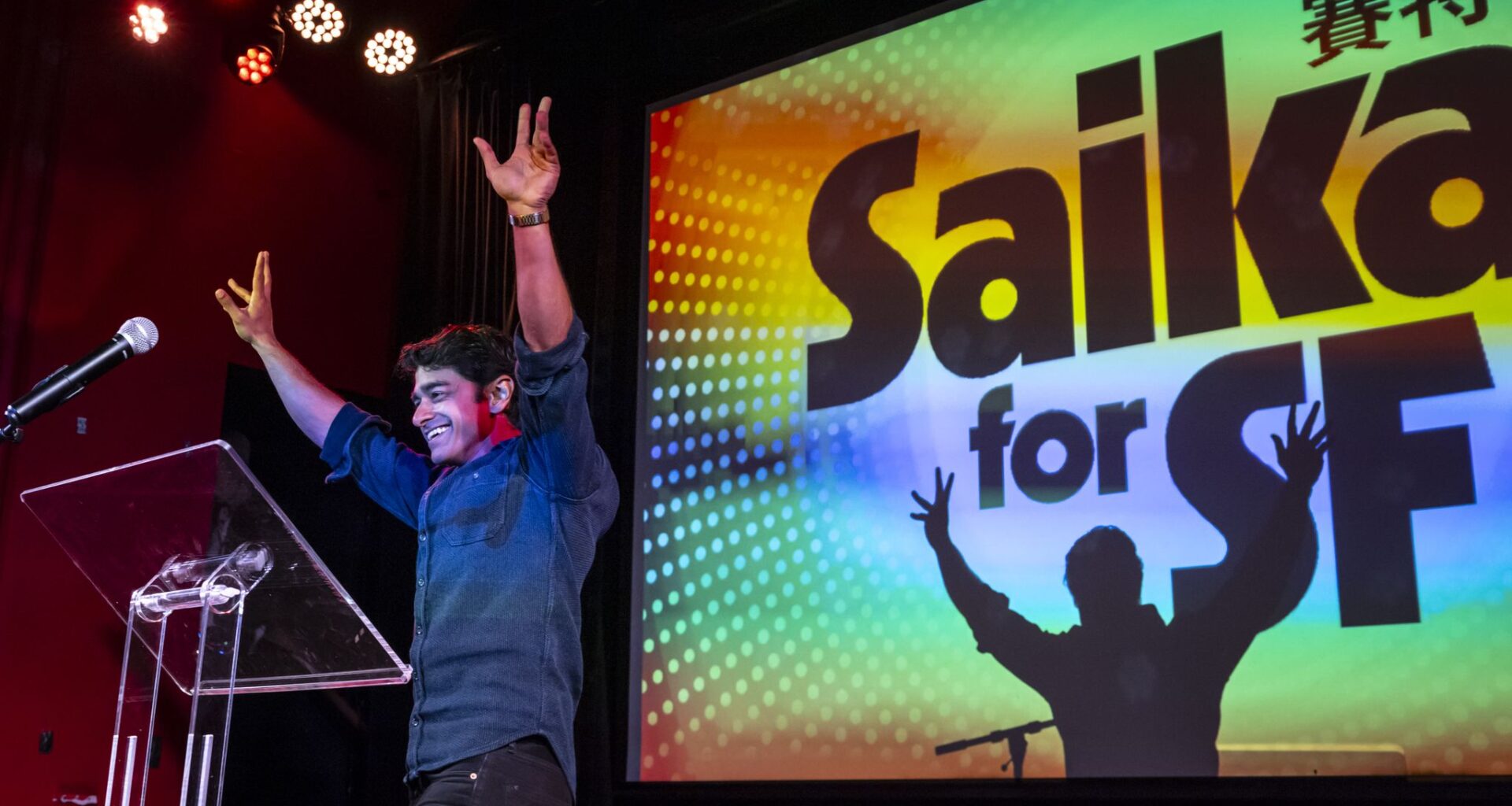
Saikat Chakrabarti gestures to the crowd during his election night party in San Francisco on June 2, 2026.
Carlos Avila Gonzalez/S.F. Chronicle
On paper, Saikat Chakrabarti seemed to be a formidable candidate to succeed Speaker Emerita Nancy Pelosi in one of the nation’s bluest House districts.
He had a strong pedigree as a top aide to progressive icons Rep. Alexandria Ocasio-Cortez and Sen. Bernie Sanders, a $160 million fortune earned as an early employee of Stripe and lefty policy chops as a co-creator of the Green New Deal.
But Chakrabarti, who finished third in the race to succeed Pelosi, didn’t account for the most important factor of all: San Francisco has its own set of rules when it comes to running for office. Candidates need to treat it more like a small town than New York City, where Chakrabarti masterminded Ocasio-Cortez’s 2018 upset of Joe Crowley, then the No. 4 Democrat in the House. Yes, it is a big city with big-city problems and characters, but it is also a 7-by-7-mile hothouse where politics are extremely relationship-driven. Chakrabarti didn’t do enough to forge the right relationships.
Article continues below this ad
Unlike Ocasio-Cortez’s primary victory, where about 12% of registered voters cast ballots, hyper-engaged San Francisco voters typically best the state’s turnout figures. The newcomer would have a lot of people to meet to beat state Sen. Scott Wiener, who served on the Board of Supervisors and represents part of the district in the Legislature, and Supervisor Connie Chan, who has lived here since immigrating as a teenager and is well known to the city’s Asian American community.
Doing so would be a challenge in San Francisco’s bare-knuckled political scene that is famously described as a “knife-fight in a phone booth.” The kind of atmosphere that forged nationally known politicians like Pelosi, Dianne Feinstein and Gavin Newsom.
San Francisco Chronicle Logo
Make us a Preferred Source to get more of our news when you search.
Add Preferred Source
But San Francisco Democratic Party Chair Nancy Tung added a telling detail to that description when we spoke Wednesday: “It’s a knife fight in a phone booth where you know everybody in the phone booth.”
From Tung’s vantage point, Chakrabarti didn’t do enough outreach to the city’s 23 chartered Democratic Party clubs nor the city’s influential political class who are very engrossed in the city’s politics. While national organizations like Justice Democrats, which Chakrabarti co-founded, the Sunrise Movement and Stanford Democrats endorsed him, the only local club that backed him was the San Francisco Latino Democratic Club and it is not a chartered San Democratic Party club, Tung said.
Article continues below this ad
Tung pointed out that every candidate the San Francisco Democratic Party endorsed won or was leading in the latest count, including Weiner. “There are 200 people that you need to know in San Francisco politics in order to really have a handle on the political landscape,” Tung said. “That’s what is so unique about San Francisco. We are a big city, we have big-city problems, we have big-city budgets and money, and yet, quite frankly, this is the smallest big city you will ever find.”
Saikat, Tung said, “was not one of (those 200 people), and he was never one of them.”
Nor did he apparently seek many of them out. Pelosi, who endorsed Chan, emphasized that point in an interview with KQED last month.
“I’ve never seen him at a homeless shelter, or a food bank or an immigration center,” Pelosi said. “I’ve never seen him in our community. I don’t have any idea who he is.”
Former Board of Supervisors President Aaron Peskin, one of the city’s leading progressives, said San Franciscans “want somebody who’s invested in San Francisco. Connie Chan and Scott Wiener have a track record in and for San Francisco.”
Article continues below this ad
Added Tung: “People who want to build a political career in San Francisco need to be engaged.” And they have to have validators, she said.
Chakrabarti had national endorsers, like progressive members of “The Squad,” including Reps. Ilhan Omar, D-Minn., and Rashida Tlaib, D-Mich., and buzzy progressive podcaster Hasan Piker. But other than Honey Mahogany, chair emerita of the San Francisco Democratic Party, he didn’t have any boldfaced local names to vouch for him.
Fatally, neither Ocasio-Cortez nor Sanders — names that Chakrabarti would regularly invoke when he introduced himself to voters — endorsed him. Ocasio-Cortez refused to even discuss it.
So when an independent group began questioning how long Chakrabarti had actually lived in the city or when stories appeared about his scant voting record in the district he was vying to represent, there were no friendly faces inside San Francisco’s political phone booth to help him out.
Tung, who moved to San Francisco in 2001, knows what it feels to run in the city as an outsider. She lost a bid for district attorney in 2019.
Article continues below this ad
“When I ran for office, people wouldn’t give me the time of day, and I have experienced that outsider experience,” Tung said. “No one was vouching for me.”
Chakrabarti didn’t reach out to Tung, she said. That wasn’t surprising, since Chakrabarti was running to reform a Democratic Party that he thought had both calcified behind its elderly cohort of leadership and had lost touch with working people.
More surprisingly, he didn’t reach out to Peskin, who is deeply wired into the city’s left. He could have helped him reach the voters he needed to win.
“I’ve never heard of him, nor encountered him until he was running for Congress, and to this day I’ve never spoken to him. I’ve never met him,” said Peskin, who endorsed Chan.
Chakrabarti instead tried to leverage his wealth to wedge his way into the city’s political class. Mission Local reported that he recruited the “largest paid canvasser operations in San Francisco history, with more than 250 of them, including two dozen who speak Cantonese, according to the campaign.”
Article continues below this ad
But he won zero precincts, according to the latest vote count. Chan, who was born in Hong Kong and raised in Taiwan and worked for years as a translator, dominated the city’s predominantly Asian American west side.
Peskin pointed out that if Chakrabarti spent roughly $10 million on his campaign and has 16,118 votes, then he spent roughly $620 on every vote. “His campaign was basically as effective as if he had just mailed every voter a $25 Starbucks gift card.”