
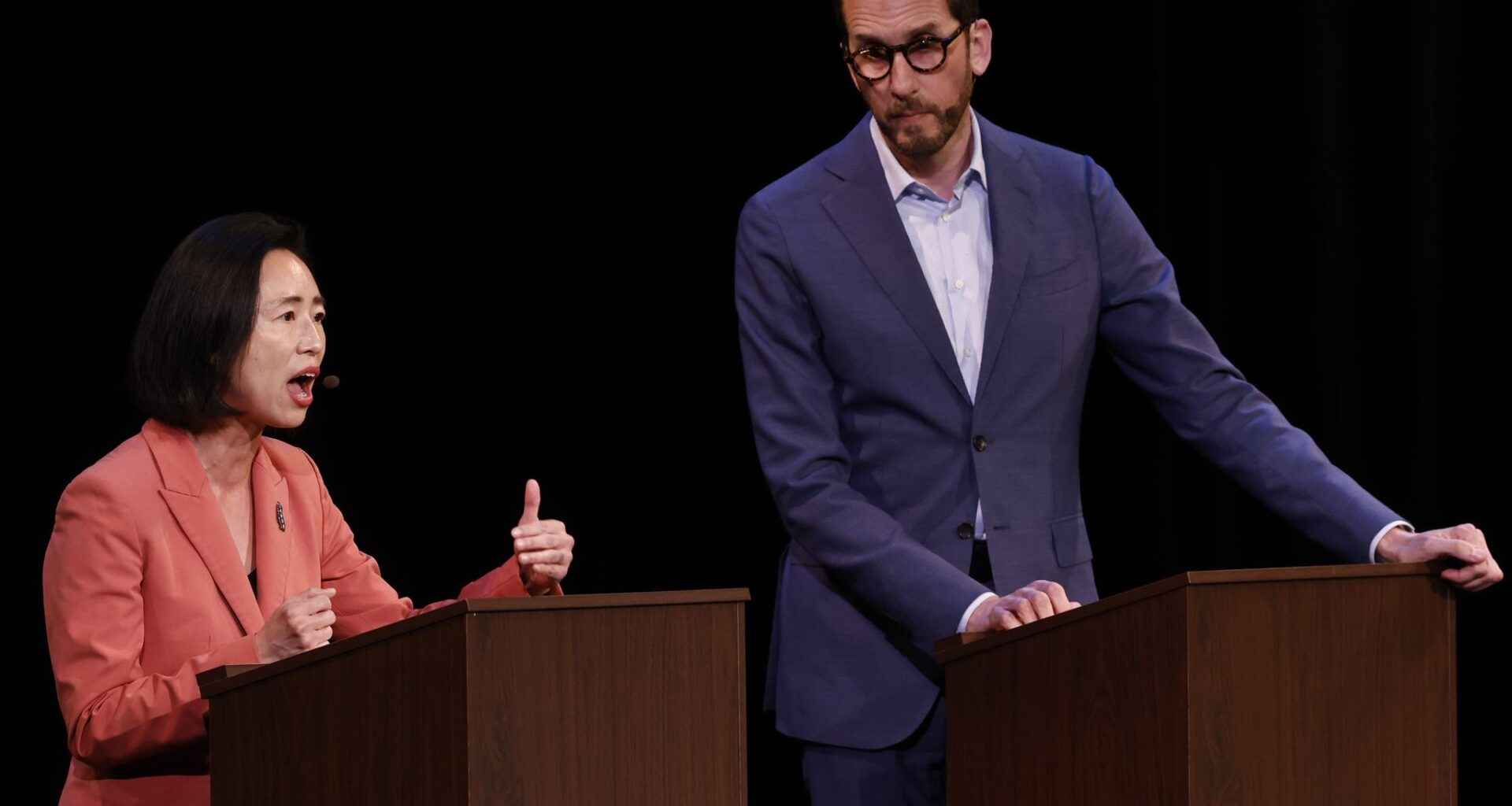
Candidates for San Francisco’s Congressional District 11 seat, Saikat Chakrabarti, Scott Wiener and Connie Chan debate at the Sydney Goldstein Theater in San Francisco, on Tuesday, March 31, 2026.
Carlos Avila Gonzalez/S.F. Chronicle
Though all the votes haven’t been counted, the result in the race to succeed Speaker Emerita Nancy Pelosi is clear: State Sen. Scott Wiener has topped the field, with supervisor Connie Chan in a comfortable second place — no doubt helped along by the influential former speaker’s endorsement.
Nearly as clear are the coalitions that propelled Wiener and Chan into the top two — and the coalition that supported, but failed to elevate, the third-place finisher, political operative Saikat Chakrabarti.
The 11th congressional district covers the majority of San Francisco, with the exception of a small southeastern slice of the city. Here’s how different areas in the city voted.
Article continues below this ad
Wiener united coalitions
Wiener’s coalition built bridges across very different parts of the city. As of Wednesday evening, Wiener was leading in precincts from north to south, old to young, and immigrant-heavy to mostly native-born.
His support also crossed important ethnic and economic lines. Wiener carried the richest and poorest precincts in the city, from the Bayview and Tenderloin to Pacific Heights and the Embarcadero. He led in 19 of the 25 precincts where Hispanic residents form a plurality, and all seven precincts where Black voters are the plurality.
San Francisco Chronicle Logo
Make us a Preferred Source to get more of our news when you search.
Add Preferred Source
He also led across the spectrum of voting ideologies. In 2024, the Chronicle grouped the city’s precincts into five clusters based on historical votes in state propositions, city measures, and candidate choices.
Article continues below this ad
Wiener is the top vote-getter in all but one of them: the group of precincts we called “Asian S.F.,” which contains Chinatown, the Outer Richmond, Outer Sunset, and parts of the Excelsior, Portola and Visitacion Valley neighborhoods.
That electoral geography points to the kinds of places where Chan stands on top.
The important factors for Chan: Asian share and education
We tested the precinct-level results against a number of demographic factors. Two of them correlated best with Chan’s vote share: the Asian share of a precinct and its level of college education.
Article continues below this ad
Although Bay Area Asian Americans tend to be a well-educated and well-off group, Asians in San Francisco, especially Chinese and Filipino Americans, have historically skewed more working class — particularly in the parts of the city where they form the largest group of voters. That means that the most Asian areas are also some of the least college-educated.
It is precisely in these areas that Chan is doing best. In fact, when aggregated at the level of supervisorial districts, Chan’s strongest is not District 1, which she represents, but District 4 — which is more Asian as a share.
Chan and Chakrabarti outperformed in “progressive” areas — but neither won them
Wiener and Chan won unambiguously, but that doesn’t mean Chakrabarti didn’t have his supporters. In fact, Chakrabarti performed best in the areas with the most “progressive” voters.
Article continues below this ad
In past analyses of the city’s voting tendencies, the Chronicle has identified a “progressive crescent” of precincts stretching from the Haight Ashbury in the west over to the Lower Haight and Hayes Valley, and then down to the Mission and Bernal Heights.
Even here, the Chronicle’s analysis found Wiener was the highest vote getter, and Chan second. But voters in this area liked Chakrabarti better than anywhere else.
The “progressive crescent” was also Chan’s second-best group after “Asian S.F.” In fact, Chan’s areas of strength had two peaks: She enjoyed the highest rates of support in what our analyses suggest the most moderate and the most progressive areas, rather than the regions in between.
That’s a striking result, given that Chan has often been characterized as a progressive in her voting record and has courted unions in her campaigns.
Could Chan prevail in November?
It’s possible. But that would require uniting some very different voters.
Article continues below this ad
Let’s consider the vote as it currently stands. If turnout in November were exactly the same and Chan managed to win all of Chakrabarti’s supporters, that would get her to 44% of the vote, compared to Wiener’s 41%.
That still leaves the roughly 15% of voters who picked another candidate — most of whom are on the right. Marie Hurabiell, a Republican-turned-Democrat who’s run anti-Wiener ads that some consider anti-LGBT, has netted about 5% of the vote. Another 6% have supported David Ganezer, a Republican.
It will be tricky for Chan to unite both the committed leftists who supported Chakrabarti and Wiener’s opponents on the right. But some ideas could unite these disparate groups: Many are against opening up San Francisco to more market-rate housing development, which Wiener supports. Chan has opposed housing deregulation as a solution to the city’s housing crisis.