
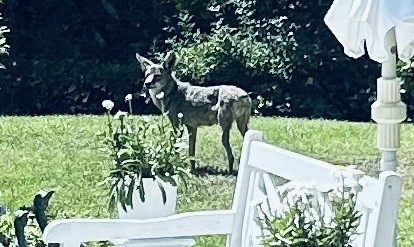
Reports are coming in across La Jolla of coyote sightings in residential areas, with some saying the animals are being “aggressive.”
However, Autumn Welch, wildlife operations manager for the San Diego Humane Society, says many of the reported behaviors are normal for this time of year and for coyotes in general.
Recent posts on social media have described coyote encounters in several La Jolla neighborhoods.
One post included security camera footage showing two coyotes hunting an opossum on the driveway of a house in the Barber Tract.
Another from Lower Hermosa stated that three cats have been killed by coyotes in the past nine months and that a coyote “bigger than my 65-pound dog” was in front of the person’s house.
“My husband and I encountered one at dusk on Avenida Cresta,” the post said. “It was stalking my French bulldog and then aggressively charged my [dog].”
A post from the La Jolla Alta Mesa area reported that “a coyote leaped over a 5-foot gate and killed a family cat in the Crystal Bay community.”
A post from Muirlands in late May stated “My husband encountered a very aggressive coyote this evening on Muirlands Drive. … It came out of the bushes and charged our leashed dog, and when shouted at, [it] retreated into a yard, only to come charging out again moments later.”
Other posts included photos from security footage showing coyotes near houses in the Windansea and Bird Rock areas.
But Welch said “this fits the time of year when you would see increased activity” as juvenile and adult coyotes explore areas close to their dens.
After breeding season, which lasts from January to March, “the pups are old enough to come out of the den, explore a bit more, and they are getting weaned, so that is when the parents need to go out and catch more food,” Welch said. “So in general, the parents are trying to find enough food, so there is more activity.”
“This year is not unique in any way,” she added.
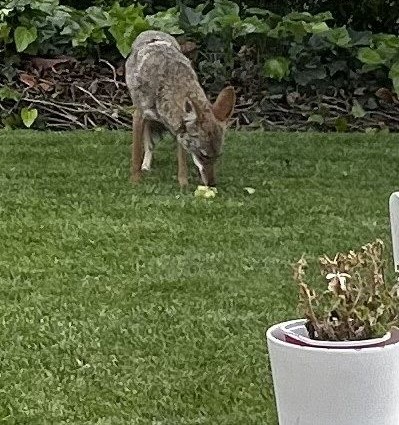 A coyote dines on an avocado that fell on the lawn in a La Jolla backyard in early 2026. (Kraig Kristofferson)
Some of the reported aggressive behaviors also are normal for coyotes, Welch said.
One of them, she said, is called “escorting,” in which the coyote follows people to make sure they don’t get too close to the den. It also tries to make itself look bigger by showing its teeth or raising its hackles to make its fur stand on end.
“The coyotes are really dedicated parents,” Welch said. “Both mom and dad do equal care and will defend the pups no matter what. So if they seem aggressive, it’s more of a warning … to say they don’t want you there. It’s a precursor to an aggressive act. … Escorting means you are too close to their babies.”
Jumping also is normal, she said.
“They can jump six feet for sure,” Welch said. “Coyotes will get creative when they need to search for food, so they might have smelled a rat and will jump a fence. Fifty percent of their diet is rodents and small mammals that might be in backyards, and those mammals are having babies, too, this time of year, so those end up as coyote prey.”
As a deterrent, Welch said, some people string rollers on the tops of their fences so coyotes can’t get traction.
A coyote typically will cover territory one to two miles from its den, Welch said. Animal feces, particularly on the sidewalk, may be evidence that a coyote is in the neighborhood.
“That is their way of telling people that is their area, which is another way to learn more about them and where they are living,” she said. “If people see that, it could be a sign to not walk there because there might be puppies nearby.”
Coyotes are “very adaptable” and will move if their dens become unsuitable, she added.
“Coyotes don’t like loud noise or bright lights, so that might encourage them to move on,” Welch said. “But if they live in a territory with a food source, a place to have babies, they might not move on. If it works, they will stay. But if it’s not a comfortable environment and there is a conflict and there are things they don’t want to be around, they may … try to find somewhere else.”
Coyotes “generally avoid humans,” according to the San Diego Humane Society website. The biggest risk they present in urban areas is to small pets.
The Humane Society recommends the following measures to prevent confrontation with coyotes:
• Don’t feed pets outside or feed them there for more than an hour, and remove the food and water bowls afterward.
• Don’t leave your animals unattended and off leash in public areas.
• Don’t feed coyotes.
• Remove fallen fruit and use enclosed bins for compost and trash to avoid attracting coyotes.
• Leave coyotes alone, and if confronted by one, use “hazing” methods, including yelling, waving and making noises. Don’t run away.
Additional guidelines are available at sdhumane.org/resources/coyote-hazing-guidelines. The Humane Society also has fliers with information about coexisting with coyotes at sdhumane.org/resources/wildlife-fliers. ♦