
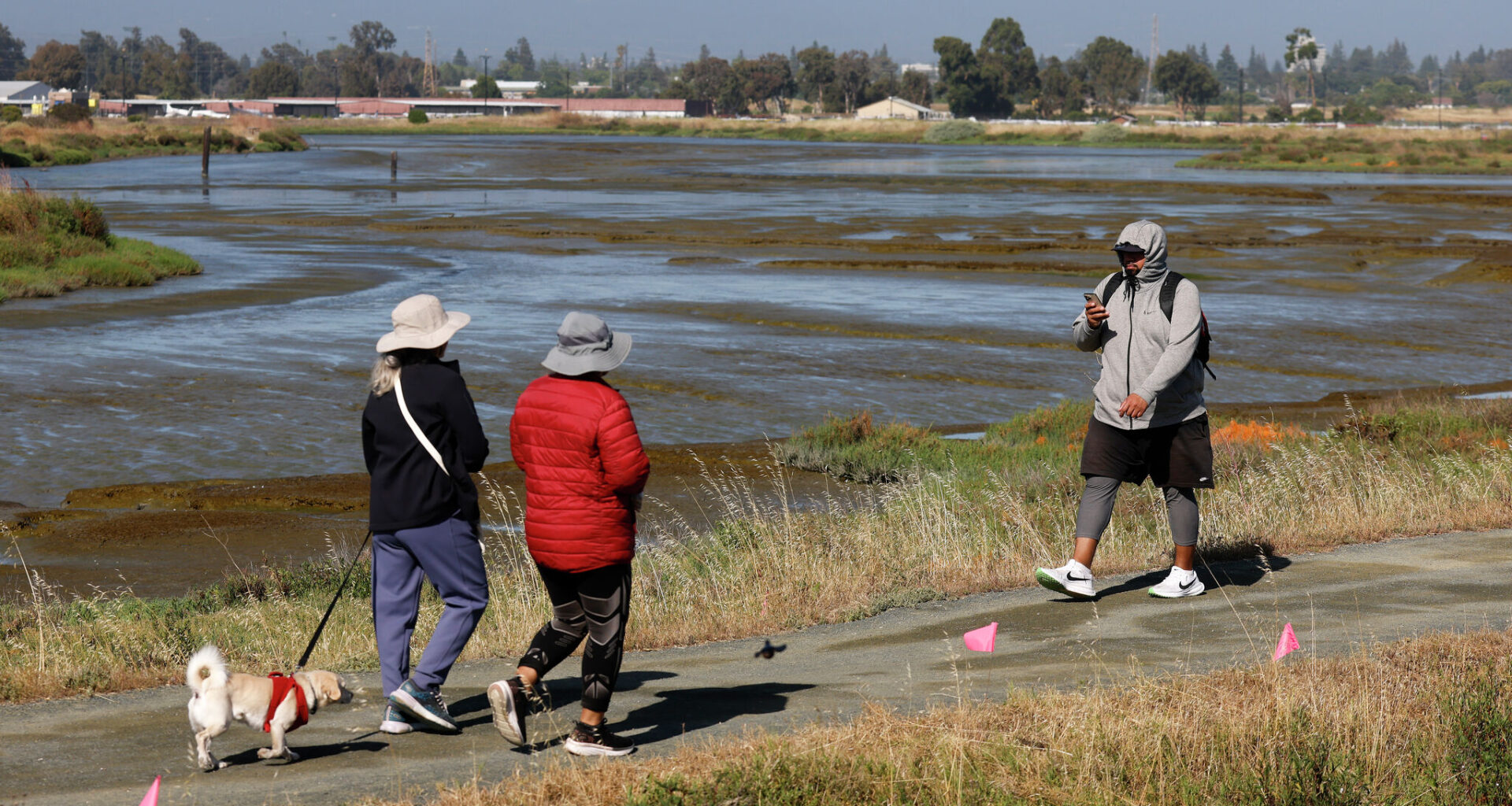
Encompassing 1,940 acres of restored tidal marsh and open space, the Baylands Nature Preserve in Palo Alto is one of the elite bird-watching spots on the West Coast.
Jessica Christian/S.F. Chronicle
If you were on the Palo Alto City Council in the 1960s and 1970s, God help you, then “Baylands Lucy” was a reliable pain in your life.
Elementary school teacher Lucy Evans, who packed her curriculum with immersed-in-nature field trips, was the self-appointed guardian of the Palo Alto marshlands, filling her home with legal papers and meeting minutes related to Bay Area conservation. She once surprised the council with proof that land around San Francisquito Creek in Palo Alto, set for development, had been deeded for exclusive parkland use by Leland Stanford’s right-hand man Timothy Hopkins.
An aircraft passes over a duck pond at the Baylands Nature Preserve, adjacent to the Palo Alto Airport.
Jessica Christian/S.F. Chronicle
At least 150 bird species pass through the Baylands Nature Preserve.
Photos by Jessica Christian/S.F. Chronicle
At least 150 bird species pass through the Baylands Nature Preserve.
Photos by Jessica Christian/S.F. Chronicle
The park is still there. Named after Hopkins, of course.
Article continues below this ad
So, be sure to quietly thank Evans as you walk around the Baylands Nature Preserve, 1,940 acres of tidal marsh and open space, and one of the elite bird watching spots on the West Coast. The Palo Alto shoreline park is a collage of wildlife, alien-looking flora and texturized mudflats that change like an Etch A Sketch with the shifting tides.
During my three hours exploring I saw visitors young and old enjoying the space. Nobody was wearing headphones, instead immersed in the varied and constant bird calls. Among all the reasons to visit this Peninsula gem: the opportunity to say “hello” to passersby and reliably get a “hello” back.
San Francisco Chronicle Logo
Make us a Preferred Source to get more of our news when you search.
Add Preferred Source
The Bay Area once contained marshland as far as the eye could see, including from San Francisco’s Mission Bay shoreline deep into the South Bay. But by 1921 remote country had become suburbs, and there were just nine acres of marsh left around Baylands Nature Preserve, with plans for more development.
The Baylands Nature Preserve protects the region’s marshland, which once extended from San Francisco’s Mission Bay shoreline deep into the South Bay.
Jessica Christian/S.F. Chronicle
In the following decades, Palo Alto approved a golf course, yacht harbor, airport, swimming pool and, worst of all, a shoreline landfill for this rich natural landscape. But Evans and her allies in the League of Women Voters and Audubon Society fought back.
Article continues below this ad
When Palo Alto in the 1950s considered selling the eastern tip of the preserve to developers for an apartment complex and motel, fellow marsh-lover Harriet Mundy led a successful petition against the plan. Evans, who carefully catalogued every endangered species in the wetlands — from the California clapper rail bird to the salt marsh harvest mouse — shamed the council at every meeting. (And she never missed a City Council meeting.)
Activists clawed the land back slowly. The swimming pool became a duck pond. The yacht harbor was converted back to marshland; its harbormaster quarters became a ranger’s station. The dreaded landfill, now the southern shoreline of Baylands, was closed with promises of a park. The Lucy Evans Interpretive Center, a mini-museum and swallow sanctuary, was dedicated in 1969.
Palo Alto school teacher Lucy Evans studies birds with Bay Area students. Evans, who died in 1978, was instrumental in helping preserve the 1,940-acre Baylands Nature Preserve.
Courtesy of Palo Alto Historical Association
I start my journey there, and am charmed to find a building on pylons flush against the marshfront, where birds seem to be the only active landlords. Barn swallows nest under the building and cliff swallows dart in and out of cubbies built into the eaves, plastering the dock and windows with dung as if the building’s sole purpose is to be their canvas. A large photo of Evans teaching a 1940s class of rapt students is framed near the entrance.
The Baylands Nature Preserve’s must-visit attraction is connected to the center, an 850-foot boardwalk that passes above the marshland and offers the sensation of floating above this fabulous ecosystem. It also serves as a primer to the flora and fauna bobbing in the brackish water below, with rectangular placards that share the history of the marshes, introduce visitors to the species around them and answer every question I have in real time.
Article continues below this ad
An 850-foot boardwalk offers views of the marshland behind the Lucy Evans Interpretive Center.
Jessica Christian/S.F. Chronicle
What are those strange clumps of fibrous bright orange hair, resting on the cordgrass like tumbleweeds? “Marsh dodder is a parasite that thrives on pickleweed. … Due to its thread-like appearance, it is often referred to as ‘mermaid’s hair.’”
Why are there metal rollers up and down the boardwalk? “Rollers on the railings of this boardwalk were installed to keep predatory birds from perching here and hunting the (salt marsh harvest mouse).”
Can a hiker get a Ph.D. in environmental science just from reading signs? It feels like it today.
CLOCKWISE FROM LEFT: Birds walk through the low-tide marsh; salt marsh dodder engulfs pickleweed; swallows nest outside the Lucy Evans Interpretive Center.
Photos by Jessica Christian/S.F. Chronicle
FROM TOP: Birds walk through the low-tide marsh; salt marsh dodder engulfs pickleweed; swallows nest outside the Lucy Evans Interpretive Center.
Photos by Jessica Christian/S.F. Chronicle
My next quest is heading north away from the center up the San Francisquito Trail (thanks Baylands Lucy!), which passes flush against the tiny Palo Alto Airport, and takes me by mudflats, dry shrubs and a new constellation of birds that scatter every time I pull out my camera. At least 150 species pass through this space, including hawks, gulls, cormorants, terns, herons and willets.
Article continues below this ad
As I stop trying to photograph them and absorb the moment, I finally understand the appeal of bird watching. It’s like buying baseball cards, or playing Pokémon Go. My best finds are a yellow-breasted chat that darts through the bush next to me (or was that a marsh wren?) and a snowy egret, which struts brazenly next to a “feeding the birds is prohibited” sign.
Pedaling other trails by bike, I find a boat launch for kayaks, paddleboards and other non-motorized craft and spot the old landfill, now mystical Byxbee Park, filled with mounds, rails and posts clustered to form landscape art.
Swallows fly by the Environmental Volunteers’ EcoCenter, an art deco building that was once headquarters for the Sea Scouts.
Jessica Christian/S.F. Chronicle
My last stop is an art deco building with curved walls and portholes — nautical moderne in urban design critic parlance — that was once headquarters for the Sea Scouts and is now restored as an education and research center for the Environmental Volunteers.
I arrive five minutes after closing, but volunteer Diane McCoy and her small pup Coco invite me in anyway. McCoy’s a retired schoolteacher and I can tell she was a good one. She shows me a glass square on the ground built so visitors can see the changing tides underneath. And McCoy reports that children in the age of Apple watches and cartoons on demand can still get enchanted by a bug, and exclaim “whoa” in unison as a fleet of migratory ducks fly by the clubhouse.
Article continues below this ad
“They’ve never been out here,” McCoy says. “We try to teach them about what these places are and why their ecosystems are important. And we have a strong underlying message of stewardship.”
The Baylands Nature Preserve greets visitors, such as this artist, with a collage of wildlife, odd-looking flora and texturized mudflats that change with the shifting tides.
Jessica Christian/S.F. Chronicle
I think about the last Peninsula Times stories I read about Evans, from 1973, and her excitement at how many young women showed up to a nature walk. “Some of us are getting a little tired,” said Evans, then 70. She died five years later of a heart attack.
But the stewardship continues. I’m pleased to read that a 2024 attempt to extend the airport runway into the water was battled back by a combination of environmental activists, bird watchers and Palo Alto High students.
“What’s happening here,” McCoy says, “reflects the health of our planet.”