
I grew up in San Diego praying in buildings with armed guards. The security guard at my synagogue and the cameras and gates at my Jewish day school were signs of hard-learned knowledge. We knew that houses of worship could become targets.
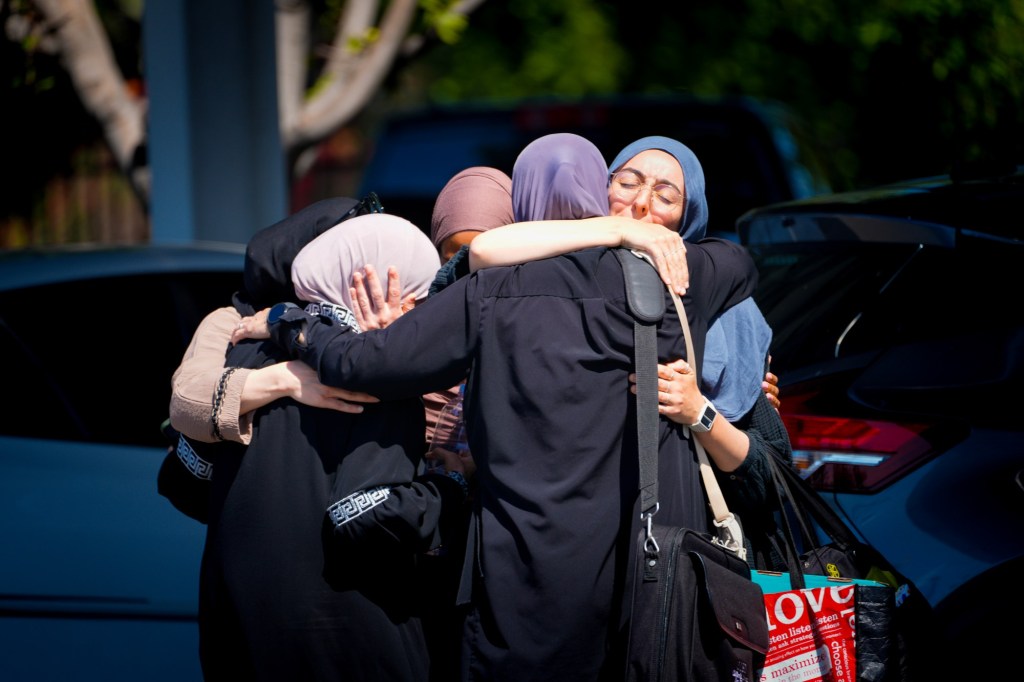
On May 18, that knowledge crystallized into a terror attack at the Islamic Center of San Diego. Security guard Amin Abdullah, community member Mansour Kaziha and store manager Nadir Awad were murdered in a targeted hate crime. Two teenage gunmen, motivated by a racist, Islamophobic and antisemitic manifesto, opened fire outside San Diego’s largest mosque before taking their own lives.
Growing up embedded in the San Diego Jewish community, I did not know San Diego’s Muslim community well until my adulthood. That saddens me, and is a symptom of the way that Israel-Palestine has been framed in this country as a religious conflict — Jews versus Muslims — rather than what it actually is: a struggle over land, power, resources and military occupation. The communities kept apart should be neighbors, collaborators and friends. It took leaving home, serving as a political appointee in the Biden administration’s Department of the Interior, and resigning from that position in protest of U.S. policy in Gaza, before I built the relationships with San Diego’s Muslim community that I have now.
The Islamic Center of San Diego is a hub for one of the largest Muslim communities in Southern California, including many Palestinian families, who have spent the past few years grieving on two continents at once. For three years, Muslim organizers and community leaders warned universities, elected officials and schools about the escalating anti-Arab and anti-Muslim hostility they were experiencing. Then the shooting happened, and the statements came. Showing up after the bodies fall is not the same as showing up when the community asks you to act.
Our entire political class has to answer for the hard truth that this abandonment of a community enables the conditions that produced this attack. Muslim community leaders called the shooting a “direct and predictable consequence of a political climate” tolerant of anti-Muslim sentiment. That climate has been stoked by Republican politicians and commentators who have called for Muslims to be “destroyed” and made Islamophobia a governing ideology. But Democrats have echoed and reinforced it too — through silence, votes and policies funded.
All of San Diego’s communities deserve leaders that act before a crisis happens and the cameras turn on. Too many elected leaders the last few years declined to meet with Muslim community leaders, refusing to acknowledge the documented Islamophobia. Rather, they passed legislation that claims to fight antisemitism but wrongly equates any support for Palestinian human rights with hatred of Jews. This trap isolates this community and delegitimizes its grievances, leaving it more vulnerable.
The great replacement theory — the White supremacist belief that Jews are engineering the demographic replacement of White America — is a common thread running through mosque and synagogue shootings, within the broader far-right ecosystem violence. The gunman who killed a worshipper at the Chabad of Poway in 2019 and lit a fire in the Escondido mosque during Ramadan weeks before was inspired by a man who massacred 51 Muslims in Christchurch.
Our Jewish community has access to institutional power and civic leaders who listen when we cry for help. Some in the Jewish community have come to believe that aligning with power — at the expense of our Muslim and Arab neighbors — delivers lasting safety for Jews. It does not. Lending our community’s painful history to legislation that silences Arabs and Palestinians, or looking away when communities beside us are abandoned by institutions claiming to protect everyone, does not make us safer. It makes us complicit in the conditions that endanger us all.
In San Diego County, religious hate crimes increased 150% from 2024 to 2025, even as other categories fell. Antisemitic incidents have also risen sharply since October 2023. The same forces are driving both. We fight them together or we don’t fight them at all.
The Jewish community I grew up in taught me three pillars: Torah, avodah and gemilut hasadim — wisdom, devotion and acts of loving kindness. We remember persecution and refuse to be bystanders to someone else’s pain. Amin Abdullah, Mansour Kaziha, Nadir Awad, their families, their children and members of the congregation — who had to celebrate Eid under the shadow of what happened — deserved a San Diego that showed up for them. We can still show up now, and we should.
Greenberg Call is a San Diego native and former Biden administration political appointee.