
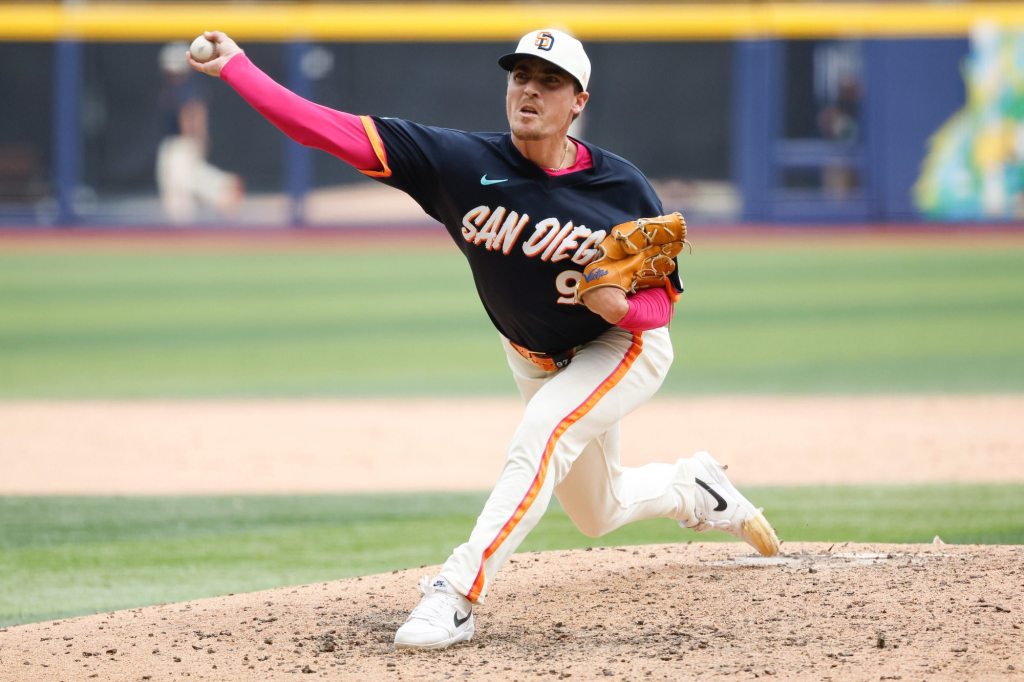
The Padres acquired right-handed reliever Ron Marinaccio from the Chicago White Sox for cash considerations in January 2025.
Marinaccio was drafted by the Yankees in the 19th round of the 2017 MLB Draft. He posted a 3.22 ERA over 114⅓ relief innings during parts of three major league seasons before New York designated him for assignment at the end of 2024. Now in his second year with San Diego, Marinaccio, 30, has become an important piece of the bullpen, carrying a collective 3.24 ERA and pitching multiple innings when needed.
A native of Toms River, New Jersey, Marinaccio played college baseball at the University of Delaware. While with the Yankees, he was teammates with Michael King, Wandy Peralta, Miguel Andujar, Randy Vasquez, JP Sears and Jhony Brito.
This interview has been lightly edited for length and clarity.
You’re from Toms River, where MTV filmed “Jersey Shore.” It’s also home to the 1998 Little League World Series champions. What was it like growing up there?
A: It was great growing up there. Really good community, close to the beach. It was fun. I met a few of the players from that (1998) team, Todd Frazier being one of them. My wife’s cousin’s husband was on the team as well. My brother actually went to the Little League World Series too, in 2010. So Toms River has always been a big baseball town. Fun to grow up playing baseball around there.
Did you go to the shore a lot as a kid?
A: Yeah, I grew up like 15, 20 minutes away. Used to work on the boardwalk for a little bit, so I got to see a lot of that action running around there. … I worked at a 3-point basketball stand. It was one of the funner ones. It was a buddy of mine, a stand that he ran. I was working for him while I was in high school.
You transitioned from being a starter to a reliever while at the University of Delaware. Was that something you resisted at the time?
A: Not so much. I was pretty open to it. At that time, playing college baseball, I just really wanted to win. At a mid-major school, we weren’t super deep with pitching, so the coaching staff brought it to me. We had another really good starting pitcher there, Brandon Walter — he’s with the Astros now — but they brought it to me as an idea, like, “Hey, this is what we think is our best chance of winning games or winning more games.” I was all for it. I think it helped me in the long run. It showed me a different side of the game. The velocity started creeping up a little bit through that, and I guess started opening up a couple more eyes.
For someone who grew up a Yankees fan, what was it like to be drafted by them?
A: It was exciting. I think it probably, just because the Yankees (are) in that area, brought a little bit more attention. But it was fun. You kind of go off the map for a few years being in the minor leagues and then, you know, popping into the big leagues later in my career there was fun. It was exciting. It was a lot, definitely, having family and friends at a bunch of games. But growing up a fan, I wouldn’t really trade it for anything. … It was something that I didn’t expect. I heard from them a little bit in the process. We hear from so many teams, so especially as you watch round after round, you’re not really sure. You feel like anybody could take you at that point. But it was exciting. I think I was like the 15th right-handed pitcher they took that year or something like that. So that was, like, the first taste of it. Right away, you feel like: There’s this many guys they took in front of me, so it’s a long hill to climb.
That takes me to 2020. You’re working your way through the minor leagues and then COVID-19 hits. You lose a year, but you sought out pitching help during that time, which improved your velocity. What changed?
A: That was the first time in a long time that we had an extended period of time to work out. The Yankees did a really good job of grouping us up with coaches, so they put one coach with “X” amount of players. My coach was Daniel Moskos, who’s the pitching coach for the Marlins now. He was great. He broke down stuff for me, like, “This is where we can get better. This is where we could find a little bit more velocity.” I was training in South Jersey at that time with a friend, CJ Appenzeller, who changed my workout routine as well. So I just got further into routine, further into different aspects — plyos, different ways to train. We had so long to do it.
That situation turned out to be somewhat opportunistic. If you hadn’t sought that help, would you necessarily be sitting here?
A: No, definitely not. COVID, as scary and sad as it was at the time, definitely changed the trajectory of my career. You talk to a lot of the Yankees coaches coming back, who I was close with being (there) for so long, and I was on a lot of lists to be released or cut coming back from COVID that year. As I expect a lot of us were, right? In the minor leagues, if you don’t make strides in a year, you’re generally getting passed up and left behind. So that was kind of the mindset I took in the offseason, was to get better. Show up as a new pitcher. That’s kind of what happened.
Was it around that time that you realized, “OK, I could actually make it to the majors?”
A: Yeah. I mean, even coming back that year, I was surprised to make the Double-A roster. I was hoping to make the team in High-A and I didn’t. I think a lot of guys got hurt that year coming back from that COVID offseason, so that gave me an opportunity to pitch in Double-A. And even still I was, you know, just having fun pitching. I was throwing a little bit harder that year, but it wasn’t probably until getting called up to Triple-A about halfway through the year where I started to realize, like, this is a real opportunity. I think I went up to Triple-A and got my teeth kicked in the first outing. That resets (you) a little bit and you get humbled. A lot of those coaches were good to me. Gave me good advice, like certain counts to try to throw more strikes, or “This might be, that might be (worth trying).” But yeah, I was knocking on the door at the end of that year, which was pretty crazy.
In 2022, you make the opening day roster and soon after, your major league debut. You had a 2.05 ERA that year and you set some crazy records. You were the first pitcher in MLB history to not allow a hit in 16 of your first 19 appearances and 22 of your first 27. You didn’t allow a hit to 57 consecutive batters. So there you are, you’re wearing the pinstripes and you’re having all kinds of success. What’s going through your mind at that point?
A: I don’t want to say it was too easy, because this game’s so hard, but the results were coming as we wanted them. I wasn’t thinking much of it. I was kind of just putting my head down, having fun. We were winning a lot of games that year, so just trying to, you know, carve out a role on the team at that point. I was so new to it. Hearing some of those numbers (is) insane, but at the time, I wasn’t thinking about it at all. It probably wasn’t until like, 14 or 15 innings, that I had even heard of it. … I definitely felt like I belonged. I knew that adversity was coming at some point.
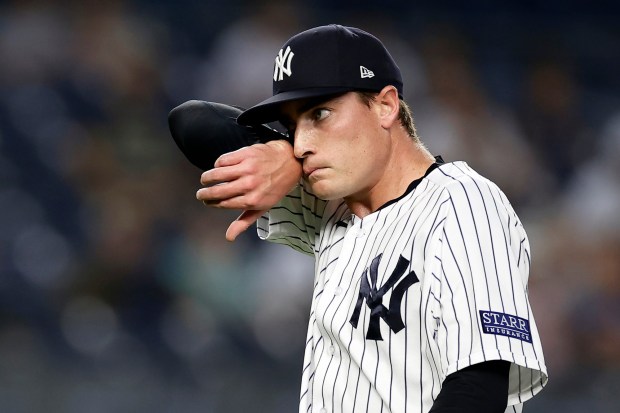 New York Yankees pitcher Ron Marinaccio reacts during the ninth inning of a baseball game against the Milwaukee Brewers, Saturday, Sept. 9, 2023, in New York. (AP Photo/Adam Hunger)
Most guys I talk to from the Yankees organization share a professionalism and businesslike approach. Did you feel that way going through the Yankees system?
A: Yeah. When I was coming through — they’ve definitely changed a lot of things now — but coming through the minor leagues there, it was definitely: “This is the Yankees way.” You earn your pinstripes. Whether it was, you know, you wear all black cleats, no white laces; you jog out to the field, you’re never walking around; collared shirts to the field every day. It was definitely very businesslike. But looking back on it, I appreciate it, because it taught me that routine. It taught me that you have to earn your way to be able to do this or that. You appreciated it a lot more once you got there.
Your next few years with the Yankees were more inconsistent, but still promising. You were shuttled between the majors and minors quite a bit. Were you surprised when they let you go?
A: Not so much. It’s such a competitive role, especially being down in the bullpen. Analytics these days, it’s easy to see who can do what or who can help in what ways. So, I don’t know. They helped me a lot through my career, so I was fortunate for that. But at that time, I wasn’t pitching my best, and I guess I understood that. I’ve always been a pretty realistic guy. There’s been times where I’ve been sent down that I didn’t think I believed to be sent down, and I felt like at that point I probably deserved to be sent down. There were things to work on.
You were picked up by the White Sox in September 2024 and then three months later, without ever throwing a pitch, they designated you for assignment. What did you make of that?
A: They claimed me with about three days left in the season and immediately optioned me and told me just to go home for the offseason and start preparing for next year. Immediately, I thought that was a little weird. Not too much communication in the offseason. It was a normal offseason for me. I don’t know. I guess that’s the business side of it. Different teams are doing different things. Not every team is, you know, going all out trying to win versus trying to get younger guys up there, whatever might be the case. But I believe that every opportunity leads to a new one. Here I am in San Diego now and (with) another team competing to win a World Series. It feels very at home for me.
What stands out about your fit with this bullpen and working with Ruben Niebla and Ben Fritz?
A: Ruben and Fritz have been great. Trying to get the best out of me, which I think is not always — it wasn’t always the case, at least in New York for me. (It was) “This is what you got, if you’re not doing it right now, we can get you out of here” — where there’s been outings I’ve struggled here, and outings that have been good, where Fritz is like, “I know it was good, but let’s try this a little bit, let’s try to get a little bit better.” Started seeing some flashes of the higher velo that I’ve had in the past, which is exciting for me to see. It’s been a couple years. We have such a great bullpen here. The endless amount of leverage guys, it’s hard to really work yourself into one of those roles. So, the way I look at it is just trying to help the team in any way. Give those guys a day off, cover two innings or whatever that might be. Just taking pride in those situations where, you know, not necessarily winning the game that day, but leading to help for the next day or whatever that might be.
You’re an East Coast guy. What’s life been like for you on the West Coast?
A: The weather’s great over here. It’s different. For me, it’s quieter because you don’t hear from anybody after the games or anything, because my family and friends are all on the East Coast. Whereas after a Yankees game, I would get back to my phone and there’s 30 or 40 texts about the outing, good or bad. So I feel a lot more, like, secluded over here, and low-key. But the weather’s beautiful. San Diego has been awesome. Fans are incredible here. Packed stadium every day. It’s easy to get up for the games.
Is there anything specific that you’re working on?
A: Right now, I would say just trying to make my changeup more and more effective. Coming up, that was probably the most effective pitch for me, and the league adjusts to it a little bit and starts looking for it a little bit more. So, (there are) times (when) you’ve got to be a little bit more fine with it, (and) times where it’s just got to be a little bit more consistent. I think we’ve seen the fastball velocity tick back up, which is going to help with playing with the changeup a little bit more and just being more consistent overall. We added a couple other pitches. The cutter is new from my time in New York. But yeah, I want to throw 85 innings this year. Staying healthy and staying competitive on this team, that’s my goal.
When you have a rough outing, what’s your way of washing it off?
A: Having some humility with it. Being able to joke with yourself a bit, I guess. I’ve been around for a bit now and I’ve seen some great pitchers have some terrible outings, and they come back the next day like nothing’s changed. I think the wrong thing to do at times is, you have a bad outing and you just try to change everything. So, believing in yourself, believing that you’re here for a reason. Our staff does a great job in enforcing that, where we all feel like we’re here for a reason and we have good enough stuff to throw the fourth inning or throw the ninth inning if we had to.
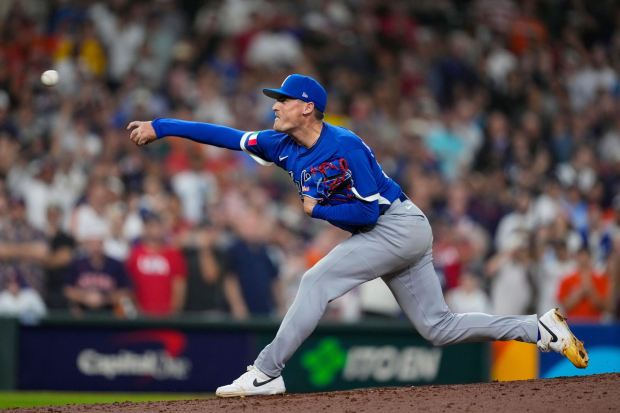 Italy pitcher Ron Marinaccio (97) throws in the eighth inning of a World Baseball Classic game against the United States , Tuesday, March 10, 2026, in Houston. (AP Photo/Ashley Landis)
You played for Team Italy in the World Baseball Classic. It was clear that was a special team. How do you reflect on that experience?
A: That was an incredible experience. I’m really happy I had that opportunity. Played (against) a couple teams so far this year with a couple guys from that team, and it’s been good to catch up with them. But just getting myself into those situations that early in the year was a huge bonus for me, just to see where I’m at and give myself the best chance to make the team. And show the league, like, I deserve to be up here and deserve to be in these situations. That was my main goal going into it.
Are you an espresso connoisseur?
A: I don’t know too much about it. I love coffee. I love caffeine. So I was all for it.
You’re passionate about playing poker. How good are you, and how did you learn how to play?
A: I would say I know what I’m doing, at least. My grandfather played a lot of poker, so growing up, I watched him play on the computer at times. And New Jersey’s kind of just, like, a gambling state. You got Atlantic City. So I grew up and a lot of my friends played poker. We’d play out of the house and just have fun. I like the psychology of the game. A lot of guys gamble, whether it’s golf or whatever, just to stay competitive. I think that’s just the nature of being an athlete and wanting to compete and wanting something to work for.
Do you think you’ll play in tournaments down the line?
A: I would love to. I’ve got to keep refining my craft, I think. Probably make a little bit more money, too. But I would love to.
Who’s your biggest competition in the clubhouse?
A: That’s tough to say. He’s not here right now, but Kyle Hart is pretty good.
What would be on the table for your ideal Sunday night Italian dinner?
A: I would say some type of chicken cutlet or a veal parm. I like veal parm a lot.